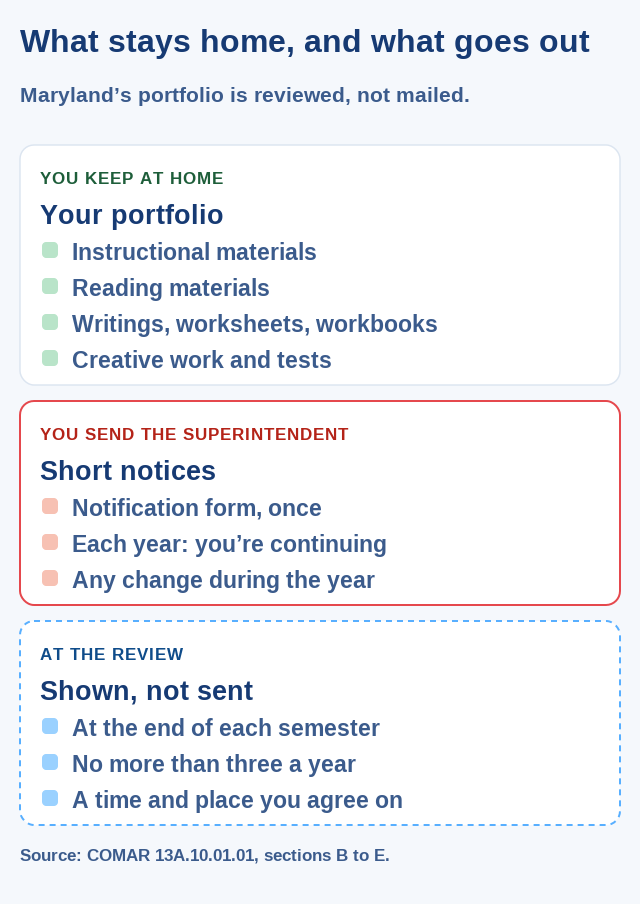
- Keep a portfolio of instructional and reading materials, plus examples of your child’s writings, worksheets, workbooks, creative materials and tests.
- It must show regular, thorough teaching in English, math, science, social studies, art, music, health and physical education.
- Your school system reviews it at the end of each semester, at a time and place you agree on, and no more than three times a year.
The paper here is one child’s portfolio. Beside it sit the notification form you filed to start, the yearly note that you’re continuing, and any letter from your school system about a review.
This page covers the portfolio review option under COMAR 13A.10.01. If a church umbrella or a state-approved school supervises your homeschool, other rules apply. See which route you’re on.
What goes in a Maryland homeschool portfolio
Maryland’s portfolio rule lives in a regulation, not the statute. The statute excuses a child who gets “regular, thorough instruction” in the studies taught in public school (Educ. § 7-301(a)(3)). The regulation then says you “shall maintain a portfolio of materials” that shows that instruction (COMAR 13A.10.01.01D(1)).
It lists the kinds of materials to include (.01D(1)(b)):
- Instructional materials
- Reading materials
- Examples of your child’s writings, worksheets, workbooks, creative materials and tests
The portfolio must cover eight subjects: English, mathematics, science, social studies, art, music, health and physical education (.01C(1)(b)).
Good news: there’s no hour count. Teaching must happen “on a regular basis during the school year” and be “of sufficient duration” for your program. The regulation sets no number of days or hours, and no format (.01C(1)(c)).
What counts as a work sample?
The list says “such as,” so it gives examples, not a checklist (.01D(1)(b)). The regulation sets no number of samples and no minimum per subject.
Examples, not rules: a dated math page, a book list, a narration, a science lab sheet, a photo of a project, a unit test. Our advice: have something for each of the eight subjects by the end of each semester, since that’s when the review comes.
Taking a college course? For those courses, you may show the college report card or transcript instead of portfolio materials (.01C(2), D(2)).
How the portfolio review works
A representative of your local school system reviews the portfolio and talks with you about your program. There are no more than three reviews a school year, each at a time and place you both agree on (.01E).
The review has one purpose: to make sure your child is getting regular, thorough instruction (.01E(2)). The regulation ties it to “the conclusion of each semester” of your local school system (.01D(1)(c)).
The school system may not add requirements beyond the regulation (.01F). A reviewer looks at the portfolio and talks with you.
The rule that let a reviewer observe instruction came out in 2019 (chapter history; HSLDA). HSLDA advises leaving your children home for the review. That’s advice, not law.
If the reviewer finds a gap, the superintendent tells you in writing. You then have 30 days to show it has been, or is being, fixed. Only if there’s no workable plan, or the gap stays, must your child enroll in a public or nonpublic school (.03B).
Testing is optional. On request, your child may take the standardized tests given at your local public school (.02).
The Maryland homeschool year, step by step
Maryland has no single statewide deadline. Your dates follow the day you start and your school system’s semesters.
| When | What | Rule |
|---|---|---|
| At least 15 days before you start | Send the notification form to your local superintendent (once) | .01B(1)(b) |
| Before each new school year | Confirm you’re continuing | .01B(2) |
| All year | Teach the eight subjects and keep the portfolio | .01C, D(1) |
| End of each school-system semester | Portfolio review, at a time and place you agree on | .01D(1)(c), E |
| Each school year | No more than three reviews | .01E(3) |
| Within 30 days of a deficiency letter | Show the gap is fixed or being fixed | .03B(1) |
| If anything changes mid-year | Tell your superintendent | .01B(3) |
The form is one MSDE prescribes, and signing it shows you consent to the portfolio and review rules (.01B(1)). HSLDA calls it the Notice of Consent.
About the 15 days: the regulation says to send the form at least 15 days before you begin (.01B(1)(b)). HSLDA’s view is that the wait can’t be enforced, and that filing on the day you withdraw your child is enough. That’s HSLDA’s reading, not the regulation’s text.
How long to keep homeschool records in Maryland
Maryland sets no period. Neither the statute nor the regulation says how long to keep the portfolio.
HSLDA advises keeping your records for at least two years. It also advises keeping high school records, and proof that you followed the law in the high school years, “on file forever.” That’s advice, not law.
Here’s why high school work matters. If your child enrolls in a public school, the superintendent decides the grade placement and any high school credits by an evaluation (.04).
Portfolio review or umbrella: which rules apply
If an umbrella supervises your homeschool, the school system does not review a portfolio. Supervised programs are free of the portfolio and review rules (.05A).
| Route | Rule | School-system portfolio review? | Who supervises |
|---|---|---|---|
| Portfolio review | .01 | Yes: up to three a year | Your local school system reviews; you keep the portfolio |
| Church umbrella | .05A(1) | No | A school or institution run by a bona fide church: a conference before you enroll, materials for home use, and conferences with you during the year |
| State-approved school | .05A(2) | No | A nonpublic school approved by the State Board: materials for home use and an assigned teacher who issues progress reports, marks papers and grades tests |
Every route still sends the notification form to the superintendent (.05A). Under an umbrella, the umbrella confirms its students with the superintendent each year (.05C).
HSLDA counts four options, because it splits church umbrellas into two kinds. The regulation names the two kinds of supervisor above.
Will a reviewer accept a digital portfolio?
The regulation doesn’t say. It asks for materials and a review at a time and place you both agree on, with no word on paper or digital (.01D, E(1)).
So ask your school system before the review. A printed copy works for anyone who wants paper.
What changes in 2026 and 2027
2026
No change to Maryland’s homeschool rules. The regulation was last amended in 2019, and the statute’s text is the same in the 2025 and 2026 editions.
The Maryland State Department of Education (MSDE) reviewed the rules in 2025, in the state’s routine eight-year review of regulations (Maryland Register). MACHE, a Maryland homeschool group, reports that MSDE’s evaluation report recommends opening them for amendment, with two technical fixes. No proposed change has been published in the Maryland Register.
Two 2026 bills would have opened school sports and activities to homeschool students: HB 1043 and HB 1528. Each had a hearing and did not pass. Neither touched the portfolio.
2027
No change is scheduled. The General Assembly meets January 13, 2027 (Md. Const. art. III, § 14). Any change to the regulation would be published in the Maryland Register for public comment first (HSLDA).
Before the 2027-28 school year, confirm with your superintendent that you’re continuing (.01B(2)).
Keeping the portfolio in KidsFoldr
The semester’s portfolio can build itself as you teach. Snap a worksheet, and KidsFoldr files it under your child, grade and subject, with nothing to type and nothing to sort. Then the page can go: scan it for peace of mind, then toss it.
No binder on the shelf, no stack on the counter: years of schoolwork fit on your phone. Keep the originals the state or a program may need, like letters from your school system and high school work your child may need for credit. Scan those too, so you always have a copy.
- Organized with zero effort. Every paper is filed by child, grade, type and subject, so the eight subjects sit side by side, and you can find any page by a word on it.
- Keeping up. A letter from your school system that comes by email or as a PDF files the same way. Share it to KidsFoldr or forward it.
- The review on your calendar. Snap the letter that sets your review, and its date lands on the family calendar, linked back to the letter.
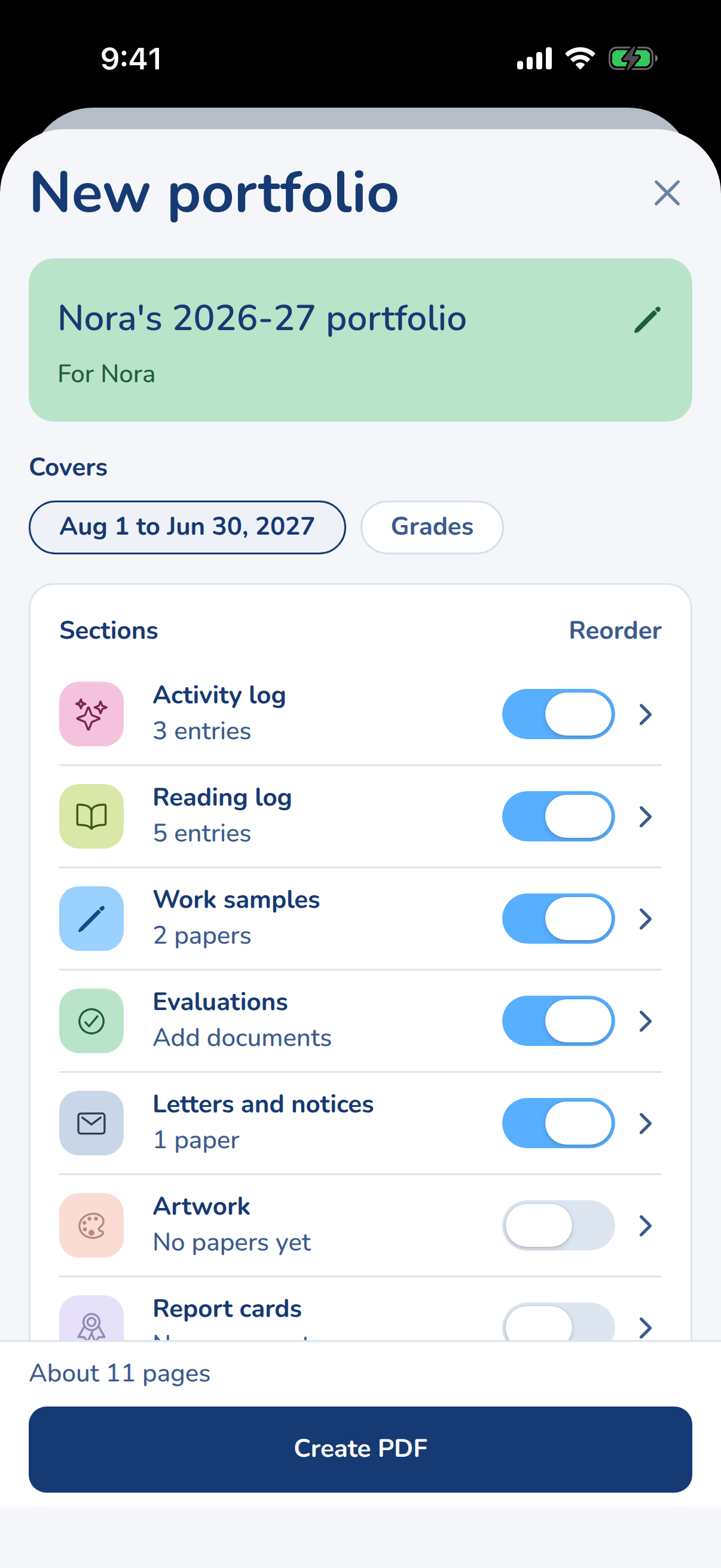
- The semester’s portfolio, on demand. Tap New portfolio, pick Dates and set From and To to your school system’s semester, or pick Grades. Add a Cover page and Contents, tap Create PDF, then Share or Print it.
- Keepsakes kept. Turn on automatic backup, and every paper, artwork included, goes to KidsFoldr Cloud as it is filed. One tap on Back up copies every paper to your own Google Drive or iCloud.
When you build a portfolio, you pick the sections and their order. For Maryland’s list, you might use:
- Activity log (a date and what you did) for instructional materials, or a lesson plan added with Add a document
- Reading log (title, author and date) for reading materials
- Work samples, grouped by Subject, for writings, worksheets, workbooks and tests
- Artwork for creative materials
- Letters and notices for your notification form, yearly confirmations and any school-system letter
Common questions
Do I send my portfolio to the school system?
No. You keep it and show it at the review, at a time and place you both agree on (COMAR 13A.10.01.01D, E).
How often can the school system review my portfolio?
No more than three times a school year. The regulation ties the review to the end of each semester (.01D(1)(c), E(3)).
How long do I have to keep homeschool records in Maryland?
Maryland sets no period. HSLDA advises at least two years, and high school records forever.
Do I file the notification form every year?
No. You file it once, at least 15 days before you start. After that, you confirm before each school year that you’re continuing (.01B).
Does my child have to take a standardized test?
No. Testing is optional. On request, your child may join the tests given at your local public school (.02).