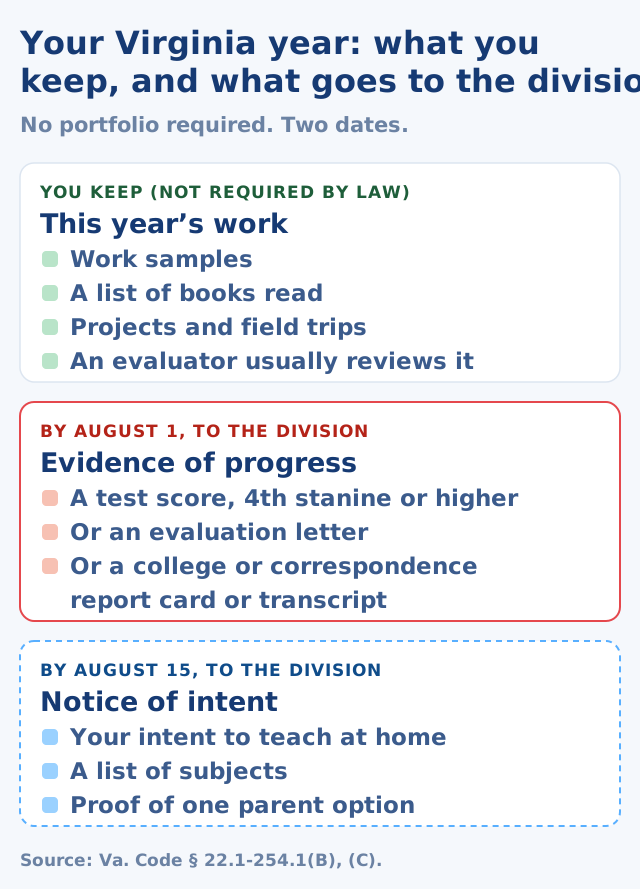
- Virginia law requires no portfolio. Each year, by August 15, you send a notice with a list of subjects and proof of one of four parent options.
- By August 1 after each school year, you send evidence of progress: a test score, an evaluation letter, or a college or correspondence school report card.
- A portfolio is what an evaluator usually reviews before writing that letter. The law sets no period for keeping records.
The papers here are this year’s folder of your child’s work, plus the two papers that go to your school division: the notice of intent each summer, and the evidence of progress, usually a test score report or an evaluation letter.
This page covers home instruction under Va. Code § 22.1-254.1. Families with a religious exemption, a tutor or a private school follow other rules. See which route you’re on.
Does Virginia require a homeschool portfolio?
No. Good news: the home instruction law, § 22.1-254.1, never uses the word “portfolio,” and it doesn’t ask you to keep any records at all. It asks for two things a year: the notice and the evidence of progress.
A portfolio still earns its place. One way to show progress is an evaluation letter, and most evaluators write it after looking through your child’s work. The Home Educators Association of Virginia (HEAV) describes a portfolio as a sample of a year’s work, collected to show that progress.
Could you send the portfolio itself to the division instead? HEAV calls that “extremely rare and not recommended.” Send the letter.
The yearly notice of intent
You send it every year, by August 15, to your division superintendent (§ 22.1-254.1(B)). It tells the division three things:
- That you intend to teach your child at home this year
- The subjects you plan to cover. The law limits the curriculum description to “a list of subjects.”
- Which of the four parent options you meet, with proof
You need only one of the four options (§ 22.1-254.1(A)):
- You hold a high school diploma.
- You meet the teacher qualifications set by the Board of Education.
- You give your child a program of study or curriculum. It can come through a correspondence course, a distance learning program “or in any other manner.”
- You show you can provide an adequate education for your child.
Moving into a new division, or starting after the school year has begun? Notify the superintendent as soon as you can, then meet the rest of the section within 30 days.
Your information stays local. The division may not share what you send with the state or anyone outside the division without your written consent (§ 22.1-254.1(G)).
Evidence of progress by August 1
By August 1 after each school year, you send the division superintendent one kind of evidence (§ 22.1-254.1(C)). Here are the options the law names:
| Option | What you send | Who decides | Uses a portfolio? |
|---|---|---|---|
| Test score | A composite score in or above the fourth stanine on any nationally normed achievement test, or an equivalent ACT, SAT or PSAT score | The score itself | No |
| Evaluation letter | A letter from someone licensed to teach in any state, or with a master’s degree or higher in an academic discipline, who knows your child’s progress. It states your child is making adequate educational growth and progress. | Your division superintendent | Usually: the evaluator reviews your child’s work |
| College or correspondence record | A report card or transcript from a college, a college distance learning program or a home-education correspondence school | Your division superintendent | No |
HSLDA and HEAV put the fourth stanine at the 23rd percentile. The law itself says “fourth stanine.”
The letter and the report card are examples, not a closed list. The law says the evaluation or assessment “including” those two. If you plan something else, HSLDA and HEAV advise agreeing it with your division early in the year.
No evidence is needed for a child who is under 6 on September 30 of the school year.
If the evidence falls short, the division may place your program on probation for a year. You file proof that you can provide an adequate education and a remediation plan. Home instruction continues if the superintendent accepts both, and you have 30 days to appeal a decision to an independent hearing officer (§ 22.1-254.1(C), (E)).
What counts as a work sample?
The law doesn’t say. Your evaluator does, so ask early in the year what they want to see.
HEAV lists what portfolios usually hold. These are examples, not rules: a list of books read, samples from each subject that show growth from fall to spring, unit studies and projects (photos count), field trips, and programs or awards your child is proud of.
The Virginia homeschool year, date by date
Virginia has two fixed dates. One thing to watch: the August 1 evidence for the year you just finished comes before the August 15 notice for the year ahead.
| When | What | Rule |
|---|---|---|
| Spring (advice) | Test or evaluation done, with time to spare | HSLDA; HEAV |
| By August 1 | Evidence of progress for the year just finished | § 22.1-254.1(C) |
| By August 15 | Notice for the year ahead: intent, list of subjects, proof of your option | § 22.1-254.1(B) |
| Moving in or starting mid-year | Notify as soon as you can; meet the rest within 30 days | § 22.1-254.1(B) |
| Within 30 days of a decision | Appeal to an independent hearing officer | § 22.1-254.1(E) |
| Under 6 on September 30 | No evidence of progress needed that year | § 22.1-254.1(C) |
How long to keep homeschool records in Virginia
Virginia law sets no period. Section 22.1-254.1 never asks you to keep records at all.
Our advice is to keep them anyway. HSLDA advises keeping records of what your child studied for at least two years, and high school records, with each notice you filed, for good. HEAV adds: keep a copy of everything you send the division.
Home instruction, religious exemption, tutor or private school
The rules above are for home instruction. Virginia’s compulsory attendance law, § 22.1-254, offers other routes, and each one changes what you file.
| Route | Law | Notice and evidence of progress? | Your papers |
|---|---|---|---|
| Home instruction | § 22.1-254.1 | Yes: notice by August 15, evidence by August 1 | The notice, the evidence, and the work behind it |
| Religious exemption | § 22.1-254(B)(1) | No yearly evidence under § 22.1-254.1. HEAV lists it as an exception. | Your application letter and the school board’s reply |
| Tutor or teacher | § 22.1-254(A) | Not under § 22.1-254.1. The tutor meets the Board’s qualifications and is approved by the division superintendent. | The approval |
| Private school | § 22.1-254(A) | Not under § 22.1-254.1 | Whatever the school asks for |
A school board must excuse a child whose family is opposed to school attendance “by reason of bona fide religious training or belief.” Political, sociological or philosophical views don’t qualify (§ 22.1-254(B)(1)). HSLDA’s advice: keep the board’s letter somewhere safe and permanent.
Will an evaluator accept a digital portfolio?
The law doesn’t say. Section 22.1-254.1 never mentions paper, digital or emailed records.
So whether a digital homeschool portfolio is accepted is up to your evaluator, and how the notice and evidence arrive is up to your division. Ask before you send. A printed copy works for anyone who wants paper.
What changes in 2026 and 2027
2026
No change to Virginia’s home instruction law (§ 22.1-254.1) in 2026. It was last amended in 2022, by ch. 355, which only tidied its wording.
A 2026 law, ch. 193, amended the compulsory attendance section, § 22.1-254. The home instruction rules did not change.
2027
No change to § 22.1-254.1 is scheduled. The General Assembly’s 2027 session opens January 13, 2027. Odd-year sessions run 30 days and can be extended.
Your dates stay the same: evidence by August 1, notice by August 15.
Keeping the portfolio in KidsFoldr
A paper folder works fine. If you’d rather keep the year on your phone, KidsFoldr works as a homeschool record keeping app, and you can still print everything.
- Snap each page as you teach, and it’s filed by child, grade and type, with schoolwork and tests by subject too. No binder to build and nothing to type. A name at the top of a page files it under that child, and every paper is searchable by any word on it.
- The paperwork keeps up: an emailed score report or evaluation letter files the same way. Share it to KidsFoldr or forward it.
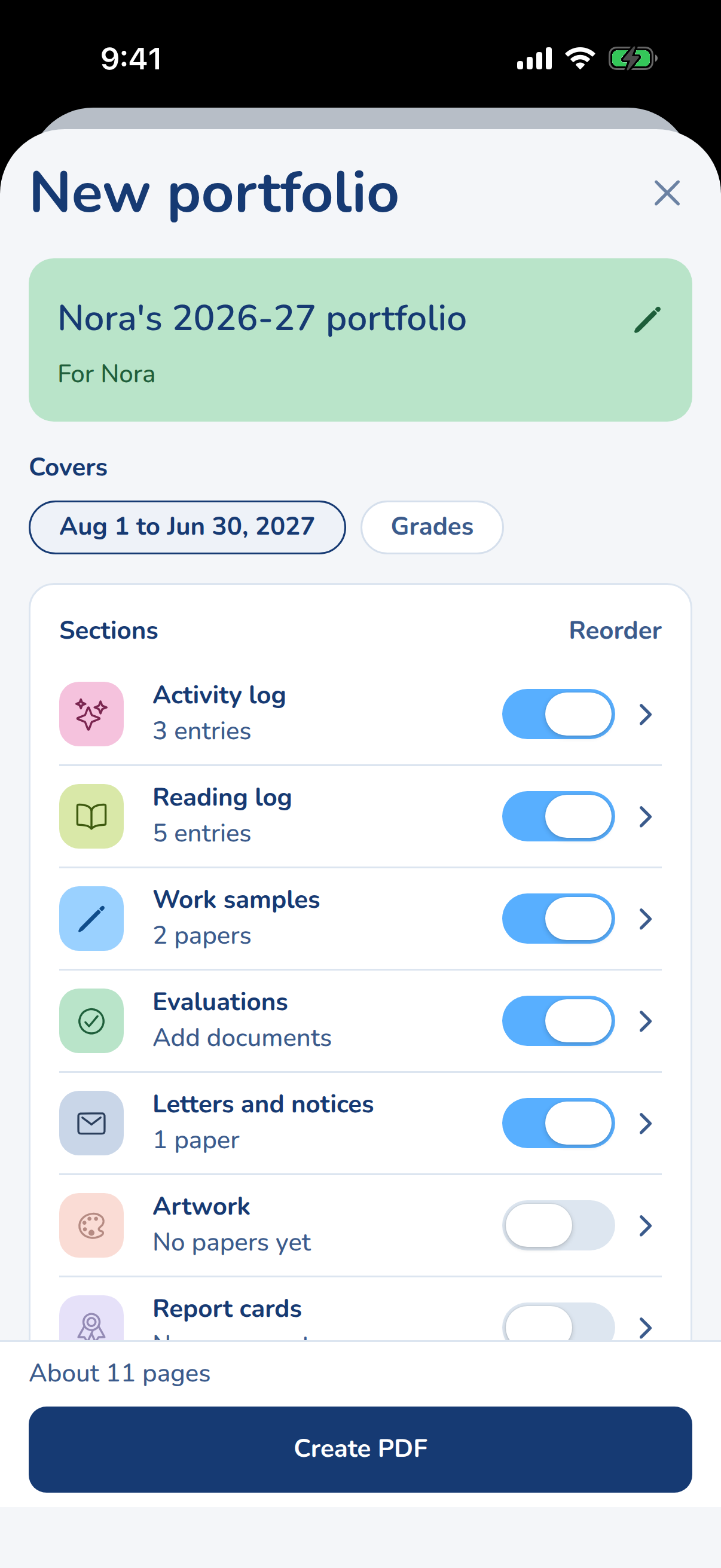
- The portfolio is ready when your evaluator is. Tap New portfolio, pick Dates and set From and To to your own school year, or pick Grades. Add a Cover page and Contents, then Create PDF.
- Hand it over with a single click: Share or Print it. You can also share your child’s Portfolios folder read-only with the evaluator.
- Keepsakes stay safe: every paper, artwork included, is kept on your phone. Turn on automatic backup, and every paper goes to KidsFoldr Cloud as it is filed. One tap on Back up copies it to your own Google Drive or iCloud.
You pick the portfolio’s sections and their order. For Virginia:
- Work samples, grouped by Subject or Date, and Artwork: what the evaluator reviews.
- Reading log (title, author and date): the list of books read.
- Activity log (a date and what they did): unit studies, projects and field trips.
- Evaluations for the evaluation letter or a correspondence school report card, and Test results for a score report. Add it when it comes back, then tap Make a new version.
- Letters and notices for your notice, your list of subjects, proof of your parent option and anything the division sends back. Add a document brings each one in.
Common questions
Do I have to keep a portfolio in Virginia?
No. The law doesn’t require one. Most families keep one anyway, because an evaluator usually reviews it before writing the evaluation letter.
When is the notice of intent due?
By August 15, every year. If you move into a division or start after the school year begins, notify the superintendent as soon as you can (§ 22.1-254.1(B)).
What test score do I need?
A composite score in or above the fourth stanine on a nationally normed achievement test, or an equivalent ACT, SAT or PSAT score. HSLDA and HEAV put that at the 23rd percentile.
How long do I have to keep homeschool records in Virginia?
The law sets no period. HSLDA advises at least two years, and high school records for good.
Does my five-year-old need evidence of progress?
Not if your child is under 6 on September 30 of that school year (§ 22.1-254.1(C)).