- The portfolio has two parts: a log of educational activities kept as you teach, naming reading materials by title, and samples of your child’s work.
- Keep it two years. The superintendent may ask to see it, on 15 days’ written notice.
- Once a year, you file a copy of an annual evaluation with the superintendent’s office.
The paper here is one child’s portfolio: the log and the work samples. Three more papers go to your county school district. They are the notice of intent that started your program, a copy of each year’s evaluation, and a notice of termination when you stop.
This page covers a home education program under Fla. Stat. § 1002.41. Families in an umbrella school or the Personalized Education Program (PEP) follow other rules. See which route you’re on.
What goes in a Florida homeschool portfolio
Florida’s statute uses the word “portfolio.” The parent “shall maintain a portfolio of records and materials,” and it “must consist of” two things (§ 1002.41(1)(d)):
- A log of educational activities
- Samples of your child’s work
You decide what goes in it. The statute says the parent determines the content of the portfolio (§ 1002.41(1)(e)).
The log of educational activities
The log must be “made contemporaneously with the instruction” and must designate “by title any reading materials used.” In plain words, write it as you teach, and name each book by title.
The law sets no format and no schedule. Examples, not rules: a dated line for each day or week of what you taught, and a book list with titles and dates.
What counts as a work sample?
The statute asks for “samples of any writings, worksheets, workbooks, or creative materials used or developed by the student.” It sets no number, no minimum per subject and no schedule. Florida sets no required subjects for home education at all.
Florida sets no attendance, day or hour rule either. Home education programs are excluded from the school-day rule and from the attendance register (§ 1002.41(3); § 1003.23).
Examples, not rules: a dated math page, a narration, a science lab sheet, a photo of a project.
Advice, not law: keep a copy of each year’s evaluation with the portfolio. The Florida Parent Educators Association (FPEA) suggests it.
Who sees the portfolio, and what goes to the district
The portfolio stays with you. The district gets three things: the notice of intent once, a copy of the evaluation each year, and the notice of termination at the end.
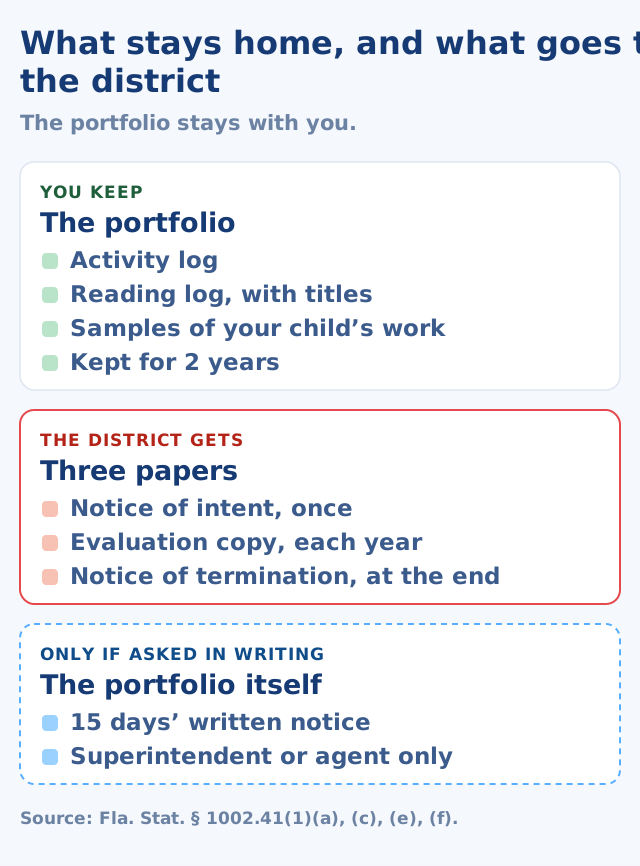
Only the district school superintendent, or the superintendent’s agent, may ask to see the portfolio. The request must come with 15 days’ written notice. The district does not have to inspect it at all (§ 1002.41(1)(e)).
The district may not ask for documentation beyond § 1002.41 unless your child joins a district program or service (§ 1002.41(1)(b), (13)). It may not assign your child a grade level either (§ 1002.41(1)(b)).
The notice of intent goes to the superintendent of the county where you live, within 30 days of starting. It must be in writing and signed, with each child’s full legal name, address and birthdate. The superintendent must accept it and register your program right away. You file it once, not every year (§ 1002.41(1)(a), (1)(b)).
The Home School Legal Defense Association (HSLDA) says a family that moves to another Florida county files a new notice there.
The annual evaluation: five options
Each year, you choose one of five ways to show your child’s “educational progress at a level commensurate with her or his ability” (§ 1002.41(1)(f)). In the statute’s words, only the first option uses the portfolio.
| Option | Who gives it | Uses the portfolio? | Rule |
|---|---|---|---|
| Teacher evaluation | A teacher you pick, with a valid regular Florida certificate | Yes: the teacher reviews it and talks with your child | § 1002.41(1)(f)1 |
| Nationally normed achievement test | A certified teacher | Not in the statute | § 1002.41(1)(f)2 |
| State student assessment | A certified teacher, where and how the district approves | Not in the statute | § 1002.41(1)(f)3 |
| Psychologist evaluation | A licensed psychologist or school psychologist | Not in the statute | § 1002.41(1)(f)4; § 490.003(7), (8) |
| Another valid tool | One you and the superintendent agree on | Not in the statute | § 1002.41(1)(f)5 |
You file a copy of the evaluation itself with the superintendent’s office in your county. The statute sets no form for it.
The superintendent “shall accept” the results (§ 1002.41(2)). If they do not show adequate progress, the superintendent tells you in writing. You then have one year of remedial instruction, and your child is evaluated again.
Families using the Family Empowerment Scholarship for Students with Unique Abilities (FES-UA) can stay in a home education program. The scholarship can pay for a state-certified teacher’s annual evaluation (§ 1002.394).
The Florida homeschool year, date by date
Florida has no statewide homeschool deadline. Your dates count from the day you start your program and the day you file your notice.
Florida law says once a year for the evaluation. FPEA and HSLDA count the year from the anniversary of your notice of intent. FPEA warns against counting from the date of your last evaluation.
| When | What | Rule |
|---|---|---|
| Within 30 days of starting | Notice of intent to your county superintendent (once) | § 1002.41(1)(a) |
| All year | Keep the log as you teach, with reading titles, and keep samples | § 1002.41(1)(d) |
| Once a year | File a copy of the annual evaluation. FPEA and HSLDA: by the anniversary of your notice of intent | § 1002.41(1)(f); FPEA |
| Any time, if asked in writing | Show the portfolio after 15 days’ notice | § 1002.41(1)(e) |
| Two years | Keep each portfolio | § 1002.41(1)(e) |
| Within 30 days of stopping | Notice of termination, filed with the annual evaluation | § 1002.41(1)(c) |
The notice of termination goes in together with the annual evaluation, not on its own (§ 1002.41(1)(c)).
How long to keep homeschool records in Florida
Two years. The statute tells you to “preserve it for 2 years” (§ 1002.41(1)(e)).
It does not say when the two years start. HSLDA reads it as two years after the portfolio is completed. Our advice: count from the end of each evaluation year.
HSLDA also advises keeping high school records permanently. That is advice, not law.
Home education, umbrella school or PEP: which rules apply
The rules on this page apply only to a home education program under § 1002.41. A private school and PEP each run on their own rules (§ 1002.01).
| Route | Law | Portfolio and evaluation? | Who keeps the records |
|---|---|---|---|
| Home education program | § 1002.41 | Yes: log, samples, and an annual evaluation filed with the district | You |
| Private school (often called an umbrella or cover school) | § 1002.42 | No, not under § 1002.41 | The school keeps an attendance register. Anything else is the school’s own policy. |
| Personalized Education Program (PEP) | §§ 1002.01(2), 1002.395 | No. A student learning plan, a yearly sworn compliance statement, and a nationally norm-referenced test or statewide assessment, with results given to the scholarship organization before renewal | You, with a scholarship-funding organization such as Step Up For Students |
A PEP student cannot also be enrolled in a home education program (§ 1002.395(4)(e)).
“Umbrella” and “cover” are common terms, not the statute’s. HSLDA advises choosing a private school registered with the Florida Department of Education.
Private tutoring is a fourth route, under § 1002.43. The tutor holds a Florida teaching certificate for the subjects or grades taught and keeps attendance records.
Step Up For Students’ PEP handbook, effective April 2026, set August 15, 2026 for 2026-27 PEP students to end home education status with the district. That is Step Up’s deadline, not the statute’s.
Will an evaluator accept a digital portfolio?
The law does not require paper, and it does not mention digital records (§ 1002.41). FPEA and HSLDA say nothing about it either.
So whether a digital homeschool portfolio is accepted is the evaluator’s call for a teacher evaluation, and the district’s call for an inspection. Ask before you send. A printed copy works for anyone who wants paper.
What changes in 2026 and 2027
2026
No change to Florida’s home education law (§ 1002.41) in 2026, and none is scheduled. It was last amended in 2018, by ch. 2018-134. The 2024, 2025 and 2026 editions read the same.
Four 2026 laws touch nearby rules. Each took effect July 1, 2026:
- Ch. 2026-33 changed how money in a closed scholarship account is handled under § 1002.395.
- Ch. 2026-59 amended private school rules, including how PEP students meet the rule on contact with teachers.
- Ch. 2026-67 covers Florida Virtual School.
- Ch. 2026-93 rewrote the sports eligibility rules in § 1006.15.
None of the four changes the portfolio, the notice of intent or the evaluation.
2027
No change to § 1002.41 is scheduled. No 2027 bill touching home education has been filed.
On July 1, 2027, the paragraph that caps PEP scholarships, § 1002.395(6)(d)1, is repealed. The 2027 regular session opens March 2, 2027.
Your evaluation is still due once a year. FPEA and HSLDA count from the anniversary of your notice of intent.
Keeping the portfolio in KidsFoldr
A portfolio can be a paper or a digital record. KidsFoldr does both at the same time, so you can have either.
- Snap each page as you teach, and it is filed by child, grade and type, with schoolwork and tests by subject too, with no binder to build. A name at the top of a page files it under that child. Every paper is searchable by any word on it.
- The paperwork keeps up: an emailed or PDF evaluation files the same way. Share it to KidsFoldr or forward it.
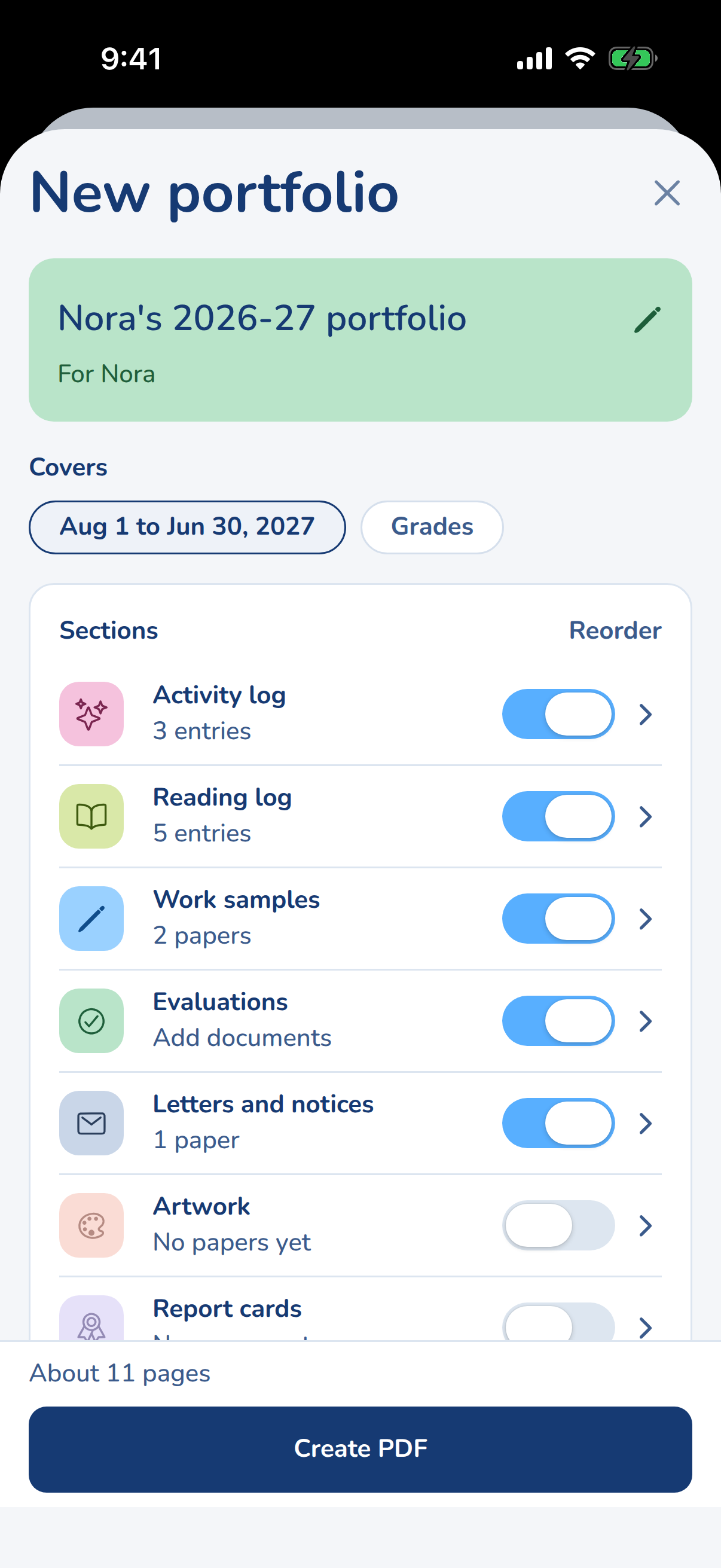
- The portfolio is ready on demand. Tap New portfolio, pick Dates and set From and To to your own evaluation year, or pick Grades. Add a Cover page and Contents, then Create PDF.
- Export it with Share or Print it, with a single click. For a teacher-evaluator, share the child’s Portfolios folder read-only.
- Keepsakes stay safe: every paper, artwork included, is kept on your phone and, with automatic backup on, in KidsFoldr Cloud. One tap on Back up copies it to your own Google Drive or iCloud.
You pick the portfolio’s sections and their order. For Florida:
- Activity log (a date and what they did): the log of educational activities. Snap the log pages as you keep them, or type in the entries from your log.
- Reading log (title, author and date): the reading materials, by title.
- Work samples, grouped by Subject or Date, and Artwork for creative materials.
- Evaluations for the teacher’s or psychologist’s letter, or Test results for a score report. Add it when it comes back, then tap Make a new version.
- Letters and notices for the notice of intent, any letter from the district and the notice of termination. Add a document brings each one in.
If your umbrella school asks for attendance, add the Attendance or hours log.
Common questions
Do I send my portfolio to the school district?
No. You keep it. The superintendent may ask to see it on 15 days’ written notice.
When is the annual evaluation due?
Florida law says once a year. FPEA and HSLDA count from the anniversary of your notice of intent.
How long do I have to keep homeschool records in Florida?
Two years, under § 1002.41(1)(e). HSLDA advises keeping high school records permanently.
Do I file a notice of intent every year?
No. You file it once, within 30 days of starting your program.
Do I have to track attendance or hours?
No. Home education programs are excluded from the school-day rule and from the attendance register (§ 1002.41(3); § 1003.23).