- Send a notice of intent by July 1, then an IHIP, four quarterly reports and an annual assessment. Attendance records stay home.
- A portfolio matters only for a written narrative in place of a test (grades 1-8), where the assessor reviews "a portfolio of the child's work."
- The regulation sets no contents for that portfolio and no period for keeping records. Keep each child's papers together and back them up.
The paper you are holding is one child's stack for one school year: the notice of intent, the IHIP, four quarterly reports, a test score or narrative, your attendance record and the work you kept.
What New York asks for, and what stays home
Four kinds of paper go to your school district each year. Two things stay home.
| Paper | Where it goes | Rule (8 NYCRR § 100.10) |
|---|---|---|
| Notice of intent | Superintendent | (b)(1) |
| IHIP | District | (c)(2) |
| Quarterly reports (4) | District | (g) |
| Annual assessment | District | (h) |
| Attendance records | Stays home, shown on request | (f)(4) |
| Work samples | Stays home, for a narrative assessor | (h)(2)(iii) |
The regulation sets no form or schedule for attendance records.
The IHIP (individualized home instruction plan) lists, for each child:
- name, age and grade level
- the syllabi, curriculum materials, textbooks or plan of instruction for each required subject
- the dates of the four quarterly reports, spaced evenly
- the names of the people teaching
In New York City, below high school, your district is your community school district. Ask it where to send filings.
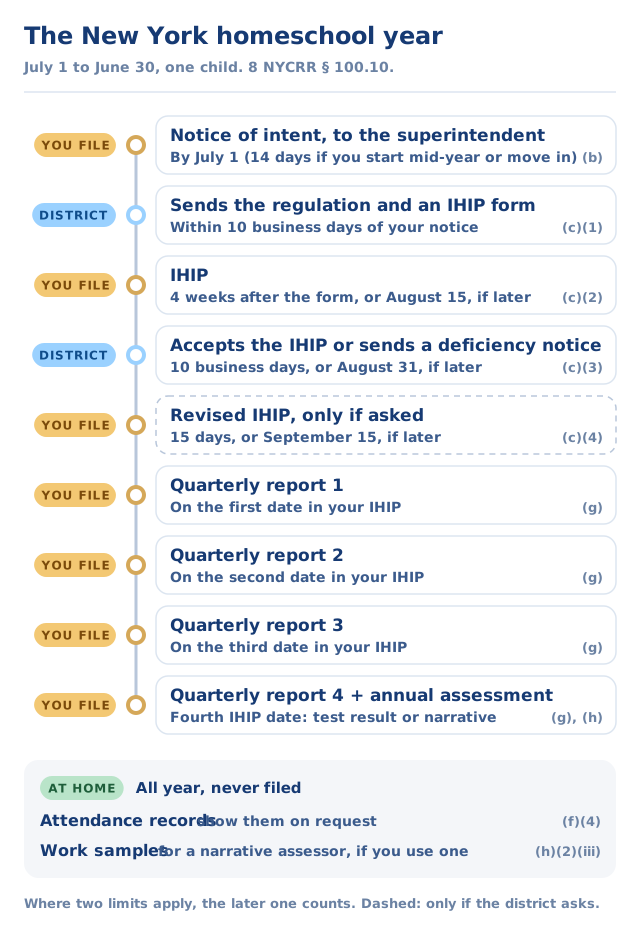
The New York homeschool year, date by date
New York's home instruction year runs July 1 to June 30. Where two limits apply, the later one counts.
| When (from the step before) | What | Rule |
|---|---|---|
| By July 1 | Notice of intent (within 14 days if you start mid-year or move in) | (b)(1)-(2) |
| Within 10 business days | District sends the regulation and an IHIP form | (c)(1) |
| 4 weeks after that, or August 15 | IHIP due | (c)(2) |
| 10 business days, or August 31 | District accepts the IHIP or sends a notice of deficiency | (c)(3) |
| 15 days, or September 15 | Revised IHIP, if asked | (c)(4) |
| Your four IHIP dates | Quarterly reports | (g) |
| With the fourth report | Annual assessment | (h) |
What goes in a quarterly report
Each quarterly report goes to your district by its IHIP date, one per child. It must contain:
- the hours of instruction that quarter;
- a description of the material covered in each IHIP subject;
- a grade in each subject, or a written narrative evaluating progress;
- a written explanation if less than 80 percent of the quarter's planned material was covered in any subject.
The annual assessment, by grade
Every year you file a standardized test result or a written narrative with the fourth quarterly report.
| Grades | Test or narrative | Rule |
|---|---|---|
| 1-3 | Either, in any year | (h)(2)(i) |
| 4-8 | A narrative no more than every other year; a test otherwise | (h)(2)(ii) |
| 9-12 | A test every year (the regulation offers no narrative) | (h)(2) |
A composite test score passes above the 33rd percentile on national norms, or with one year of academic growth over a test taken during or after the prior school year. A narrative passes if the assessor certifies adequate academic progress.
You choose the test from those the regulation names, such as the Iowa or Stanford.
What counts as a work sample?
The regulation does not say. The narrative assessor interviews your child and reviews "a portfolio of the child's work," and the rule sets no number, subject list or format.
The assessor can be a New York-certified teacher, a peer review panel or another person, chosen with the superintendent's consent. You pay any cost.
How long to keep homeschool records in New York
The regulation sets no retention period for any record. Its only record-keeping rule is to keep attendance records and show them on request.
HSLDA, a homeschool legal group, advises keeping attendance records, curriculum information, work samples, correspondence and test results for at least two years, and high school records permanently. That is advice, not law.
Will an assessor accept a digital portfolio?
The regulation does not say. It requires no paper, and it neither allows nor forbids email or digital records.
Your assessor (or evaluator) and district decide. Ask before you email anything.
What changes in 2026 and 2027
2026
No change to the law is scheduled. Cornell's copy of the regulation shows no amendment since July 2021.
Two bills died when the legislative session ended in June 2026, HSLDA reports. A2326/S199 would have made districts issue a completion letter to homeschool graduates who followed the regulation. A323/S4037 would have lowered the compulsory age from 6 to 5.
The notice of intent was due by July 1, 2026, when the 2026-27 year began. The IHIP was due by August 15, 2026, or four weeks after the district's form, if later. Quarterly reports follow on your IHIP dates.
2027
No change to the law is scheduled.
The 2026-27 year ends June 30, 2027. The annual assessment goes in with the fourth quarterly report. The notice of intent for 2027-28 is due by July 1, 2027.
Building the portfolio in KidsFoldr
A portfolio can be a paper or a digital record. KidsFoldr does both at the same time, so you can have either.
KidsFoldr keeps the year's work as it happens. Snap any paper, and it is filed under the right child and grade, searchable by any word on it.
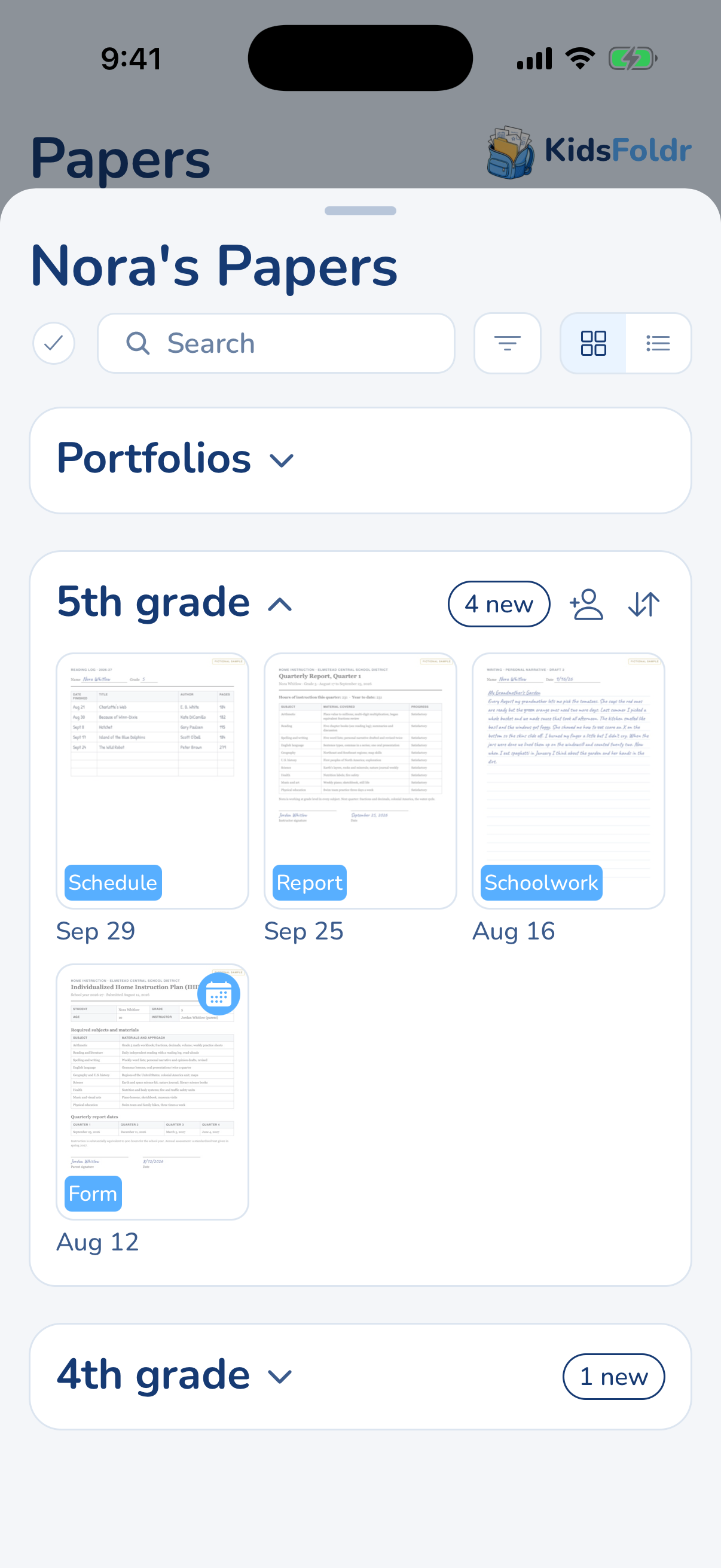
When the assessor asks, build a Portfolio: a PDF of one child's work for a grade or a date range. Share it digitally or print it. For New York's July 1 to June 30 year, pick those dates.
You pick the sections. For New York:
- Attendance or hours log: your attendance record and each quarter's hours.
- Work samples: the "portfolio of the child's work" a narrative assessor reviews.
- Test results: the standardized test score report.
- Evaluations: the assessor's narrative.
- Letters and notices: the IHIP, the district's reply and the quarterly reports.
- Parent summary: the year, in your words.
Common questions
Do I send a portfolio to my school district?
No. The district gets the notice of intent, IHIP, quarterly reports and assessment. A portfolio is for a narrative assessor, if you use one.
How long should I keep homeschool records?
New York's regulation sets no period. HSLDA advises at least two years, and high school records permanently.
Can I give my child the standardized test at home?
At home, the test must be given by a New York-certified teacher or another qualified person, and only if the superintendent consents. Ask your district early.