- The portfolio has three parts: a reading log kept as you go, work samples, and reading and math test results in grades 3, 5 and 8.
- An evaluator reviews it and interviews your child. Only the evaluator’s certification goes to the district, by June 30.
- The law says to keep it on file but sets no number of years.
The paper here is one child’s portfolio for this school year. Two more papers sit beside it: the affidavit you file with your district superintendent, and the evaluator’s written certification.
What goes in a Pennsylvania homeschool portfolio
Under 24 P.S. § 13-1327.1(e)(1), the portfolio holds three things. The evaluator’s yearly written evaluation is kept on file with it.
- A reading log
- Work samples
- Standardized test results, in grades 3, 5 and 8
The reading log
The statute asks for a log “made contemporaneously with the instruction” that “designates by title the reading materials used.” In plain words, list each book by title as you go. The Pennsylvania Department of Education (PDE) also expects the portfolio to show the required 180 days, or 900 hours (elementary) or 990 (secondary).
What counts as a work sample?
The statute says “samples of any writings, worksheets, workbooks or creative materials used or developed by the student.” It sets no number, no minimum per subject and no schedule. Grades from district or career and technical classes go in too.
Examples, not rules: a dated math worksheet, a history narration, a science lab sheet, a photo of an art project. PDE’s example binder has samples for every subject taught.
Test results in grades 3, 5 and 8
Add reading or language arts and math results from the state’s PSSA or Keystone exam, or a test on PDE’s approved list. You cannot give the test yourself. Results stay in the portfolio, not with the district.
Who sees the portfolio, and what goes to the district
The evaluator sees the portfolio. The district does not. Who can evaluate:
- A licensed clinical or school psychologist
- A Pennsylvania-certified teacher with experience at the level evaluated
- A nonpublic school teacher or administrator with two years of teaching in a Pennsylvania school in the last ten
- Someone else, with the superintendent’s prior consent
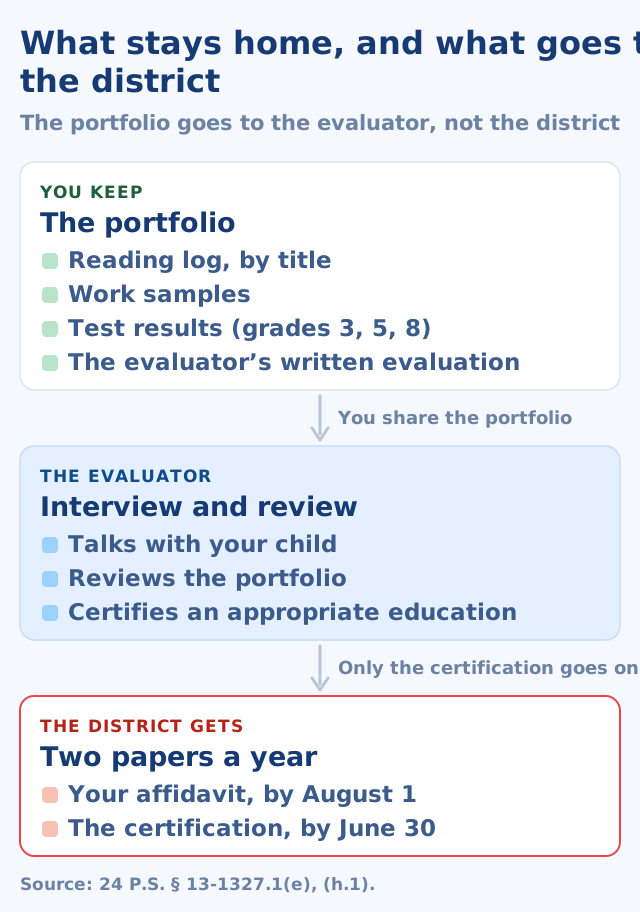
The evaluator cannot be you or your spouse. PDE keeps no list of evaluators, and the family pays. The evaluator interviews your child, reviews the portfolio and certifies whether an appropriate education is occurring. That means the required subjects and time, with “sustained progress in the overall program.”
If the certification is missing, the superintendent sends a certified letter, and you have 10 days to file it. If it is still missing, the school board holds a hearing.
The school-year timeline
Two dates matter: August 1 for the affidavit and June 30 for the certification.
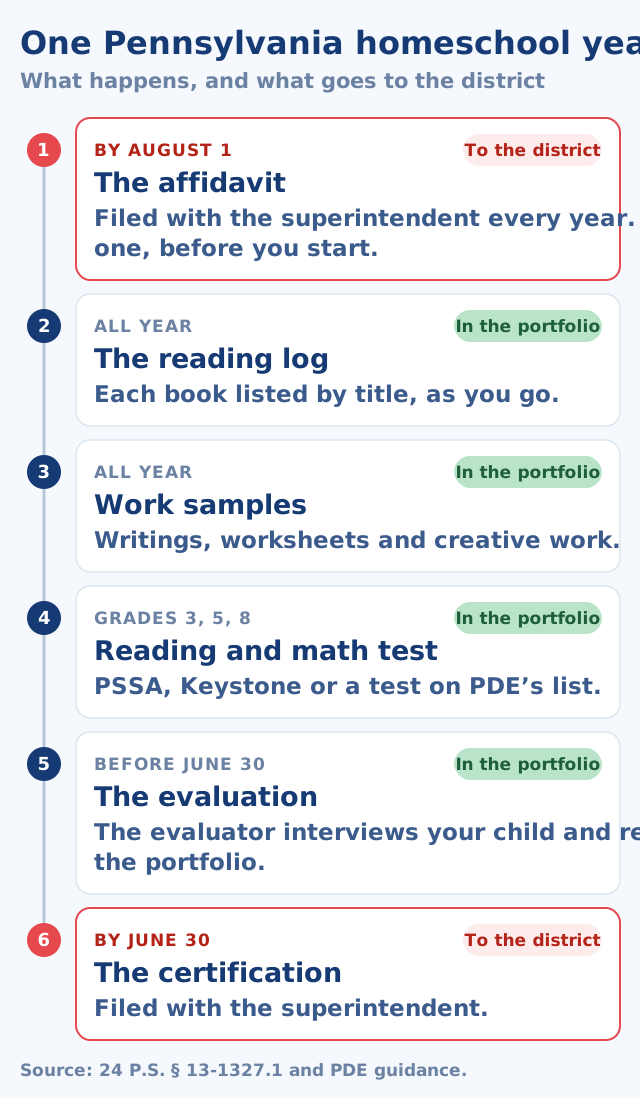
The statute calls for a notarized affidavit; PDE also accepts an unsworn declaration, which needs no notary. Check your district’s board policy for its forms.
How long to keep homeschool records in Pennsylvania
The statute says to “maintain on file” the portfolio and the evaluation. It sets no period. Neither the State Board regulation nor PDE’s guide sets one for parents. The rest is advice:
- Keep transcripts. PDE says parents should, since the district no longer tracks courses toward graduation.
- Keep records from grades 9 to 11. A twelfth-grade evaluator co-signs a diploma you issue and may want proof of those courses.
- HSLDA advises keeping records at least two years, and high school records permanently.
Will an evaluator accept a digital portfolio?
The law does not require paper or mention digital, and PDE’s guidance is silent too. Whether a digital portfolio is accepted is the evaluator’s call, so ask before the review.
What changes in 2026 and 2027
2026
No change to the law is scheduled. The statute was last amended by Act 55 of 2022, and PDE’s guide, revised May 2026, lists nothing newer.
One bill is pending, not law: Senate Bill 1340. Military families who move in or start mid-year would get 30 days after notifying the district to comply, and JROTC programs would open to eligible homeschoolers. It was referred to the Senate Education Committee on May 20, 2026, and has had no vote.
The affidavit for 2026-27 was due by August 1, 2026. PDE counts the school year from July 1.
2027
No change to the law is scheduled.
The evaluator’s certification for 2026-27 goes to your superintendent by June 30, 2027. The affidavit for 2027-28 is due by August 1, 2027.
Keeping the portfolio in KidsFoldr
A portfolio can be a paper or a digital record. KidsFoldr does both at the same time, so you can have either.
- Snap a worksheet, a test report or a log page, and it is filed under the right child and grade, searchable by any word on it. A name written at the top of a page files it under that child.
- A score report that arrives as a PDF or an email files the same way: share it or forward it.
- Before the evaluation, build a Portfolio on demand: a PDF of one child’s work for a grade or a date range, with a cover and contents. Share it digitally or print it. For the evaluator, share the child’s Portfolios folder read-only.
- Every paper is kept on your phone. Turn on automatic backup, and it goes to KidsFoldr Cloud as it is filed; one tap on Back up copies it to your own Google Drive or iCloud.
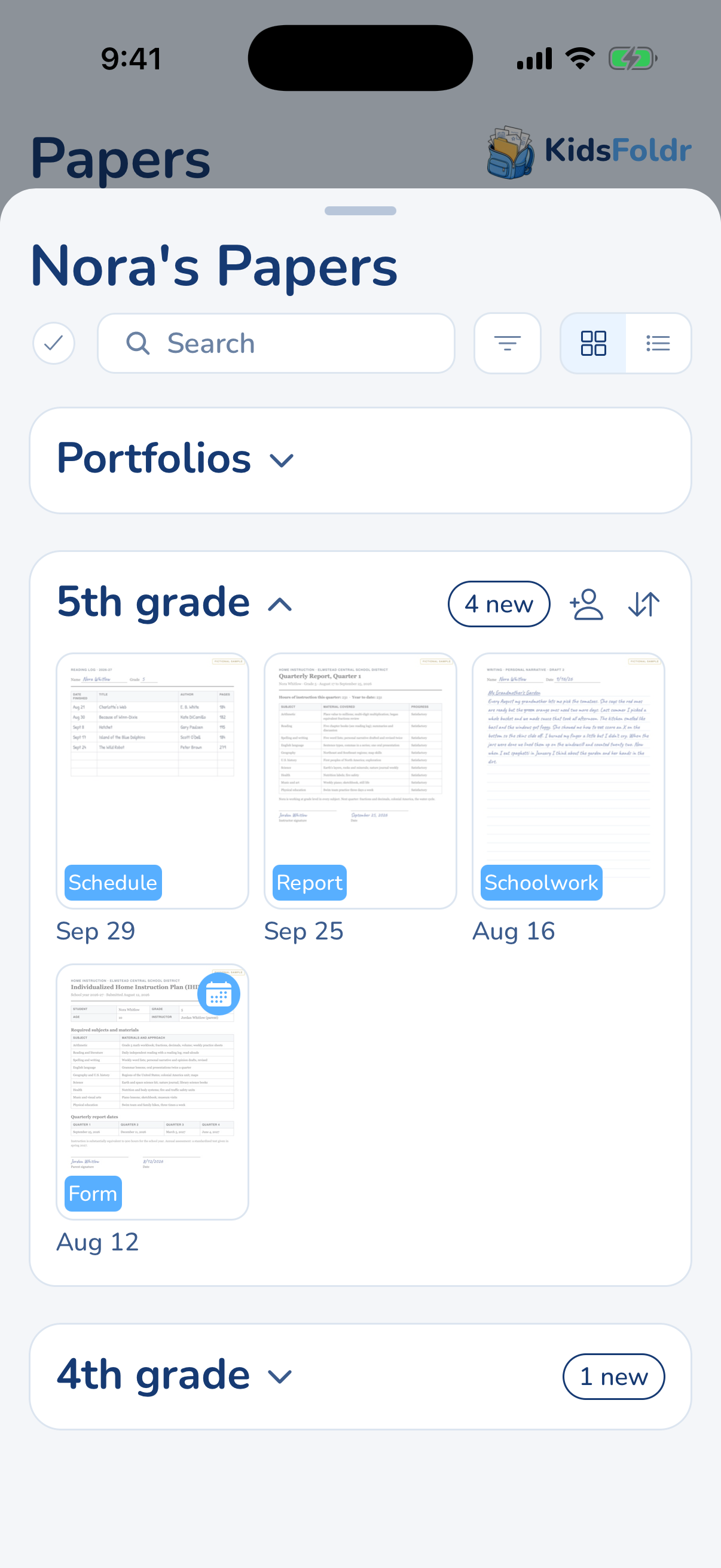
You pick the portfolio’s sections and their order. For Pennsylvania:
- Reading log: snap the log pages as you go, or type the titles in.
- Work samples, grouped by subject or by date.
- Test results: the grade 3, 5 and 8 score reports.
- Evaluations: the evaluator’s written evaluation and a copy of the certification.
- Attendance or hours log: the 180 days, or 900 or 990 hours, PDE expects to see.
Common questions
Do I send my portfolio to the school district?
No. Only the evaluator’s certification goes to the district, by June 30.
How long do I have to keep homeschool records?
No law sets a period. HSLDA advises at least two years, and high school records permanently.
Does the affidavit need a notary?
The statute says notarized, but PDE also accepts an unsworn declaration.