- No portfolio is required. Each year your child gets an academic assessment: a standardized test, the state test, a certified teacher's portfolio review, or an option your county superintendent agrees to.
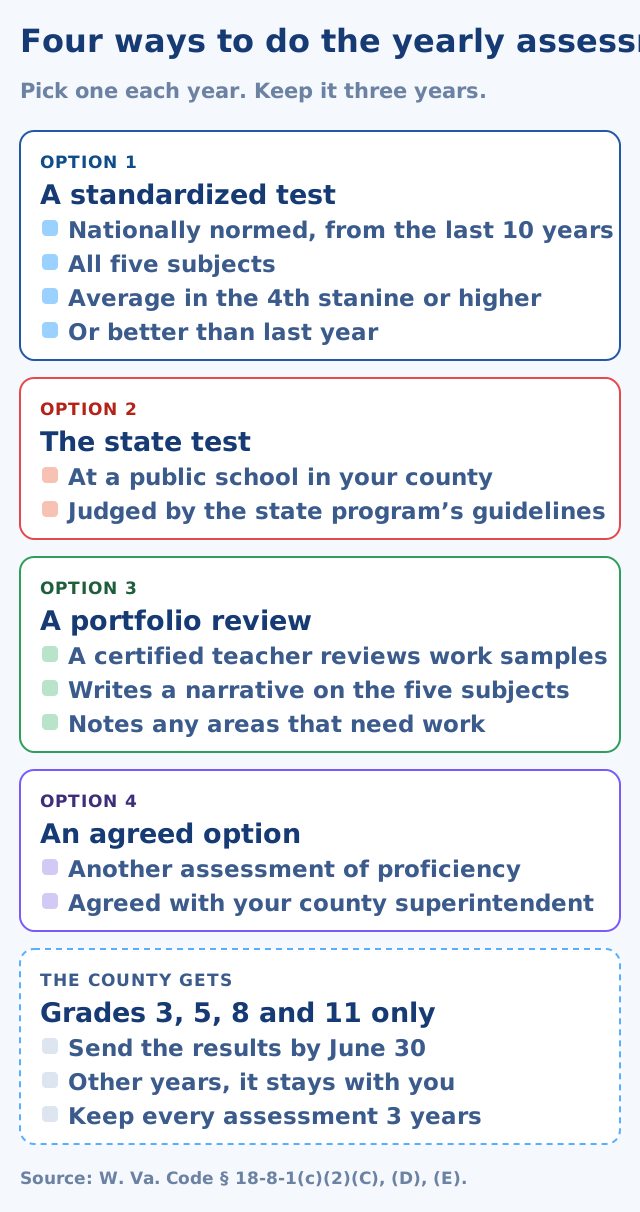
- Keep each assessment three years. Send the results to the county superintendent only for grades 3, 5, 8 and 11, by June 30.
- You file a notice of intent once, when you start, with proof of your high school diploma or equivalent.
The papers here are the notice of intent you sent your county superintendent, with a copy of your diploma, and each year's assessment. That's a test score report or a certified teacher's written narrative. In grades 3, 5, 8 and 11, a copy of those results goes to the county. If you choose the teacher review, there's one more: the portfolio of your child's work.
This page covers homeschooling under a notice of intent, W. Va. Code § 18-8-1(c)(2). County approval, learning pods, private schools and the Hope Scholarship follow other rules. See which route you're on.
Do you need a homeschool portfolio in West Virginia?
No. The word "portfolio" shows up in the law only as one of four ways to do the yearly assessment (§ 18-8-1(c)(2)(C)(iii)).
Here's what the law does ask for:
- A one-time notice of intent to your county superintendent or county board
- Proof of a high school diploma or equivalent (or a college degree or certificate)
- Instruction in reading, language, mathematics, science and social studies
- An academic assessment every year
Sources: § 18-8-1(c)(2)(A), (B), (C).
The West Virginia Department of Education (WVDE) adds the reassuring part. You don't need a teaching certificate, there's no set instructional year, and you choose the curriculum.
No law asks you to keep work samples, a reading log or attendance on this route. The assessment is the one record you must keep.
The yearly assessment: four options
Each year you pick one of four ways to show "acceptable progress" for the school year just finished (§ 18-8-1(c)(2)(C)). Only one of them uses a portfolio.
| Option | What happens | Acceptable progress | Rule |
|---|---|---|---|
| Standardized test | A nationally normed achievement test, published or normed in the last 10 years, given by someone qualified under the test's rules, in all five subjects | The average is in the fourth stanine or higher, or better than last year | § 18-8-1(c)(2)(C)(i) |
| State test | The public school testing program, taken at a public school in your county. WVDE says to ask your school district. | The state testing program's guidelines | § 18-8-1(c)(2)(C)(ii) |
| Portfolio review | A certified teacher reviews samples of your child's work and writes a narrative | The narrative says progress is in line with your child's abilities | § 18-8-1(c)(2)(C)(iii) |
| Agreed option | An assessment you and the county superintendent agree on | As you agree | § 18-8-1(c)(2)(C)(iv) |
If an assessment doesn't show acceptable progress, you start a remedial program. If it happens two years in a row, you send the county superintendent more evidence that your child is getting appropriate instruction (§ 18-8-1(c)(2)(D)).
On request, the county board will also tell you in writing about services to check for special education needs. Identifying a disability doesn't end your homeschool.
What goes in a West Virginia homeschool portfolio
If you pick the portfolio review, the portfolio is "samples of the child's work" (§ 18-8-1(c)(2)(C)(iii)). The law sets no number of samples, no list and no format.
What the law does set is the teacher's job. The certified teacher writes a narrative about your child's progress in reading, language, mathematics, science and social studies. It also notes any areas that need improvement or remediation.
What counts as a work sample?
Any page of real work from the year. Examples, not rules: a math page, a short essay, a science lab sheet, a map, a photo of a project.
Since the narrative covers all five subjects, give the teacher something from each one. That's our advice, not the law. Ask the teacher what they'd like to see before you gather it.
The notice of intent
You send it once, to your county superintendent or county board, when you start. If your child is enrolled in a public school, it goes in on or before your first day of home instruction (§ 18-8-1(c)(2)(A)).
It lists each child's name, address and age. It promises instruction in the five subjects and a yearly assessment. With it, you send evidence of your high school diploma or equivalent (§ 18-8-1(c)(2)(A), (B)).
WVDE has a one-page notice of intent form. The law doesn't require a particular form.
You file again only if you move to another county: tell the old superintendent and send a new notice to the new one. When you stop homeschooling a child of compulsory school age, tell the county superintendent (§ 18-8-1(c)(2)(A)).
Here's a reassuring detail. The superintendent can't simply turn your notice down. To stop home instruction, the superintendent must go to circuit court, which can grant an order only on clear and convincing evidence that your child's education would be neglected, or another compelling reason (§ 18-8-1(c)(2)).
The West Virginia homeschool year, date by date
Most of your dates are your own. The one fixed date is June 30, and only in four grades.
| When | What | Rule |
|---|---|---|
| When you start (on or before day one if your child leaves a public school) | Notice of intent, with proof of your diploma or equivalent | § 18-8-1(c)(2)(A), (B) |
| All year | Teach reading, language, math, science and social studies | § 18-8-1(c)(2)(A) |
| Each year, for the year just finished | Get the assessment | § 18-8-1(c)(2)(C) |
| By June 30, in grades 3, 5, 8 and 11 | Send the results to the county superintendent | § 18-8-1(c)(2)(E) |
| Three years | Keep a copy of each assessment | § 18-8-1(c)(2)(D) |
| If you move counties | New notice in the new county, and tell the old one | § 18-8-1(c)(2)(A) |
| When you stop | Tell the county superintendent | § 18-8-1(c)(2)(A) |
How long to keep homeschool records in West Virginia
Three years for each assessment. The law says to keep "copies of each student's Academic Assessment for three years," and that's the only record it names (§ 18-8-1(c)(2)(D)).
The law doesn't say when the three years start. The Home School Legal Defense Association (HSLDA) counts from when the assessment is done.
HSLDA also advises keeping attendance, curriculum lists, work samples, letters with officials, portfolios and test results for at least two years. It suggests keeping high school records, and proof that you followed the law in those years, forever. That's advice, not law.
The state gives you good reasons of its own. You may issue your teen's diploma, and it counts as a high school diploma (§ 18-8-12). A public school must accept your homeschool transcript for placement and credit (§ 18-8-1a(e)). And WVDE says homeschooled applicants for the Promise Scholarship send a transcript and a Grade Verification Form.
Notice of intent, county approval, pod or Hope: which rules apply
This page covers the notice-of-intent route. Four other routes have their own rules (§ 18-8-1).
| Route | Law | Yearly evidence | Who keeps the records |
|---|---|---|---|
| Notice of intent (this page) | § 18-8-1(c)(2) | One of the four assessments. Results go to the county in grades 3, 5, 8 and 11. | You, for three years |
| County board approval | § 18-8-1(c)(1) | What the county board asks for. Instruction for a time equal to the public school term. | You, for the county board on request |
| Learning pod or microschool | § 18-8-1(n) | The same four assessments. A pod may send combined results. | You, for three years |
| Private school | § 18-8-1(k); § 18-28 | A standardized test in the grades the state tests | The school (attendance and immunization records) |
| Hope Scholarship, individualized program | § 18-8-1(m); § 18-31 | A test, or a certified teacher's review of the work, reported to the county superintendent | Set by the Hope Scholarship rules |
A Hope Scholarship student in an individualized instructional program follows the Hope rules, not the homeschool exemption (§ 18-31-2(8)).
Will the teacher accept a digital portfolio?
The law doesn't say, and neither does WVDE. Nothing in § 18-8-1 asks for paper or mentions digital records.
So a digital homeschool portfolio is the reviewing teacher's call, and the format of your results is your county office's call. Ask each one before you send. A printed copy works for anyone who wants paper.
What changes in 2026 and 2027
2026
No change to West Virginia's homeschool law. Section 18-8-1 was last amended in 2022, when SB 268 added learning pods and microschools.
Several 2026 bills dealt with homeschooling, including SB 966, which would have changed the home instruction rules, and HB 4136, on who may review homeschool portfolios. None passed before the session ended March 14, 2026. In 2025, HB 2777 passed the House and died in the Senate.
2027
One change takes effect July 1, 2027. SB 890 makes the public school term at least 900 hours instead of 180 days. That matters only on the county-approval route, which ties its time to the public school term (§ 18-8-1(c)(1)).
The notice-of-intent route, the four assessment options and the three-year rule stay the same. The 2027 session runs January 13 to March 13, 2027, and no bills are filed yet.
Your one fixed date holds: June 30, 2027 for grades 3, 5, 8 and 11.
Keeping the year's work in KidsFoldr
The stack of worksheets can go, and the year's work stays organized with zero effort and nothing to type. Snap each page as you teach, and KidsFoldr files it by child, grade and type, with schoolwork and tests by subject too. Nobody sorts anything.
- The paper goes. Scan a page for peace of mind, then toss it: less clutter, no pile on the counter, no shelf of binders. Keep the originals of official papers, though: your copy of the notice of intent, any letter from the county, each assessment for its three years, the teacher's written narrative, and high school work your teen may need for credit or a scholarship.
- Samples for the teacher are already sorted. Every page sits under its subject, and each prints with its title and date.
- Dates land on your calendar. Snap a paper with a date on it, like a testing appointment from your county or the day the teacher reviews the portfolio, and the date lands on the family calendar, linked back to the paper, with nothing to type.
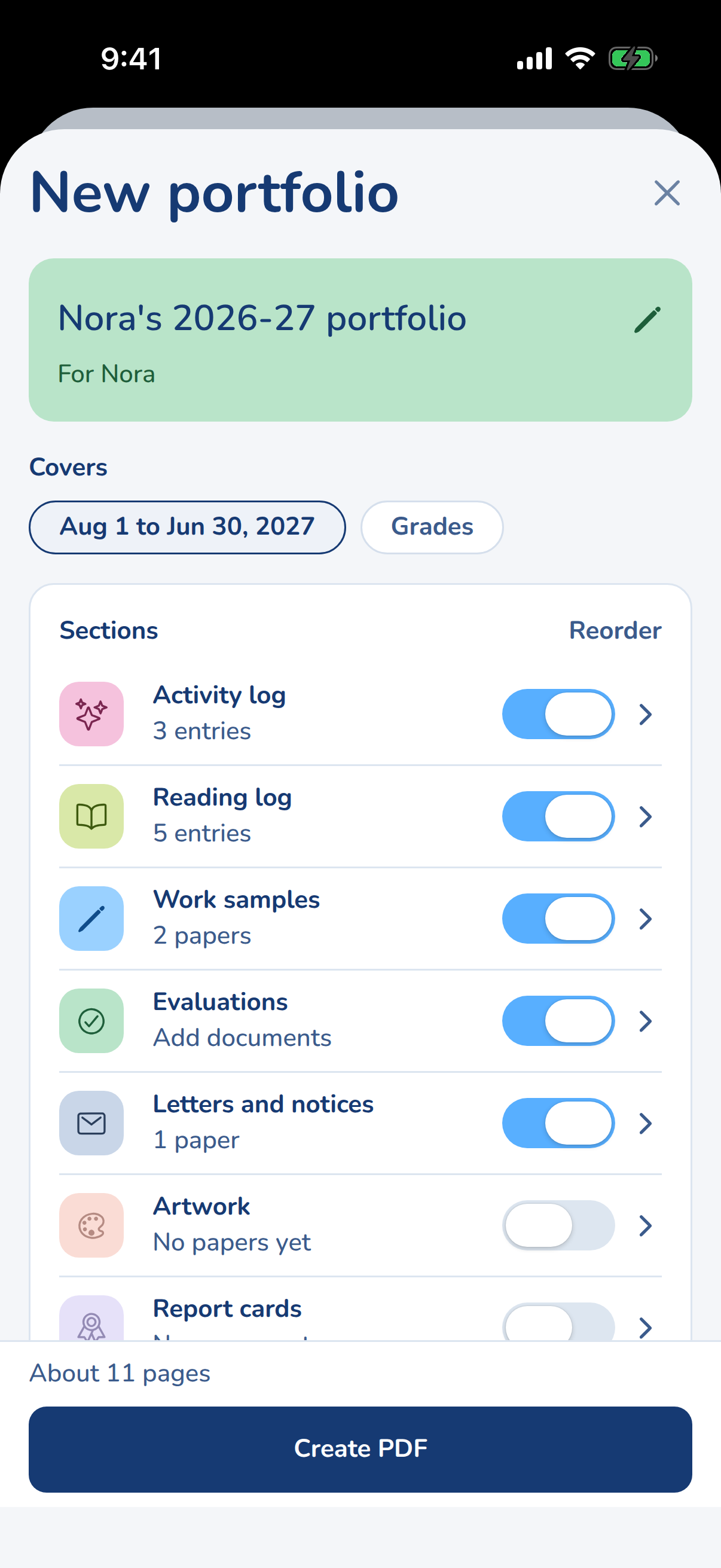
- The portfolio is ready when the teacher is. Start a New portfolio, pick the dates of the year just finished, and switch on the sections you need. You get one PDF with a cover and contents.
- Share or print it with a single click. You can also share your child's Portfolios folder read-only with the teacher who reviews it.
- Keepsakes stay safe, artwork included. Turn on automatic backup, and every paper goes to KidsFoldr Cloud as it is filed. One tap on Back up copies every paper to your own Google Drive or iCloud.
You pick the sections. For West Virginia:
- The portfolio review: Work samples, grouped by subject. Add the teacher's narrative to Evaluations when it comes back, then tap Make a new version.
- A test: Test results, for the score report.
- Either way: your notice of intent, any letter from the county and the copy of results you sent go in Letters and notices.
Common questions
Do I need a portfolio to homeschool in West Virginia?
No. A certified teacher's portfolio review is one of four ways to do the yearly assessment. A standardized test, the state test or an option agreed with your county superintendent work too (§ 18-8-1(c)(2)(C)).
Do I send my child's assessment to the county every year?
No. You send the results only for grades 3, 5, 8 and 11, by June 30 of that year (§ 18-8-1(c)(2)(E)). In other years, you keep the assessment.
Who reviews a homeschool portfolio in West Virginia?
A certified teacher. The teacher writes a narrative on your child's progress in reading, language, math, science and social studies, and notes any areas that need work (§ 18-8-1(c)(2)(C)(iii)).
How long do I keep homeschool records in West Virginia?
Three years for each assessment (§ 18-8-1(c)(2)(D)). HSLDA advises keeping other records at least two years and high school records forever.
Do I file a notice of intent every year?
No. You file it once, when you start, and again only if you move to another county (§ 18-8-1(c)(2)(A)).
Do I need a teaching certificate?
No. You need a high school diploma or equivalent, or a college degree or certificate (§ 18-8-1(c)(2)(B)).