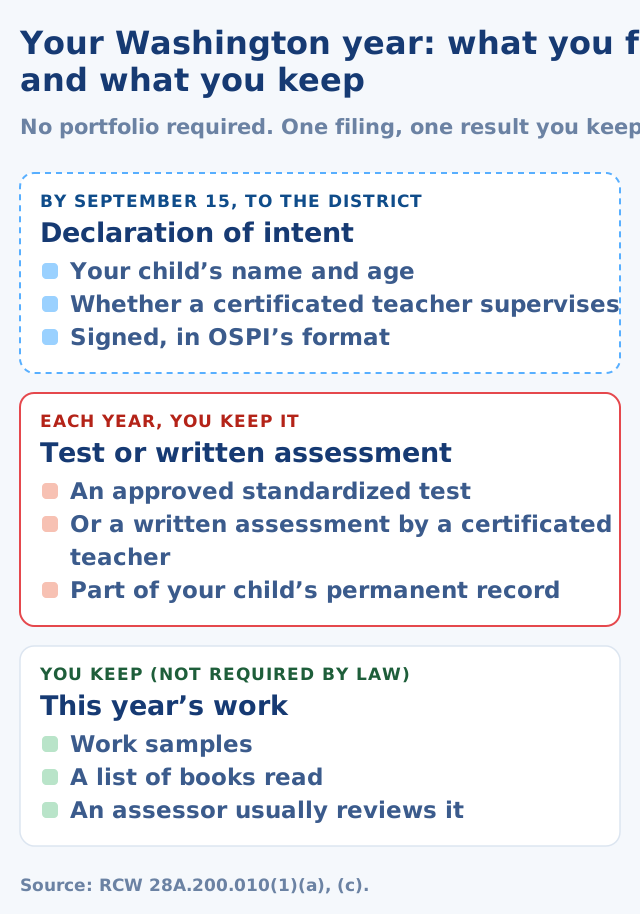
- Washington law requires no portfolio. Each year, by September 15, you file a declaration of intent with your school district.
- Each year, your child takes an approved standardized test or gets a written assessment from a certificated teacher. You keep the result. You don’t send it in.
- A folder of the year’s work is what an assessor usually reviews. The law sets no number of years for keeping records, but the result becomes part of your child’s permanent record.
The papers here are this year’s folder of your child’s work, the declaration of intent you file each September, and the test score report or written assessment that stays with you.
This page covers home-based instruction under chapter 28A.200 RCW, for children 8 to 18. Families in a private school’s extension program follow other rules. See which route you’re on.
Does Washington require a homeschool portfolio?
No. Washington’s home-based instruction law never uses the word “portfolio,” and it doesn’t ask for a log or an attendance record either. It asks for two things a year: the declaration and the test or assessment.
A portfolio still earns its place. If you choose the written assessment, the teacher writing it needs something to look at. OSPI, the state’s education office, says the assessment should reflect your child’s progress for their age or stage of development.
Good news: the law leaves the rest to you. Books, curriculum, teaching methods, timing and how you evaluate are all your call (RCW 28A.200.020).
The yearly declaration of intent
You file it every year, by September 15, with the superintendent of your school district (RCW 28A.200.010(1)(a)). It’s short. It gives:
- Your child’s name and age
- Whether a certificated teacher will supervise your teaching
- Your signature, in the format OSPI sets. Ask your district for its form.
Starting later in the year? File within two weeks of the start of any public school quarter, trimester or semester. You can also file with another district that accepts your child as a transfer student.
There’s no approval step. A parent who meets the duties in the law is presumed to be providing home-based instruction (RCW 28A.200.010(2)).
Who can teach at home
You teach your own child and meet one of these (RCW 28A.225.010(4)):
- A certificated teacher supervises you. You plan objectives together, the teacher averages one contact hour a week with your child, and the teacher evaluates progress.
- You’ve earned 45 college-level quarter credits, or the semester equivalent.
- You’ve completed a course in home-based instruction at a college or a vocational-technical institute.
- Your district superintendent deems you qualified. OSPI notes the law doesn’t require a superintendent to review such a request.
Subjects and hours
The law lists 11 subjects: occupational education, science, math, language, social studies, history, health, reading, writing, spelling, and an appreciation of art and music (RCW 28A.225.010(4)).
The hours match what approved private schools offer: an annual average of 1,000 hours for grades 1 to 12 (RCW 28A.195.010(1)). Here’s the easy part. The law calls home learning “less structured and more experiential” than a classroom, so these rules “shall be liberally construed” (RCW 28A.225.010(5)).
The law doesn’t ask you to log those hours. Keeping track is up to you.
The annual test or assessment
Each year, your child does one of two things (RCW 28A.200.010(1)(c)):
| Option | Who gives it | What you get | Uses a portfolio? |
|---|---|---|---|
| Standardized achievement test | A “qualified individual.” OSPI says test publishers authorize proctors, which can include parents. Or the state test, at a regularly scheduled sitting through your district. | A score report | No |
| Written assessment | A certificated person currently working in education | A written assessment of your child’s academic progress | Usually: the assessor looks at your child’s work |
The State Board of Education approves the tests and keeps a list of examples. It includes the Iowa Assessments, Stanford 10, CAT, TerraNova, PIAT, Woodcock-Johnson IV, CLT, PSAT, SAT and ACT. A test not on the list can work if a test review organization the Board recognizes has evaluated it, and the Board will help you check (WAC 180-52-070).
You keep the result. The law says it “shall be made a part of the child’s permanent records,” and it asks you to file it nowhere.
If the result shows your child isn’t making reasonable progress for their age or stage of development, you make “a good faith effort to remedy any deficiency.” The law sets no district review. Skipping the yearly duties, though, counts as your child missing school without a valid reason under the state’s truancy law (RCW 28A.200.010(2)).
What counts as a work sample?
The law doesn’t say. Your assessor does, so ask early in the year what they want to see.
These are our examples, not rules: dated pages from each subject across the year, a list of books read, a writing piece from fall and one from spring, and photos of projects. Together they show progress over the year, which is what OSPI says the assessment should reflect.
The Washington homeschool year, date by date
Washington has one fixed date: September 15. The test or assessment has no date in the law, so you pick it.
| When | What | Rule |
|---|---|---|
| The year your child turns 8 | Home-based instruction duties begin (ages 8 to under 18) | RCW 28A.225.010(1) |
| By September 15, each year | Declaration of intent to your district superintendent | RCW 28A.200.010(1)(a) |
| Starting later | Within two weeks of the start of a public school quarter, trimester or semester | RCW 28A.200.010(1)(a) |
| Each year (you pick when) | Standardized test or written assessment, kept in your child’s permanent record | RCW 28A.200.010(1)(c) |
| If progress falls short | A good faith effort to remedy it | RCW 28A.200.010(1)(c) |
| If your child moves to a school | Forward test scores or assessments, immunization records and other records you kept | RCW 28A.200.010(1)(b) |
How long to keep homeschool records in Washington
The law sets no number of years. It does make each test or assessment part of your child’s permanent record, so keep every one.
There’s a practical reason too. If your child moves to a public or private school, you forward the test scores or assessments, immunization records and any other records you kept. A public school district may require a standardized achievement test, then decides the grade and courses after talking with you and reviewing those records (RCW 28A.200.010(1)(b)).
HSLDA’s advice, not law: keep attendance records, curriculum lists, work samples, letters from school officials, portfolios and test results for at least two years. Keep high school records and each declaration from the high school years forever.
Home-based instruction, extension program or school
The rules above are for home-based instruction. Washington has other routes, and each one changes what you file.
| Route | Law | Declaration and yearly test? | Your papers |
|---|---|---|---|
| Home-based instruction | Ch. 28A.200 RCW; RCW 28A.225.010(4) | Yes: declaration by September 15, and a test or assessment each year that you keep | Your declaration copies, each result, and the work behind it |
| Private school extension program | RCW 28A.195.010(4) | No declaration and no yearly test. The school’s certificated teacher supervises and evaluates progress (OSPI). | Whatever the school asks for |
| Approved private school | RCW 28A.195.010; RCW 28A.225.010(1)(a) | No | Whatever the school asks for |
| Public school program at home (alternative learning experience) | Public school enrollment (OSPI) | No. Your child is a public school student. | Whatever the program asks for |
Home-based students can also take classes or services part time at their district school, if otherwise eligible to enroll there. OSPI counts testing and sports among those services (RCW 28A.150.350).
Will an assessor accept a digital portfolio?
The law doesn’t say. Neither the statute, the State Board’s rule nor OSPI’s guidance says anything about digital, scanned or emailed records.
So whether a digital homeschool portfolio is accepted is up to your assessor. If your child moves to a school, that school decides what records it takes. Ask before you send. A printed copy works for anyone who wants paper.
What changes in 2026 and 2027
2026
No change to Washington’s home-based instruction law in 2026. RCW 28A.200.010 was last amended in 2019, by ch. 252, which only changed its line about state learning standards and tests.
One bill came close to the topic. SB 6261, requested by OSPI, would have had parents of 6- and 7-year-olds who aren’t enrolled in school file a declaration of their plans. It had a hearing in January, stayed in committee and did not become law. Your duties still start at 8.
2027
No change is scheduled. The Legislature’s 2027 session opens January 11, 2027.
Your dates stay the same: the declaration by September 15, and a test or assessment each year.
Keeping the year’s work in KidsFoldr
The stack of worksheets can go, and the year stays organized with no sorting and nothing to type. Snap each page as you teach, and KidsFoldr files it by child, grade and type, with schoolwork and tests by subject too. It’s a homeschool record keeping app that does the filing for you.
- The paper goes, with no guilt. Scan a page for peace of mind, then toss it: no pile on the counter, no shelf of binders. Keep the originals that matter, though: each test score report or signed assessment, your copy of each declaration, any official letter, and high school work a school may need for credit.
- The paperwork keeps up. A score report or assessment that arrives by email or as a PDF files the same way.
- Dates land on the calendar. Snap the district’s letter with a test date, or forward the assessor’s email, and it goes on your family calendar, linked back to its paper, with nothing to type.
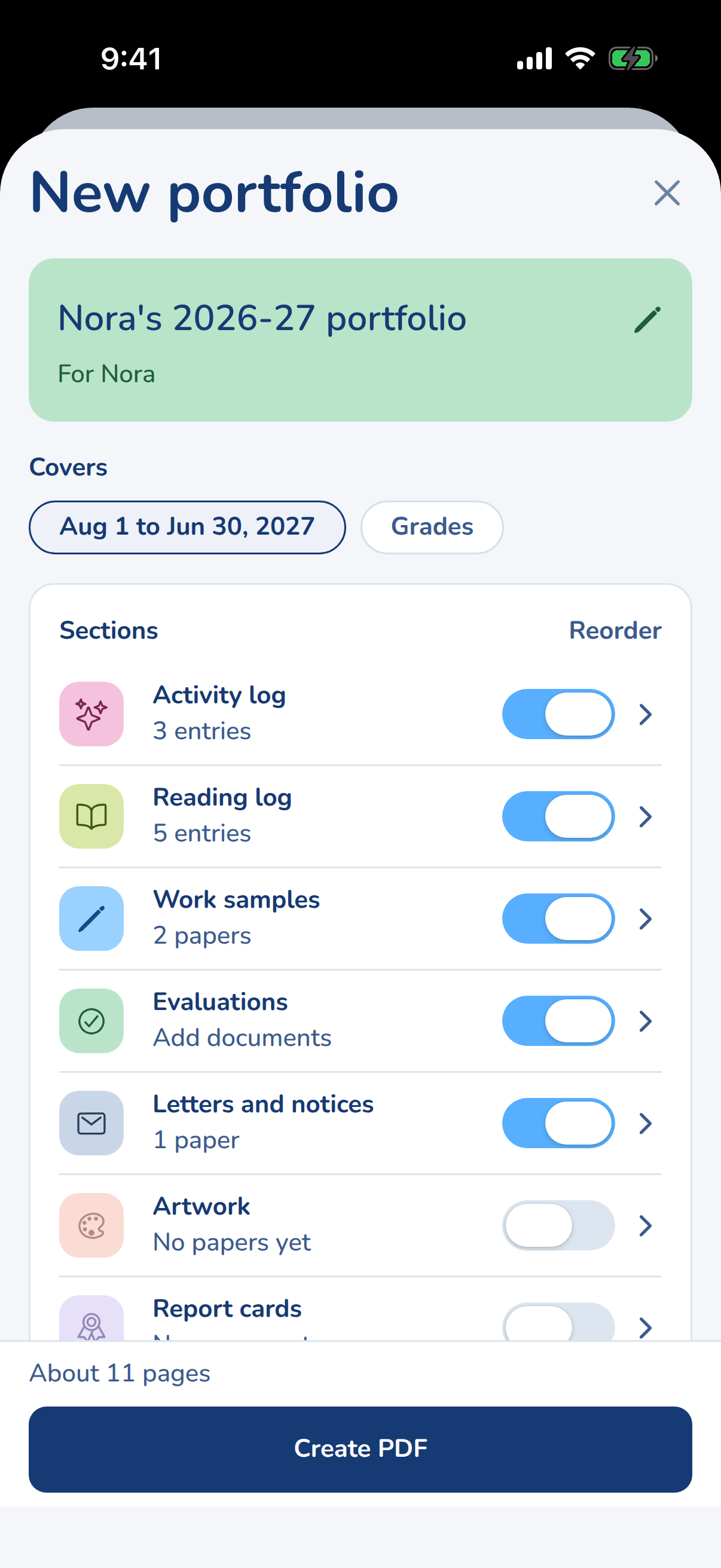
- The year is ready when your assessor is. Start a New portfolio, pick your dates or grades, and get one PDF with a cover and contents. Share or print it with a single click, or share your child’s Portfolios folder read-only with the assessor.
- Keepsakes stay safe, artwork and projects included. Turn on automatic backup, and every paper goes to KidsFoldr Cloud as it is filed. One tap on Back up copies every paper to your own Google Drive or iCloud.
You pick the portfolio’s sections and their order. For Washington, you might switch on:
- Work samples, grouped by subject, for what your assessor reviews.
- A reading log (title, author and date) for the year’s books.
- An Attendance or hours log, if you keep track of your hours. Each entry takes days or hours. The law asks for the hours, not a log.
- Test results for the score report, or Evaluations for the written assessment.
- Letters and notices for each year’s declaration.
Common questions
Do I have to keep a portfolio in Washington?
No. The law doesn’t require one. It’s still what an assessor usually reviews before writing the annual assessment.
When is the declaration of intent due?
By September 15, every year. If you start later, file within two weeks of the start of any public school quarter, trimester or semester (RCW 28A.200.010(1)(a)).
Do I send my child’s test scores to the district?
No. The law makes the result part of your child’s permanent record and asks you to file it nowhere. If your child moves to a school, you forward it there (RCW 28A.200.010(1)(b), (c)).
How long do I have to keep homeschool records in Washington?
The law sets no number of years, and each test or assessment is part of your child’s permanent record. HSLDA advises keeping records at least two years, and high school records forever.
Do I file for my 6- or 7-year-old?
No. Home-based instruction duties start at 8 (RCW 28A.225.010(1)). One thing to know: a 6- or 7-year-old you enrolled full time in public school must attend unless you formally withdraw them (RCW 28A.225.015).