- A portfolio is one of five ways to do Vermont’s yearly end-of-year assessment: your summary of what your child learned, plus at least four samples of their work.
- You don’t send the assessment to the state. You keep the record at home.
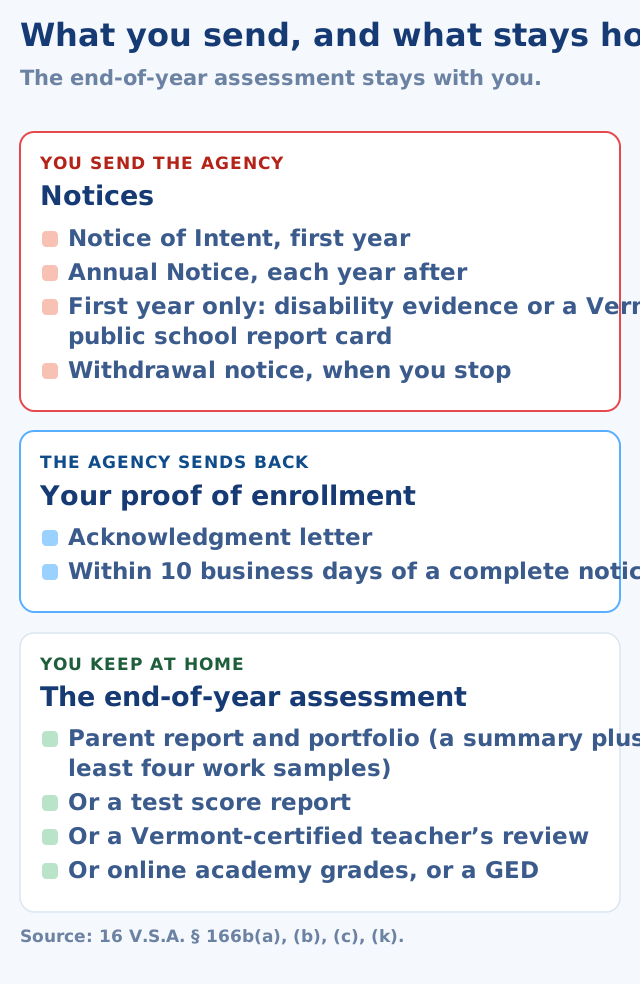
- What does go to the state: a notice at least 10 business days before you start, and an Annual Notice before each year after that.
The paper in your hand is this year’s homeschool portfolio for one child, or whichever end-of-year assessment you chose instead, such as a test score report or a teacher’s letter. Beside it sit the notice you sent the Agency of Education and the letter the Agency sent back.
This page covers a home study program under 16 V.S.A. § 166b. If your child attends an independent school, the school keeps the records. See which route you’re on.
Does Vermont require a homeschool portfolio?
Not on its own. Vermont calls homeschooling a “home study program,” and its law asks for an assessment of your child’s progress at the end of each school year. A “parent or guardian report and portfolio” is one of five ways to do it (§ 166b(a)(3)).
Good news: since July 1, 2023, nothing gets sent in. You assess, and you keep the record (Agency of Education).
That’s worth knowing when you read older advice. Act 66 of 2023 dropped the yearly course plan and the assessment review families used to file, and older pages may still describe them.
The notice and the acknowledgment letter
You send the Agency of Education a notice at least 10 business days before you start. Within 10 business days of a complete notice, the Agency sends back a written acknowledgment, and that letter is your proof of enrollment (§ 166b(a), (b)).
The notice includes:
- Your child’s name, age and date of birth
- Contact details for every parent or guardian with legal say over your child’s education
- Your promise (the law calls it an attestation) to assess progress at the end of each year and keep the record
- Your promise of the equivalent of at least 175 days of instruction in the required subjects, or of adaptations for a child with a documented disability
- The signature of every parent or guardian with that legal say
In your first year, you also send “independent professional evidence” on whether your child has a documented disability (§ 166b(a)(4)). The Agency accepts a Vermont public school report card, a 504 plan or an IEP instead.
The Agency confirms by email, then mails an official letter. Wait for it before you withdraw your child from school (Agency of Education). Then keep the letter somewhere safe (HSLDA).
Each year after
Before each later year starts, you send an Annual Notice, again at least 10 business days ahead (§ 166b(k)). The Agency calls it the only form you need to re-enroll.
The subjects and the 175 days
Vermont’s minimum course of study has six areas (§ 906). A child under 13 covers all six: reading, writing and math; citizenship, history and government; physical education and health; literature; the natural sciences; and the fine arts. From 13, it’s four: no PE, health or fine arts (§ 166b(a)(5)).
The 175 days is something you promise, not something you log. Section 166b asks for no attendance record. The Agency does suggest writing a course plan each year and keeping a copy.
The end-of-year assessment: five options
At the end of each school year, you assess your child’s progress one of five ways and keep the record (§ 166b(a)(3)). Here are the five:
| Option | What you keep | Uses a portfolio? |
|---|---|---|
| Parent report and portfolio | Your summary of what your child learned, plus at least four work samples | Yes, it is the portfolio |
| Teacher review | A review of your child’s progress by someone with a current Vermont teacher’s certificate | It can. The Agency lists reviewing the portfolio as one way a teacher can assess. |
| Standardized test | The score report, from a test given by your district, a testing service or as the test maker allows | No |
| Online academy or school | Your child’s grades | No |
| GED | Proof of passing | No |
The Agency says not to send a copy of your assessment unless you want it reviewed.
For a teacher review, the Agency’s guidance describes a face-to-face meeting with your child and a signed letter. The letter says whether progress matched your child’s age and ability in each subject.
Choosing a test? The Agency’s test chart notes that tests skip literature, so add a list of books read. For children under 13, add samples and a short report for PE, health and fine arts too.
What counts as a work sample?
The law asks for at least four samples of student work, with your summary (§ 166b(a)(3)(C)). It sets no subjects and no format.
The Agency’s own template asks for more: four to six samples for each core subject, and one each for PE, health and fine arts if your child is 12 or younger. That’s guidance, not law, but it makes a solid portfolio.
What counts, from the Agency’s forms (examples, not rules): worksheets, book reports, writing, science experiments and captioned photos of projects. One sample can count for two subjects. For the summary, the Agency’s template asks for a brief description of the work in each subject.
The Vermont home study year, date by date
Vermont’s dates count from your own start date, not a statewide deadline. The Agency adds its own enrollment windows on top.
| When | What | Rule |
|---|---|---|
| At least 10 business days before you start | Notice of Intent (first year) or Annual Notice (later years) | § 166b(a), (k) |
| Within 10 business days of a complete notice | The Agency’s acknowledgment letter | § 166b(b) |
| All year | Teach the required subjects, the equivalent of 175 days | § 166b(a)(5); § 906 |
| End of each school year | Do the assessment and keep the record | § 166b(a)(3) |
| Within 10 business days after you stop | Written withdrawal notice | § 166b(c) |
| March 1 | The Agency opens enrollment for the next school year | Agency |
To start with the school year, the Agency recommends sending your paperwork by early August. Partial-year enrollments for 2026-27 stay open through March 31, 2027.
On withdrawal, the law gives you 10 business days after your child leaves home study, and the Agency asks for notice before. Sending it early covers both.
How long to keep homeschool records in Vermont
The law sets no period. Section 166b says only that you’ll “maintain the record” of each assessment.
The Agency’s guidance is to keep each end-of-year assessment until your child turns 18. A school your child later joins may ask for it to place them in a grade, look into a possible disability or give credit (Agency of Education).
HSLDA’s advice goes further: keep your acknowledgment letter and other records at least two years, and high school records for good. If you’ll want proof of the high school years for a college or employer, the Agency writes a Verification letter of enrollment on request.
Home study or an independent school: which rules apply
Teaching your own children at home is a home study program in Vermont. An independent school runs on its own rules, and the school keeps the records.
| Route | Law | Who files and keeps the records |
|---|---|---|
| Home study program | 16 V.S.A. § 166b | You: notices to the Agency, and a yearly assessment kept at home |
| Recognized independent school | § 166(c) | The school: its own notice, attendance records and a yearly assessment it shares with you |
| Approved independent school | § 166(b) | The school, under State Board approval |
A home study program teaches the children who live in that home. It may add at most two other children, or the children of one other family (§ 11(a)(21)).
Will a digital portfolio work?
The law doesn’t say. And since you keep the assessment yourself, no one reviews its format unless you ask.
The Agency itself works digitally: its forms are online, and its portfolio template is a Word or PowerPoint file you paste photos of work into. So a digital homeschool portfolio fits right in.
If a teacher reviews it, or a school later asks for it, they decide what form they want, so ask first. A printed copy works for anyone who wants paper.
What changes in 2026 and 2027
2026
No change to Vermont’s home study law (§ 166b) in 2026. Its last rewrite was Act 66 of 2023, in effect since July 1, 2023.
Act 122 of 2026 (H.930), in effect since July 1, 2026, rewrote the school attendance chapter. Home study is still one of the ways to meet the attendance law, and the ages are still 6 to 16 (§ 1121).
The same act asks the Agency of Education to send lawmakers recommendations for updating the home study law by December 1, 2026. That’s a report, not a change.
2027
No change to § 166b is scheduled. The Legislature’s new session opens January 6, 2027, so watch for bills that follow the Agency’s report.
Keeping the portfolio in KidsFoldr
Snap each worksheet as your child finishes it, and it’s filed under that child, grade and subject, with nothing to sort and nothing to type. Once it’s scanned, the paper can go: less clutter, and the whole year fits on your phone.
Keep the originals someone may ask for: the Agency’s letter, a signed teacher review, and high school work a school may want for credit. KidsFoldr works as a homeschool record keeping app for those too, with a scan of each one in the same place.
- Organized with zero effort. Every paper is filed by child, grade and type as you snap it, and schoolwork and tests by subject too. A name at the top of a page files it under the right child, and any word on any paper is searchable.
- The paperwork keeps up. An emailed score report or teacher’s letter files the same way: share it to KidsFoldr or forward it. A test date or a teacher-review meeting on a paper or in an email lands on your family calendar, linked back to its paper, with nothing to type.
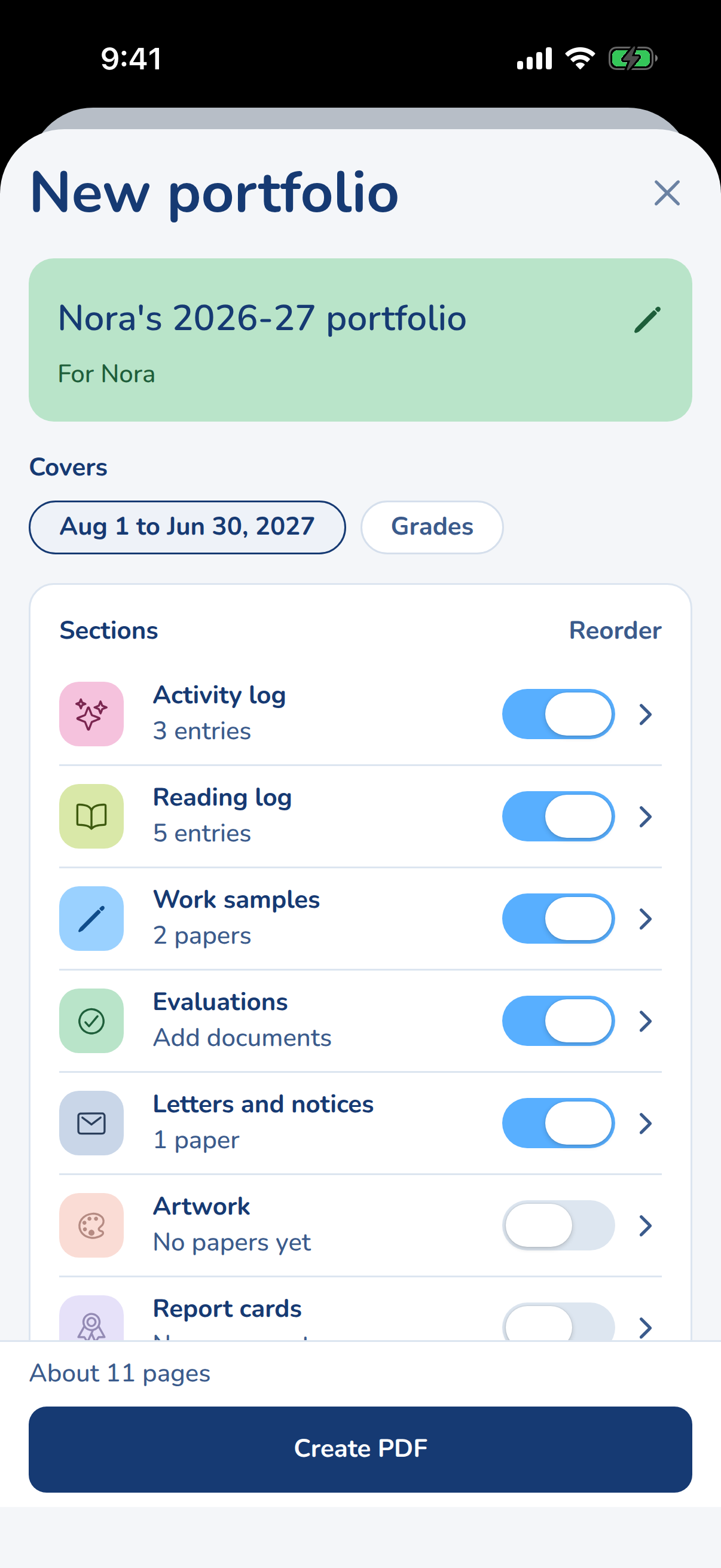
- The portfolio, on demand. Start a New portfolio, set Dates to your own school year, and create the PDF, with a cover page and contents. Share it or print it.
- Keepsakes, safe. Artwork and favorite work are kept as scans. Turn on automatic backup, and every paper goes to KidsFoldr Cloud as it is filed. One tap on Back up copies every paper to your own Google Drive or iCloud.
You pick the portfolio’s sections. For Vermont’s parent report and portfolio:
- Parent summary: your summary of what your child learned.
- Work samples, grouped by subject: at least four, or the Agency’s set per subject.
- Artwork and a Reading log: fine arts, and the books behind literature.
- Evaluations or Test results, if you chose a teacher review or a test instead.
- Letters and notices: your notice and the Agency’s letter.
Want your own record behind the 175 days? Add the Attendance or hours log, and Fill from papers adds a day for each date your child has schoolwork, artwork or a test. The law doesn’t ask for one.
Common questions
Do I send my portfolio to the Agency of Education?
No. You keep it at home. The Agency says to send a copy only if you want it reviewed.
How many work samples does Vermont require?
At least four, with your summary of what your child learned (§ 166b(a)(3)(C)). The Agency’s template suggests four to six per core subject.
How long do I have to keep homeschool records in Vermont?
The law sets no period. The Agency’s guidance is to keep each end-of-year assessment until your child turns 18.
Do I file something every year?
Yes. Before each year after the first, you send an Annual Notice at least 10 business days before you start (§ 166b(k)).
Do I have to track attendance or hours?
No log is required. You promise the equivalent of at least 175 days of instruction in the required subjects (§ 166b(a)(5)).