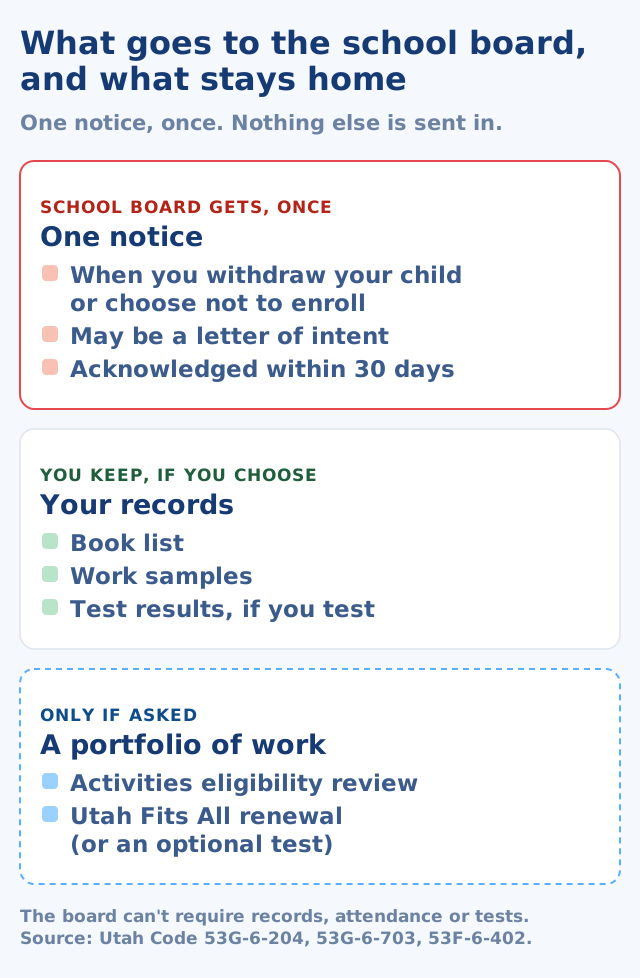
- Utah asks a homeschool for no portfolio, no work samples, no tests and no set days or hours. The school board may not require records of instruction or attendance.
- File a one-time notice with your local school board when you take your child out of school or decide not to enroll them. The board acknowledges it within 30 days.
- A portfolio comes up in only two places: if your child’s eligibility for a public school activity is challenged, or if you renew a Utah Fits All scholarship (a portfolio or an optional test, by May 31).
Picture one child’s homeschool folder. It holds your copy of the notice you sent the school board, the board’s acknowledgment, and whatever else you choose to keep: a book list, some work samples, a test score report.
This page covers a homeschool under Utah Code § 53G-6-204. A private school, a microschool, a public school option and the Utah Fits All scholarship each run on their own rules. See which route you’re on.
What Utah requires instead of a portfolio
Utah has no portfolio rule. The law gives you the choices and puts limits on the school board instead (§ 53G-6-204).
| Requirement | What the law says | Rule |
|---|---|---|
| Notice | One time, to the local school board where you live, when you withdraw your child or choose not to enroll. It may include a letter of intent | § 53G-6-204(3) |
| Who decides | You choose the books and materials, the time, place and method of teaching, and how to evaluate it | § 53G-6-204(2)(a) |
| Records | The board may not require records of instruction or attendance | § 53G-6-204(2)(b) |
| Teacher | The board may not require credentials. No license or degree needed | § 53G-6-204(2)(b); USBE |
| Testing | The board may not require standardized or other tests | § 53G-6-204(2)(b) |
| Home visits | The board may not inspect your homeschool | § 53G-6-204(2)(b) |
| Ages | From 6 until 18 | § 53G-6-201(15) |
Utah sets no number of school days or hours and no required subjects or curriculum (USBE).
Want a yardstick? Ask your school board, and it must tell you the knowledge and skills recommended for each grade and subject (§ 53G-6-204(2)(c)).
Teaching with other families, or paying for classes, doesn’t change anything. The law also allows voluntary testing and resource sharing with your district (§ 53G-6-204(6)).
Filing your notice with the school board
The one thing you file is a notice to the local school board of the district you live in. You send it when you withdraw your child from school to homeschool, or when you choose not to enroll them (§ 53G-6-204(3)).
It is one notice per child, not one a year (USBE). It may be a letter of intent, and the law sets no form.
The board keeps a record of your notice and acknowledges receipt within 30 days. The board and your child’s old school are not liable for your child’s education (§ 53G-6-204(5)).
Already homeschooling? If you filed a notice or an affidavit on or before May 7, 2025, the board can’t ask for a new one (§ 53G-6-204(4)).
That date matters because the law changed in 2025. HB 209 replaced the old affidavit with this one-time notice and dropped the statement about criminal history (HB 209; USBE).
Who checks your homeschool
No one, on a schedule. The board can’t require records or tests, and it can’t inspect your homeschool (§ 53G-6-204(2)(b)). USBE says the district may not evaluate or supervise your homeschool program.
A homeschooled child is exempt from enrollment, so no truancy notice goes out (§§ 53G-6-202, 53G-6-203(4)). Intentionally failing to enroll a school-age child who isn’t exempt is a misdemeanor (§ 53G-6-202(5)).
The law also names what protects a family in an educational neglect case. Two of those defenses are teaching at home under § 53G-6-204, and “documentation” that your child has made progress in line with their ability (§ 53G-6-210(2)(b)).
When Utah asks for a portfolio
Only in two places, and neither is the homeschool law itself.
Public school activities
Your child can join activities at a public school. To show academic eligibility, you (or whoever teaches your child) give the principal an affidavit, and it holds for the season (§ 53G-6-703(5), (6)).
If someone gives the principal reason to doubt it, a three-person panel reviews the case. The panel asks your child for “test scores or a portfolio of work” showing their progress (§ 53G-6-703(8) to (11)).
Utah Fits All scholarship renewal
If your child has a Utah Fits All scholarship, you renew it each school year. To stay eligible, you send the program “a portfolio describing” the year’s learning and achievements, or the results of an optional test (§ 53F-6-402(3)(d); § 53F-6-410).
It is due by May 31, or on a test schedule the program approves. The program can’t share your child’s portfolio without your written consent. Follow the program’s own instructions for sending it.
The Utah homeschool year, date by date
Utah has no statewide homeschool deadline. Your dates come from your own start, your child’s age, and any activity or scholarship you choose.
| When | What | Rule |
|---|---|---|
| When you withdraw your child, or choose not to enroll | Send a one-time notice to your local school board | § 53G-6-204(3) |
| Within 30 days | The board acknowledges your notice | § 53G-6-204(5) |
| All year | You choose what, when and how. No set days or hours | § 53G-6-204(2)(a); USBE |
| Each activity season | Eligibility affidavit to the principal, if your child joins a public school activity | § 53G-6-703(6) |
| Each school year (Utah Fits All only) | Apply to renew the scholarship | § 53F-6-402(3)(c) |
| By May 31 (Utah Fits All only) | Portfolio or optional test results | § 53F-6-402(3)(d) |
| Ages 6 to 18 | School age | § 53G-6-201(15) |
How long to keep homeschool records in Utah
The law sets no time, and the school board can’t require records at all (§ 53G-6-204(2)(b)). Keeping some is still smart.
If your child goes back to public school, the school places them using your assessment of their work, agreed with the school. If you and the teacher disagree later, your child may be tested (§ 53G-6-706).
HSLDA suggests keeping attendance, book lists, work samples, letters from school officials and test results at least two years. It says to keep high school records and proof you followed the law forever. Both are advice, not law.
Our advice: keep a few originals on paper. Those are your notice copy and the board’s acknowledgment, any letter from your district, test score reports if you test, and high school work you may need for credit or a transcript. Everything else can be a scan.
Work samples: not required, still worth keeping
Utah asks a homeschool for no work samples. They still earn their place in three spots: placement if your child returns to public school, an activities review, and a Utah Fits All portfolio if you renew (§§ 53G-6-706, 53G-6-703, 53F-6-402).
What counts is up to you. Examples, not rules: a dated math page, a writing piece, a book list, a science lab sheet, a photo of a project.
Homeschool, scholarship, private school or public options
The rules on this page are for a homeschool under § 53G-6-204. The other routes keep different records.
| Route | What it is | What it means for records |
|---|---|---|
| Homeschool | You teach at home under § 53G-6-204 | One notice. No records required |
| Utah Fits All, home-based | A state scholarship for a child learning at home | Apply each year. Portfolio or optional test by May 31 |
| Private school or microschool | A private school, or a small paid program run as a business | Its own rules, not this page’s |
| Home-centered public option | A public school’s option to do some classes from home | For enrolled students, with state tests. Not open to § 53G-6-204 homeschoolers |
Sources for the table: §§ 53F-6-401, 53F-6-402; §§ 53G-6-201, 53G-6-202, 53G-6-212; § 53G-6-710.
Public school classes, activities and coming back
You can dual enroll your homeschooled child in a public school for any academic activity open to their grade, under the same rules as full-time students (§ 53G-6-702).
For activities, your child usually joins at the school for your home’s boundaries or the school they left. They pay the same fees, and the school can’t add extra requirements. Eligibility rules based on school attendance don’t apply to them (§ 53G-6-703).
Can your records be digital?
Yes, as far as the law goes. It sets no format for any homeschool record, and a Utah homeschool has no evaluator to accept or reject one.
Keep copies you could print if a school or a panel asks. That is advice, not law. For a Utah Fits All portfolio, follow the program’s instructions.
What changes in 2026 and 2027
2026
No change to the homeschool law in 2026. The 2025 change stands: one notice, once, and earlier affidavits still count (§ 53G-6-204).
A 2026 bill to define “home school student” in the code, HB 233, did not become law. HB 467 changed how Utah Fits All is run, and the May 31 portfolio-or-test rule stays (§ 53F-6-402).
2026 changes to the truancy laws keep the homeschool exemption in place (§§ 53G-6-202, 53G-6-203).
2027
No change is scheduled. Your notice is one time, so there is nothing to renew.
The Legislature meets from January 19 to March 5, 2027. Any change would start there.
Keeping your records in KidsFoldr
No law tells you what to keep, so the easy answer is to keep it all, on your phone instead of a shelf of binders. Snap each paper for peace of mind, and the paper can go. Book lists, tests and work are filed by child, grade and type (and subject for schoolwork), with nobody sorting and nothing to type.
The few originals named above stay on paper. Snap them too, so a copy is always at hand. Snap a test appointment, a tryout schedule or a letter from your district, and the date lands on your family calendar, linked back to the paper, with nothing to type.
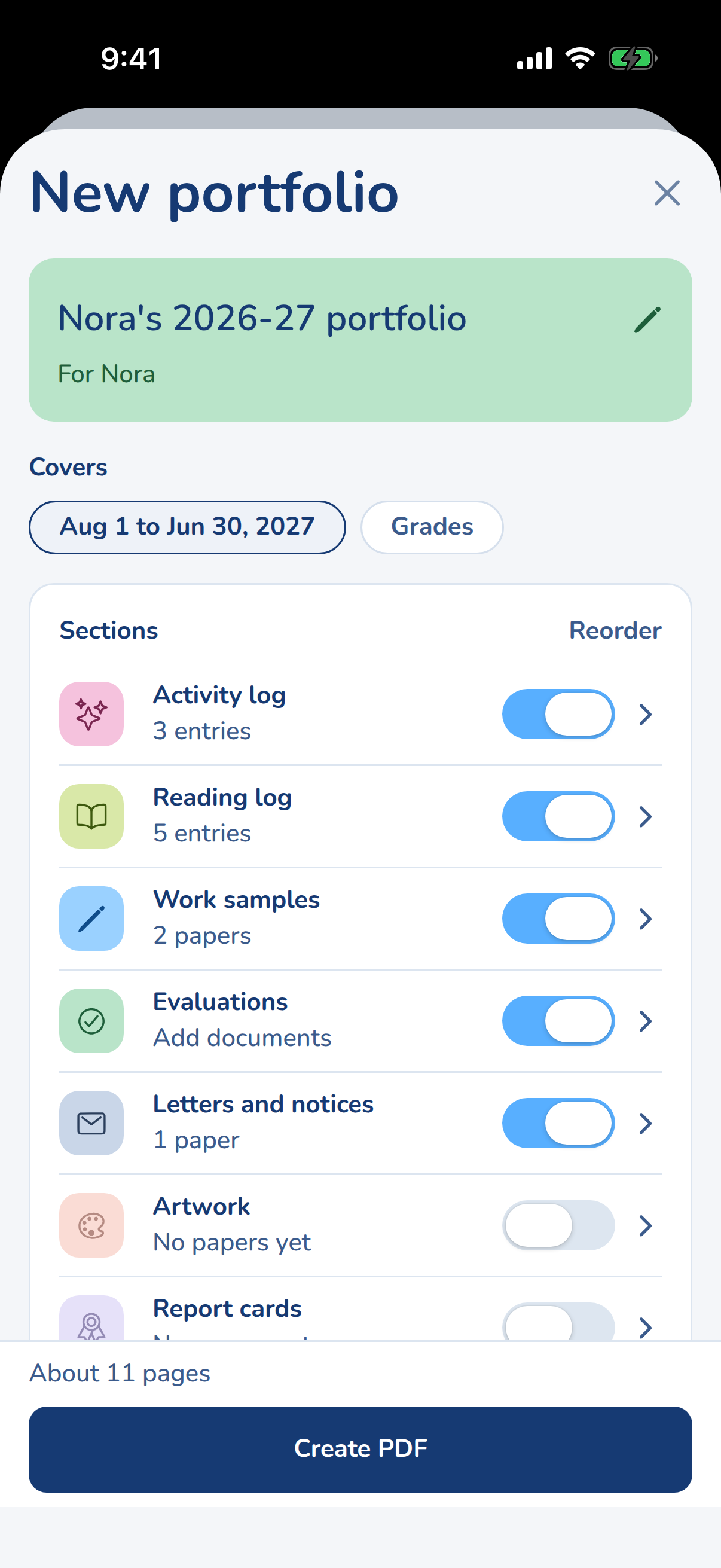
If a school or the scholarship program asks, the year is ready. Start a New portfolio for a grade or your own dates, and print or share the PDF. You pick the sections. For Utah, you might switch on:
- Work samples, sorted by subject
- A reading log, for your book list
- Test results, if you test
- Letters and notices, for your notice and the board’s acknowledgment
Turn on automatic backup, and every paper goes to KidsFoldr Cloud as it is filed. One tap on Back up copies every paper to your own Google Drive or iCloud, and every paper is searchable by any word on it.
Common questions
Do I need a homeschool portfolio in Utah?
No. The school board may not require records of instruction or attendance, or tests (§ 53G-6-204(2)(b)). A portfolio comes up only in an activities eligibility review or a Utah Fits All renewal.
Do I have to notify the school district every year?
No. You send a one-time notice for each child to your local school board (§ 53G-6-204(3)). USBE says you do not need a new notice every year.
Do I still need to file a homeschool affidavit?
No. Since 2025 the law asks for a one-time notice instead. If you filed an affidavit or notice on or before May 7, 2025, the board can’t ask for a new one (§ 53G-6-204(4)).
How long do I have to keep homeschool records in Utah?
The law sets no time, and the board can’t require records. HSLDA advises keeping most records at least two years, and high school records and proof you followed the law forever.
How many days or hours do Utah homeschoolers need?
None are set. USBE says Utah law sets no number of school days or hours for homeschool families, and you choose the time, place and method (§ 53G-6-204(2)(a)).