- Colorado asks for no portfolio and no work samples. You keep three records “on a permanent basis”: attendance, test and evaluation results, and immunization records.
- File a notice of intent with a Colorado school district 14 days before you start, and every year after. Teach at least 172 days, averaging four hours a day.
- In grades 3, 5, 7, 9 and 11, your child takes a standardized test or is evaluated by a qualified person. The results go to the district or to an independent or parochial school.
Picture one child’s records folder. It holds the attendance record, this year’s test score report or evaluation letter, the immunization record and a copy of this year’s notice of intent.
This page covers a nonpublic home-based educational program under C.R.S. § 22-33-104.5. Enrolling in an independent school, or teaching with a licensed teacher, are other routes. See which route you’re on.
What Colorado requires instead of a portfolio
Colorado has no portfolio rule. The law names three records you keep for good, and they stay with you (§ 22-33-104.5(3)(g)).
| Record | What the law says | Rule |
|---|---|---|
| Attendance data | At least 172 days of instruction a year, averaging four instructional contact hours a day | § 22-33-104.5(3)(c), (3)(g) |
| Test and evaluation results | From the test or evaluation in grades 3, 5, 7, 9 and 11 | § 22-33-104.5(3)(f), (3)(g) |
| Immunization records | As the state’s immunization law requires | § 22-33-104.5(3)(g); §§ 25-4-901 to -903 |
Here’s the easy part. The law sets no form for attendance, and it asks for no work samples, lesson logs or book lists. Its record list “need not be limited to” these three, so extras are up to you.
You teach reading, writing and speaking, math, history, civics, literature, science and the U.S. Constitution (§ 22-33-104.5(3)(d)). You need no teaching license to do it (§ 22-33-104.5(3)(a)).
The notice of intent
You send a written notice to a Colorado school district 14 days before you start, and again every year you keep going (§ 22-33-104.5(3)(e)). The Colorado Department of Education (CDE) says any district in the state can take it.
The notice states only four things for each child: name, age, place of residence and number of hours of attendance. CDE offers an optional template, and you don’t have to use it.
CDE also advises that if you file with a district where you don’t live, you tell your home district too, so no one opens a truancy case. That is advice, not law.
If your child was habitually truant in the last six months of school, you also send a written description of your curriculum with the notice (§ 22-33-104.5(3)(b)).
Testing in grades 3, 5, 7, 9 and 11
Your child is tested or evaluated five times, in grades 3, 5, 7, 9 and 11. You pick which one (§ 22-33-104.5(3)(f)).
| Option | Who | What keeps your child home | Rule |
|---|---|---|---|
| Nationally standardized achievement test | You pick the test. The law names no one to give it | A composite score above the 13th percentile | § 22-33-104.5(3)(f), (5)(a)(I) |
| Evaluation by a qualified person | A licensed Colorado teacher, a teacher at an independent or parochial school, a licensed psychologist, or someone with a graduate degree in education | “Sufficient academic progress according to the child’s ability” | § 22-33-104.5(2)(c), (3)(f), (5)(a)(II) |
The results go to the district that got your notice, or to an independent or parochial school in Colorado. If you use a school, give the district the school’s name (§ 22-33-104.5(3)(f)). The school then tells the district only about a low score or too little progress (§ 22-33-104.5(5)(b)).
The parent picks and pays for the test or evaluation (CDE). The statute sets no due date for the results, so ask the district that got your notice.
A score at or below the 13th percentile does not end your homeschool on the spot. Your child first gets a retest, on another version of the same test or a different approved test. If the result still falls short, the district requires school until the next testing year (§ 22-33-104.5(5)(a)).
Your child does not take the state’s own tests, the CMAS (§ 22-7-409(3)(b)).
Who can ask to see your records
Your records stay at home. Only the district that got your notice can ask for them, and only with probable cause, on 14 days’ written notice (§ 22-33-104.5(3)(g)).
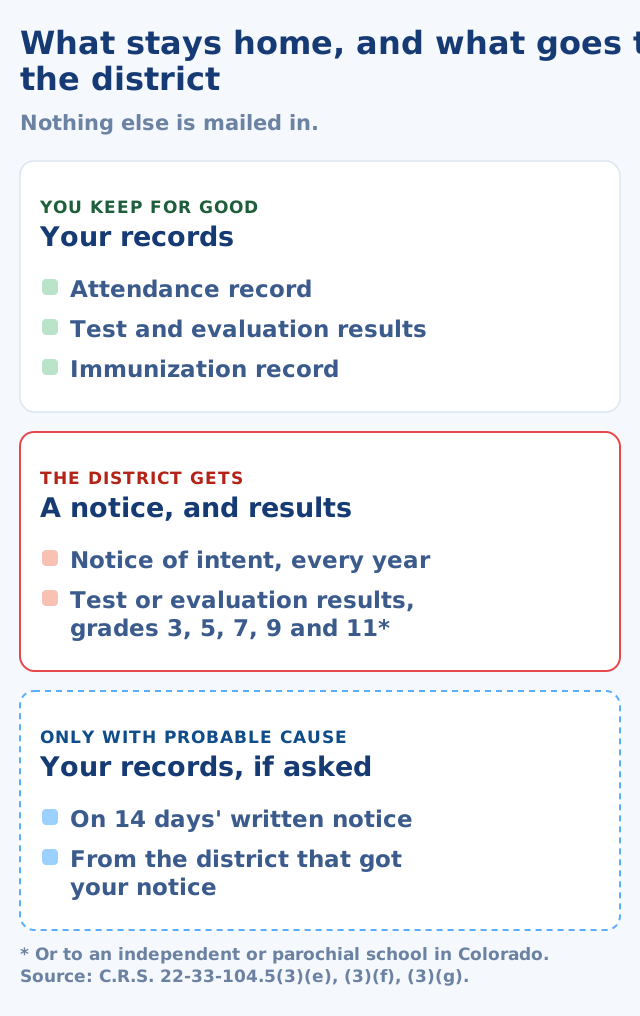
Probable cause means the superintendent has reason to believe your program does not follow the law’s guidelines. There is no yearly review of your records. CDE says the same: no request without probable cause, and 14 days’ written notice.
The Colorado homeschool year, date by date
Colorado has no statewide homeschool deadline. Your dates count from the day you start and your child’s grade.
| When | What | Rule |
|---|---|---|
| 14 days before you start | Notice of intent to a Colorado school district | § 22-33-104.5(3)(e) |
| Every year after | Notice again, while you keep homeschooling | § 22-33-104.5(3)(e) |
| All year | At least 172 days, averaging four hours a day. Keep attendance data | § 22-33-104.5(3)(c), (3)(g) |
| Grades 3, 5, 7, 9 and 11 | Test or evaluation. Results to the district or an independent or parochial school | § 22-33-104.5(3)(f) |
| Only if asked, with probable cause | Show your records within 14 days of written notice | § 22-33-104.5(3)(g) |
| Always | Keep your records permanently | § 22-33-104.5(3)(g) |
School is required for children who turn 6 by August 1, until they turn 17 (§ 22-33-104(1)(a)). For a home-based program, you need no notice before your child turns 6 and no program before 7. Neither is required after 16 (§ 22-33-104.5(3)(e)).
How long to keep homeschool records in Colorado
For good. The statute says the records “shall be maintained on a permanent basis” (§ 22-33-104.5(3)(g)).
The Home School Legal Defense Association (HSLDA) suggests keeping extras, like book lists and work samples, at least two years. It says to keep high school records and proof that you followed the law forever. Both are advice, not law.
Our advice: keep a few originals on paper. Those are the immunization record, signed evaluation letters and test score reports, letters from the district, and high school work you may need for a transcript. Everything else can be a scan.
Work samples: not required, still worth keeping
Colorado asks for no work samples. They still help if your child goes back to school.
A public school may test your child to pick a grade, with your consent. It must accept your transcripts for credit, unless its own testing does not back them up (§ 22-33-104.5(4)).
What counts is up to you. Examples, not rules: a dated math page, a writing piece, a book list, a lab sheet.
There is no state diploma. CDE says you may issue your own.
Home-based program, independent school or licensed teacher
The rules on this page apply to a home-based program under § 22-33-104.5. Two other routes are separate exceptions to compulsory attendance (§ 22-33-104(2)).
| Route | Law | Notice and testing under § 22-33-104.5? | Records |
|---|---|---|---|
| Home-based program | § 22-33-104.5 | Yes | You keep them for good |
| Enrolled in an independent or parochial school for at least 172 days | § 22-33-104(2)(b) | No | Not set by § 22-33-104.5 |
| Taught at home by a licensed teacher | § 22-33-104(2)(i)(I) | No | Not set by § 22-33-104.5 |
CDE says “umbrella school” is not a concept in Colorado law. Some umbrella schools offer services like transcripts and records retention, not instruction. If yours does, CDE says you file a notice of intent with a school district as a homeschooler. HSLDA reads the licensed-teacher route as needing no notice or testing.
Can your records be digital?
The law sets no format for any record. A digital homeschool portfolio, or a digital attendance record, is your call (§ 22-33-104.5(3)(g)). CDE says nothing about it either.
Keep a copy you can print or email within 14 days if the district asks. If an evaluator will review your child’s work, ask before you send a digital copy.
What changes in 2026 and 2027
2026
No change to Colorado’s homeschool law in 2025 or 2026. Section 22-33-104.5 was last amended in 2024, and only in its wording on part-time public school funding.
One 2026 law touches nearby rules. The School Finance Act, SB26-023, lets school districts, charter schools and BOCES (boards of cooperative services) run part-time programs for homeschool students (new § 22-33-104.3). To join one, you give the program a current copy of your notice of intent. Students enrolled in an independent or parochial school can’t join.
Your notice, your 172 days, your records and your testing years stay the same.
2027
No change to § 22-33-104.5 is scheduled. The State Board of Education’s rules for certifying part-time programs to operate outside their own boundaries apply from the 2027-28 school year, and the law’s 2026-27 transition rules end July 1, 2027.
The 2027 session of the General Assembly opens by January 13, 2027. No 2027 bill has been filed.
Keeping your records in KidsFoldr
“Permanent” doesn’t have to mean a closet of binders. Snap each record for peace of mind, and the paper can go. Years of attendance pages and score reports fit on your phone, filed by child, grade and type, with nobody sorting and nothing to type.
The few originals named above stay on paper. Snap them too, so a copy is always at hand. Snap a letter from the district or your evaluator’s appointment confirmation, and the date lands on your family calendar, linked back to the paper, with nothing to type.
Attendance can fill itself in from your papers. In the Attendance or hours log, Fill from papers adds a day for every date your child has schoolwork, artwork or a test on file. Add the days you taught without paper, and your hours.
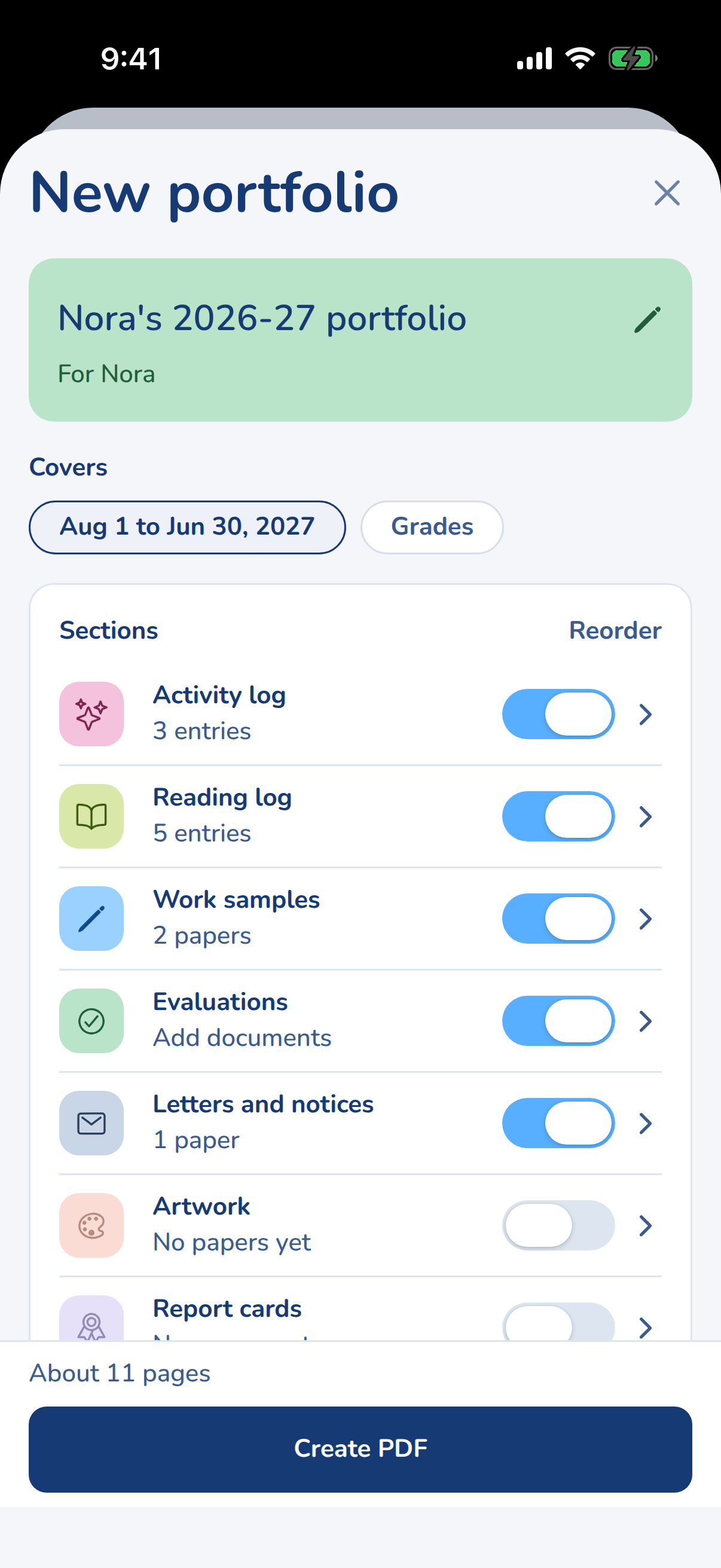
When the district asks, or a school wants to see the year, it’s ready. Start a New portfolio for a grade or your own dates, and print or share the PDF. You pick the sections. For Colorado, you might switch on:
- The attendance or hours log, for your attendance data
- Test results or evaluations, for the grades 3, 5, 7, 9 and 11 reports
- Letters and notices, for each year’s notice of intent
- Work samples and a reading log, if you keep them
Turn on automatic backup, and every paper goes to KidsFoldr Cloud as it is filed. One tap on Back up copies every paper to your own Google Drive or iCloud, and every paper is searchable by any word on it.
Common questions
Do I need a homeschool portfolio in Colorado?
No. The law asks for three records, kept permanently: attendance, test and evaluation results, and immunization records (§ 22-33-104.5(3)(g)).
Do I send my records to the school district?
No. You send the notice of intent each year and, in grades 3, 5, 7, 9 and 11, the test or evaluation results. The district can ask for your records only with probable cause, on 14 days’ written notice.
How long do I have to keep homeschool records in Colorado?
Permanently, under § 22-33-104.5(3)(g). HSLDA advises keeping extras, like work samples, at least two years.
Do I file a notice of intent every year?
Yes. File it 14 days before you start, then every year you keep homeschooling (§ 22-33-104.5(3)(e)).
Does my homeschooled child take the CMAS state tests?
No. Homeschooled children are not required to take state assessments (§ 22-7-409(3)(b)).