- Options 1 and 3: keep a plan book or diary, a portfolio of your child’s work samples, and a progress report twice a year that includes attendance. Option 1 adds a record of evaluations.
- Option 2: the law sets only minimums for SCAIHS, and SCAIHS sets its own record rules.
- No law says how long to keep these records. HSLDA advises at least two years, and high school records for good.
Picture one child’s records binder: a plan book, a stack of work samples and two progress reports a year. That is the paper South Carolina’s law has in mind.
What goes in it, and who gets to see it, depends on which of the state’s three homeschool options you use. Here’s the easy part: each option fits in one row of a table.
South Carolina’s three homeschool options
South Carolina gives you three legal ways to homeschool, and you pick one (SCDE). Each comes with its own records.
| Option | Law | Who oversees it | Records named in the law | Testing |
|---|---|---|---|---|
| Option 1 | § 59-65-40 | Your school district’s board approves it | Plan book, portfolio of samples, record of evaluations, and a semiannual progress report sent to the district | Statewide tests every year, given by a district employee |
| Option 2 | § 59-65-45 | The South Carolina Association of Independent Home Schools (SCAIHS) | None in the law. SCAIHS sets its own. | SCAIHS: every other year from grade 3 |
| Option 3 | § 59-65-47 | A home school association with at least 50 members | Plan book, portfolio of samples, and a semiannual progress report, kept by you | Not set in the law |
All three options call for at least 180 days of instruction. All three cover reading, writing, math, science and social studies, plus composition and literature in grades 7 to 12 (§ 59-65-40(A)(2), (3); § 59-65-45; § 59-65-47). Option 1 also sets a school day of at least four and a half hours, not counting lunch and recess.
The South Carolina Department of Education (SCDE) lists the Option 2 and Option 3 associations each year. It does not accredit, endorse or recommend any of them.
What goes in a South Carolina homeschool portfolio
The statute uses the word “portfolio” for one thing: “a portfolio of samples of the student’s academic work” (§ 59-65-40(A)(4)(b); § 59-65-47(d)(2)). Around it sit two more records, the plan book and the progress report.
The plan book
Options 1 and 3 ask for “a plan book, diary, or other written record indicating subjects taught and activities” you and your child take part in (§ 59-65-40(A)(4)(a); § 59-65-47(d)(1)).
The law sets no format. Examples, not rules: a dated line for each day of what you taught, a weekly lesson plan, a list of field trips.
What counts as a work sample?
Any of your child’s academic work. The law sets no number of samples, no minimum per subject and no schedule.
Examples, not rules: a dated math page, a writing draft, a science lab sheet, a photo of a history project. A few from each required subject make the year easy to see.
The semiannual progress report
Twice a year, Options 1 and 3 call for a progress report that includes attendance records and a note of your child’s progress in each required subject (§ 59-65-40(A)(4)(c); § 59-65-47(d)(3)). The statute sets no due dates and no form.
Option 1 also keeps “a record of evaluations of the student’s academic progress” (§ 59-65-40(A)(4)(c)).
Option 2 families follow SCAIHS’s own record rules. SCAIHS, for example, asks for 180 days of documented instruction between June 1 and May 31.
Who sees your homeschool records
It depends on your option. Under Option 1, your district can see them. Under Options 2 and 3, your association’s rules apply.
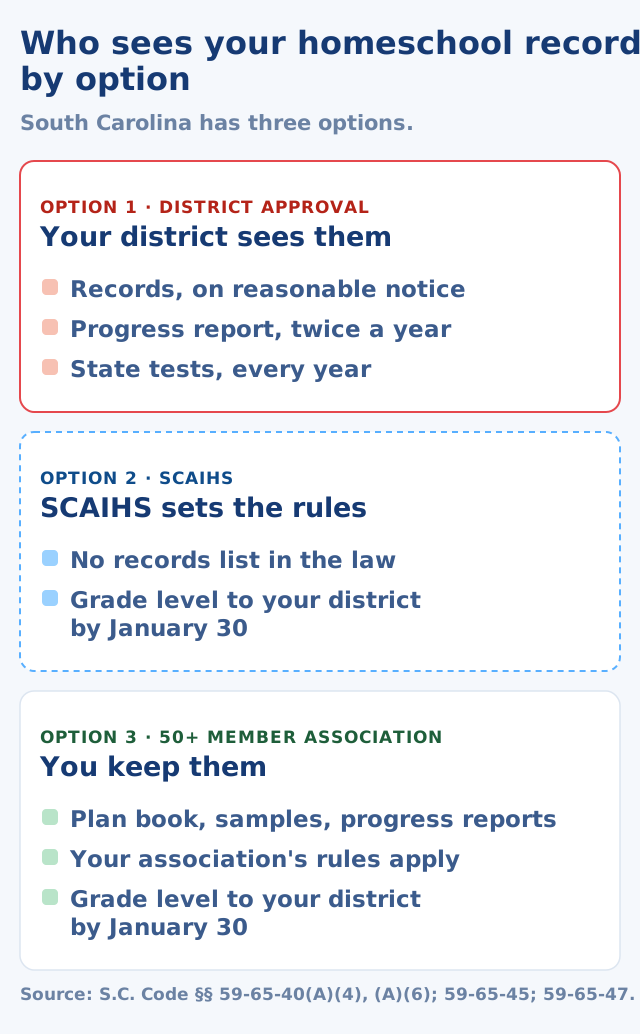
Under Option 1, you keep the records “for inspection upon reasonable notice by a representative of the school district.” The semiannual progress report “must be submitted to the school district” (§ 59-65-40(A)(4)).
If the district finds the program falls short of the standards, the board gives you 30 days to fix it. If it is not fixed, the board may withdraw its approval. You can appeal a denial to the State Board of Education within 10 days, and then to family court within 30 days (§ 59-65-40(A), (E)).
Under Option 3, the law says the records are “maintained by the parent-teacher” (§ 59-65-47(d)). It does not send them to the district. Your association’s own rules decide what it asks to see, so check them.
Under Options 2 and 3, the association tells your school district how many children it homeschools, and their grade levels, by January 30 each year (§ 59-65-45; § 59-65-47). SCDE does not monitor home schooling.
The South Carolina homeschool year, date by date
Good news: the law sets almost no calendar dates. Your district or association sets the rest.
| When | What | Option | Rule |
|---|---|---|---|
| Before you start | Apply to your district board and be approved | 1 | § 59-65-40(A), (B) |
| Before you start | Join SCAIHS or an association of 50 or more members | 2, 3 | § 59-65-45; § 59-65-47 |
| All year | Keep the plan book, work samples and attendance | 1, 3 | § 59-65-40(A)(4); § 59-65-47(d) |
| Twice a year | Semiannual progress report: sent to the district (Option 1), kept by you (Option 3) | 1, 3 | § 59-65-40(A)(4)(c); § 59-65-47(d)(3) |
| Every year | Statewide tests, given by a district employee | 1 | § 59-65-40(A)(6) |
| By January 30 | Your association reports your child’s grade level to your district | 2, 3 | § 59-65-45; § 59-65-47 |
| Across the year | At least 180 days of instruction | All | § 59-65-40(A)(2); § 59-65-45(b); § 59-65-47(b) |
How long to keep homeschool records in South Carolina
No South Carolina law sets a period. The homeschool statutes say what to keep, not for how long, and SCDE’s FAQ gives no number either.
HSLDA advises keeping homeschool records at least two years. It also advises keeping high school records, and proof that you followed the law in those years, for good. That is advice, not law.
There’s a good reason to keep high school work. SCDE says home school credits show on the transcript kept by you or your association, and other schools do not have to accept them automatically. Only accredited public high schools issue a South Carolina high school diploma.
Can your homeschool portfolio be digital?
The law does not say. South Carolina’s homeschool statutes never mention paper or digital records, and SCDE’s pages are silent too.
So it is your district’s call under Option 1, and your association’s under Options 2 and 3. Ask before you send. A printed copy works for anyone who wants paper.
What changes in 2026 and 2027
2026
No change to South Carolina’s homeschool sections in 2026. Sections 59-65-40, 59-65-45 and 59-65-47 were last amended in 1988, 1992 and 1996.
One 2026 law touches homeschoolers. Act No. 187 of 2026 says a home school athletic team in a home school athletic association may not be shut out of preseason and regular season play just for being a home school team. It does not change your records.
2027
No change is scheduled. The General Assembly’s 2027 session opens January 12, 2027, and no 2027 bill on home schooling has been filed.
Keeping your records in KidsFoldr
Snap each page for peace of mind, and the year’s binder lives on your phone instead of a shelf. The worksheet can go, kept for good as a scan, and the clutter goes with it. There is nothing to type: every page is filed by child, grade and type, with schoolwork and tests by subject too, and nobody sorts anything.
Keep the originals of official letters, like your district’s approval, and of high school work a school may need to check for credit. Everything else can be scanned, then tossed. Snap those letters anyway: every date on a letter from your district or association lands on your family calendar, linked back to the paper, with nothing to type.
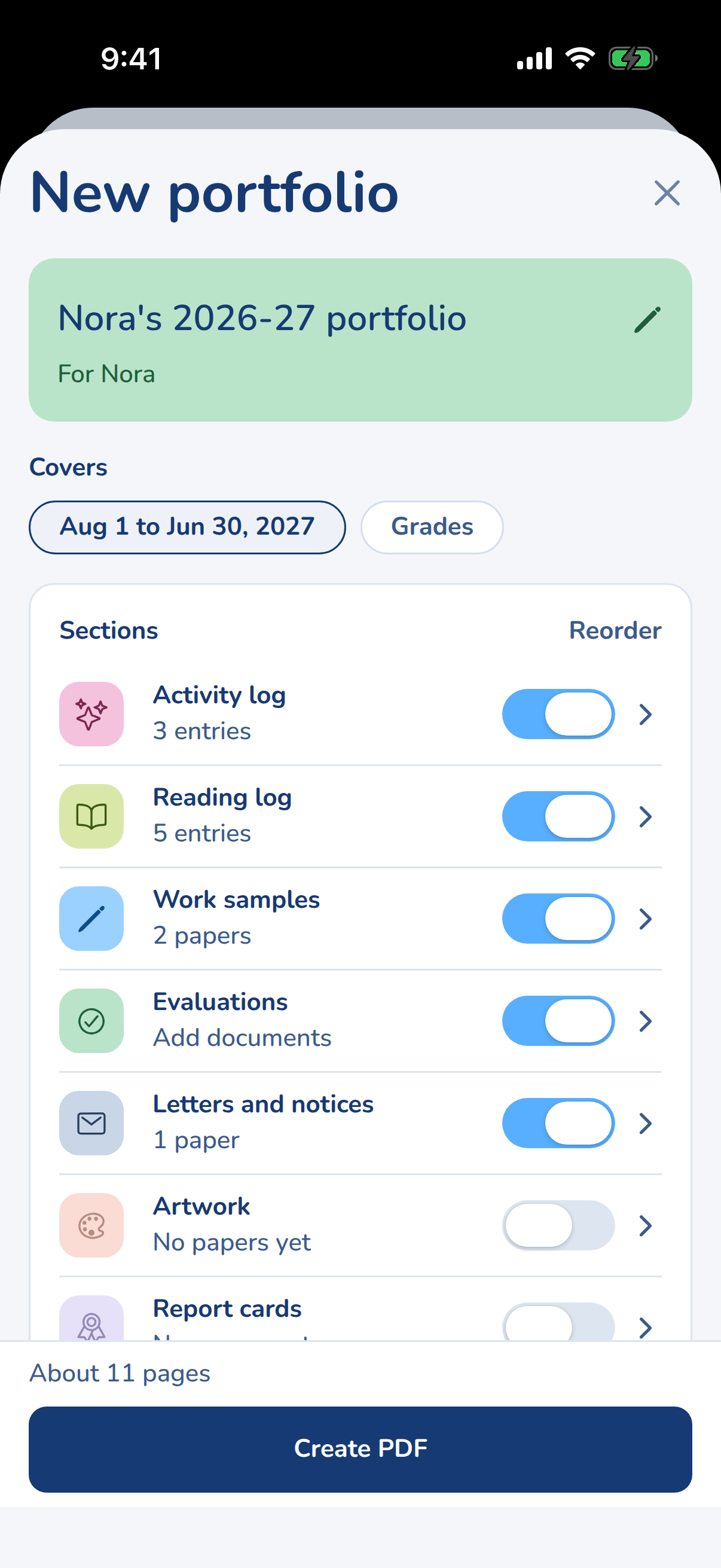
KidsFoldr works as a homeschool record keeping app that keeps up as you teach. When the half year ends, your progress report’s evidence is ready. Tap New portfolio, pick Dates, and set From and To to that half year. Add a Cover page and Contents, then Create PDF, and Share it or Print it.
You pick the sections. For South Carolina, you might switch on:
- Activity log (a date and what you did) for your plan book. Snap your plan book pages, or add entries as you go.
- Attendance or hours log for attendance. Fill from papers adds a day for each date your child has schoolwork, artwork or a test on file. Check it, then add the days you taught without paper.
- Work samples, grouped by Subject, for the portfolio of samples.
- Evaluations and Test results for Option 1’s record of evaluations and test scores.
- Letters and notices for your district’s approval or your association’s letters. Add a document brings each one in.
Turn on automatic backup, and every paper goes to KidsFoldr Cloud as it is filed. One tap on Back up copies every paper to your own Google Drive or iCloud. Every paper is searchable by any word on it.
Common questions
Do I send my portfolio to the school district?
Under Option 1, you keep it, and the district may inspect it on reasonable notice. Your semiannual progress report goes to the district. Under Options 2 and 3, no law sends your records to the district.
How long do I have to keep homeschool records in South Carolina?
No law sets a period. HSLDA advises at least two years, and high school records for good.
Do I have to track attendance?
Yes. Every option calls for at least 180 days, and under Options 1 and 3 the semiannual progress report includes attendance records.
Does my child take state tests?
Only under Option 1, every year, given by a district employee. SCAIHS sets its own testing, every other year from grade 3.
Can homeschoolers use the Education Scholarship Trust Fund?
No. SCDE says students homeschooled under any of the three options are not eligible.