
- Rhode Island law asks for no portfolio and no test. Your school committee approves your home instruction instead.
- Approval rests on three things: a school year about as long as public school’s, an attendance register you keep and return, and the required subjects taught well.
- You and your district agree on how you show progress, often with a year-end report.
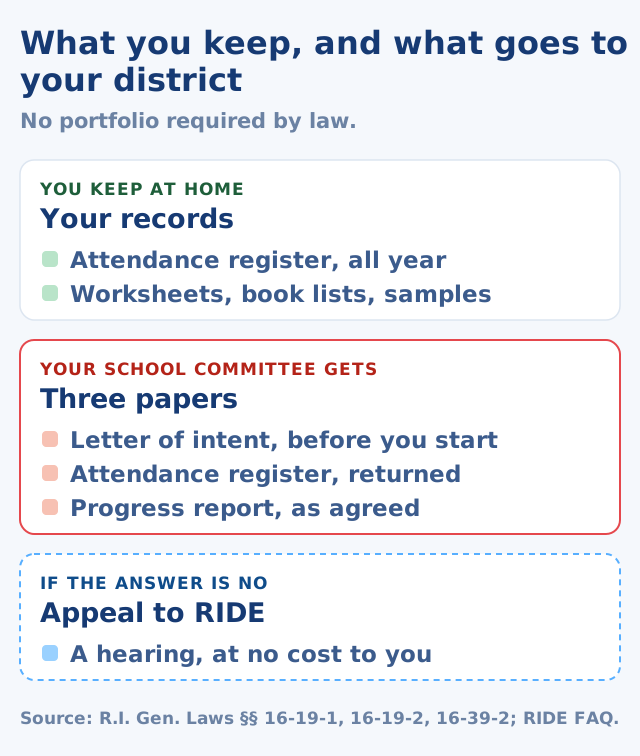
The paper that matters most is this year’s attendance register. Beside it sit the letter of intent you sent your school committee and the year-end progress report you agreed on. The year’s worksheets and book lists are your own records, and the report is drawn from them.
This page covers at-home instruction approved by your school committee, the home route in R.I. Gen. Laws §§ 16-19-1 and 16-19-2. The Rhode Island Department of Education (RIDE) does not supervise home instruction. Approval happens in your district, and your district may have its own homeschool policy.
What Rhode Island requires instead of a portfolio
Rhode Island’s statute asks for no portfolio, no work samples and no test. Instead, your school committee approves your home instruction (§ 16-19-1). The law says it may approve it “only when” three things hold (§ 16-19-2):
| Requirement | What the law says | Rule |
|---|---|---|
| Length of the year | “Substantially equal” to public school. Public schools run 180 days a year, or 1,080 hours | § 16-19-2; § 16-2-2 |
| Attendance register | Kept, and returned to the school committee, the superintendent, truant officers and RIDE, made “the same as” public school registers | § 16-19-2 |
| Required subjects | Taught in English, “substantially to the same extent” as in public school, and “thorough and efficient” | § 16-19-2; §§ 16-22-2, 16-22-4 |
You don’t need a teaching certificate. RIDE says you only need to show you can give instruction that is “thorough and efficient.”
The required subjects
Seven subjects come straight from § 16-19-2. Two more come from the curriculum chapter, which says no home instruction is approved without them (§§ 16-22-2, 16-22-4). RIDE’s list matches.
- Reading, writing, arithmetic and geography
- U.S. history, Rhode Island history and the principles of American government
- Civics
- Health and physical education, “similar to” what public schools teach
You may teach in another language too, as long as these subjects are also taught in English (§ 16-19-2).
The attendance register
The register is the one record the law names. Keep a dated record of each day you teach. The law says registers are kept and “returned” to the district (§ 16-19-2), and RIDE says to send reports to the person in charge of home instruction in your district.
When you send it is your district’s call. One example: West Warwick asks for attendance records by August 15 each year.
Getting approved: the letter of intent
You send your school committee a letter of intent that describes your plan, and the committee approves it (§ 16-19-1). RIDE says the plan should show you will teach the required subjects. It also says you and the committee should agree on how your child’s progress will be evaluated.
The Home School Legal Defense Association (HSLDA) says the letter should promise the required days, the subjects and an attendance register. HSLDA suggests sending it by certified mail, return receipt requested. That is advice, not law.
Can you start before approval?
The law protects home instruction that is approved by the school committee (§ 16-19-1). RIDE says you need approval before you begin. Some districts let you start once your letter is in (West Warwick does), so ask yours.
Every year?
The law doesn’t say approval is yearly. HSLDA says to send your letter each year, and some districts, such as West Warwick, renew approval each year. Your district’s policy tells you.
If the answer is no
You can appeal to RIDE. RIDE holds a hearing and decides, at no cost to you (§ 16-19-2; § 16-39-2).
Showing progress: the year-end report
The law sets no test, no evaluator and no portfolio. RIDE says you and your school committee should agree on a way to evaluate your child’s progress in every required subject. It may include testing, but it doesn’t have to.
Here’s the easy part: you get a say. If you test, you and your district agree on where, and testing at home or off school grounds can be part of the plan (RIDE). If you agree to test at home, RIDE says to keep the progress reports or test scores.
What does a report look like? One example: West Warwick takes a report card, narrative evaluations, dated work samples or other means. Its policy notes that Rhode Island law does not require annual or standardized testing.
What counts as a work sample?
Whatever your district agrees to. The law names none. If your report uses work samples, dated pages show progress across the year.
Examples, not rules: a dated math page from the fall and one from the spring, a writing piece, a book list, a lab sheet, a photo of a project. Cover every subject your report covers.
The Rhode Island homeschool year, date by date
Rhode Island has no statewide homeschool deadline. Your district’s policy sets the dates, and the public school year is the yardstick.
| When | What | Rule |
|---|---|---|
| Before you start | Letter of intent to your school committee. RIDE says get approval first | § 16-19-1; RIDE |
| All year | Teach about as long as public school (180 days or 1,080 hours there). Keep the attendance register | § 16-19-2; § 16-2-2 |
| When your district asks (often year end) | Return the register. Give the progress report you agreed on | § 16-19-2; RIDE |
| Each year, if your district asks | Renew your approval | HSLDA; your district |
| If you’re turned down | Appeal to RIDE, at no cost | § 16-19-2; § 16-39-2 |
You don’t have to start in September (RIDE). School is required from age 6 (by September 1, or once your child is in kindergarten) until 18 (§ 16-19-1).
How long to keep homeschool records in Rhode Island
The law sets no period. HSLDA advises keeping attendance records, book lists, work samples, letters with school officials and test results for at least two years. It advises keeping high school records forever. That is advice, not law.
Our advice: keep the register, the approval letters and each year’s report for good. They are a few pages a year, and they show the year happened.
Will your district accept a digital portfolio?
The law doesn’t mention digital records. It only asks that registers be made “the same as” public school registers (§ 16-19-2).
So whether a digital homeschool portfolio or register works is your district’s call. Ask before you send. A printed copy works for anyone who wants paper.
What changes in 2026 and 2027
2026
No change to Rhode Island’s homeschool law in 2026. Section 16-19-2 has read the same since 1984, and no 2026 law touches it.
One bill tried. H 8531 would have let a school committee deny or put off approval in some cases, such as a pending truancy case or doubts about a parent’s “competency” and “capacity” to teach. It would also have kept an enrolled child in school while the request was pending. The House Education Committee held it for further study, and it did not pass.
2027
No change is scheduled. The General Assembly’s 2027 session opens January 5, 2027.
Until the law changes, the three conditions above stay the same, even if your district updates its policy.
Keeping the year in KidsFoldr
Snap each worksheet as it’s done, and it’s filed under your child, grade, type and subject, with no sorting and nothing to type. Then the stack can go: scan it for peace of mind, toss it, and the counter stays clear. Keep the originals your district may want, like the approval letter and the year-end report.
- Your day count keeps up. In a portfolio’s Attendance or hours log, Fill from papers adds a day for each date your child has work on file. You check it and add the rest.
- Your district’s dates land on your calendar. Snap the approval letter or a notice from your district, and any date it sets, like a due date for the register or a renewal date, goes on the family calendar, linked back to the paper.
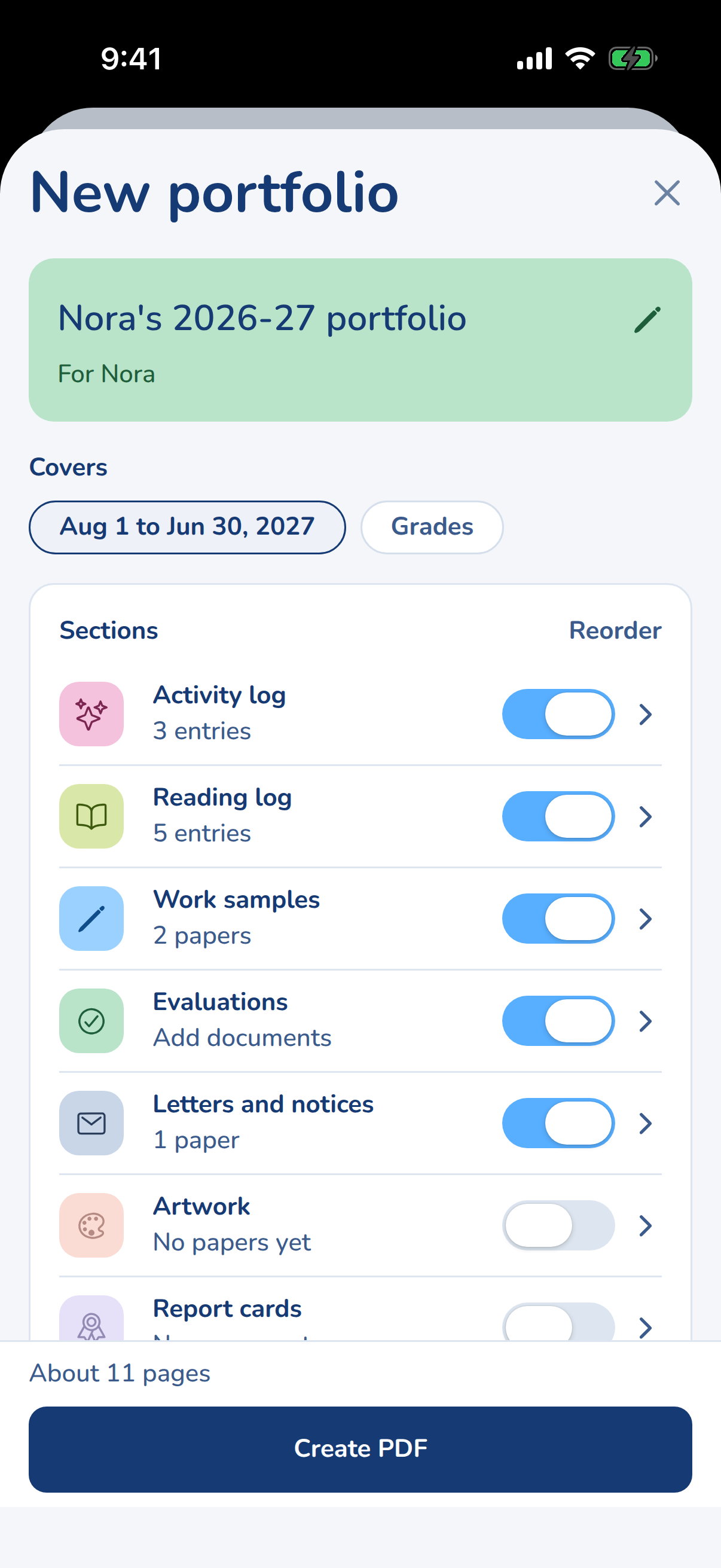
- The year-end report is ready when the district asks. Start a New portfolio for your district’s year, with work samples grouped by date, a parent summary in your own words and test results if you test. Then share or print the PDF.
- The paperwork stays together. Your letter of intent and approval letter go in Letters and notices.
- Keepsakes stay safe. Turn on automatic backup, and every paper goes to KidsFoldr Cloud as it is filed. One tap on Back up copies every paper to your own Google Drive or iCloud.
You choose which sections your district wants.
Common questions
Does Rhode Island require a homeschool portfolio?
No. The law asks for school committee approval, an attendance register and the required subjects. You show progress the way you and your district agree.
Do I need a teaching certificate?
No. RIDE says you only need to show you can give instruction that is “thorough and efficient.”
Is standardized testing required?
Not by law. Testing is one way to show progress, if you and your district agree on it.
How long do I have to keep homeschool records in Rhode Island?
The law sets no period. HSLDA advises at least two years for most records, and high school records forever.
What if my school committee says no?
You can appeal to RIDE. It holds a hearing and decides, at no cost to you (§ 16-19-2; § 16-39-2).