- No portfolio, notice, test or evaluation is required by law. N.J.S.A. 18A:38-25 asks only that your child “receive equivalent instruction elsewhere than at school.”
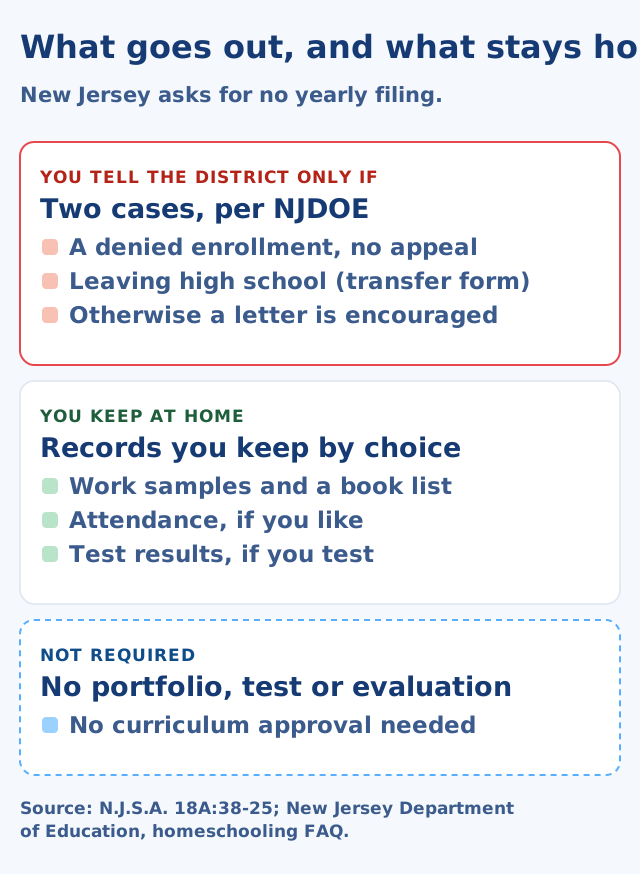
- You must tell the district in just two cases: after a denied enrollment you don’t appeal, and when you take a teen out of high school. Otherwise the state education department encourages a letter.
- Nothing is filed each year. Keeping records is smart, not required. HSLDA suggests at least two years, and high school records forever.
So what paper are you holding? The records you keep by choice: work samples, a list of books and curriculum, maybe an attendance log, and test results if you test. Beside them sit any letter you sent the school district or got back from it, and a high school transfer form if you used one.
The whole law is one clause in New Jersey’s compulsory education statute. It has read the same since 1967.
Does New Jersey require a homeschool portfolio?
No. Not one New Jersey statute asks a homeschooling family for a portfolio, a record, a test or an evaluation (N.J.S.A. 18A:38-25).
The New Jersey Department of Education (NJDOE) says the same in its homeschooling guidance. Your local board of education is not required or authorized to approve your curriculum, monitor your child’s results or test your child.
A bill in the Legislature would add a portfolio. It is not law; see what changes in 2026 and 2027.
What counts as a work sample?
New Jersey doesn’t define one, because it doesn’t require one. The Home School Legal Defense Association (HSLDA) recommends keeping samples anyway, along with book and workbook lists, attendance, letters with school officials, and test results.
HSLDA’s reason: records prove your child’s education for college, the military or a job, and they help if questions ever come up. Examples, not rules: a dated math page, a writing assignment, a science lab sheet, a book list.
What the law does ask: equivalent instruction
Every parent of a child between 6 and 16 must make sure the child attends public school, a day school with equivalent instruction, or receives “equivalent instruction elsewhere than at school” (N.J.S.A. 18A:38-25). NJDOE reads that last phrase as permission to teach at home.
What does “equivalent” mean? NJDOE points to a 1967 court case, State v. Massa. The court held that parents need show only that their teaching is academically equivalent to the local public school, not that it copies the social side of school.
You don’t need a teaching certificate. And you pick the program: NJDOE says parents are responsible for the child’s educational outcomes, and the state and the district are not required or authorized to approve it.
HSLDA adds that “equivalent” doesn’t mean “identical.” For comparison, it lists what New Jersey public schools teach, from language arts, math and science to history, civics and health. That’s HSLDA’s guide, not a rule.
When you have to tell the district
Usually you don’t. NJDOE names just two cases where a parent is required to inform the district:
- A denied enrollment. If a district refuses to enroll your child and you don’t appeal, you’re asked for a written statement of where your child will be taught, such as instruction elsewhere than at school (N.J.A.C. 6A:22-4.1).
- Leaving high school. If you take a teen out of high school, you fill in the district’s transfer form, which records that you will teach elsewhere than at school.
In every other case, NJDOE “encourages” a letter to your local board of education, so that questions don’t come up later. It’s a good habit, not a rule.
If the district asks. A district may ask for documentation, such as a letter of intent, only when it has credible evidence your child isn’t being educated. NJDOE says that withdrawing a child to homeschool is not, by itself, credible evidence.
HSLDA notes that some districts ask for notice or approval the law doesn’t require.
The New Jersey homeschool year, date by date
Here’s the easy part: New Jersey has no homeschool deadline at all. These are the only moments the rules touch.
| When | What | Rule |
|---|---|---|
| Ages 6 to 16 | Equivalent instruction at home (or school) | N.J.S.A. 18A:38-25 |
| When you start | Nothing to file. A letter is encouraged | NJDOE |
| After a denied enrollment you don’t appeal | A written statement of where your child will be taught | N.J.A.C. 6A:22-4.1; NJDOE |
| Leaving high school | The district’s transfer form | NJDOE |
| Only on credible evidence | The district may ask for documentation, such as a letter of intent | NJDOE |
| Each year | Nothing to file. No test, no evaluation | N.J.S.A. 18A:38-25; NJDOE |
How long to keep homeschool records in New Jersey
New Jersey law sets no period, because it requires no records.
HSLDA advises keeping records for at least two years. It says to keep high school records, and proof you followed the law in those years, forever. That’s advice, not law.
High school is where records matter most. NJDOE says the board doesn’t issue a state-endorsed diploma to a homeschooled child, and a teen who returns to school is placed by the district’s own assessment. Your records are the story of those years.
Can New Jersey homeschool records be digital?
Yes. Nothing in the statute or NJDOE’s guidance says what form your records take.
New Jersey has no evaluator and no yearly filing, so no one has to accept a digital portfolio. If anyone ever wants paper, a printout covers it.
What changes in 2026 and 2027
2026
No change. N.J.S.A. 18A:38-25 still reads as it did in 1967.
Several bills filed in 2026 would add rules. All are in committee, and none is law.
| Bill | What it would do | Status |
|---|---|---|
| Assembly Bill 3394 | Register each year by August 1 (or within 14 days of starting); send a curriculum aligned with state standards; keep a portfolio with a yearly evaluation and send it to the superintendent by June 30 | In committee |
| Senate Bill 3910 | A yearly letter to the superintendent by August 1, with each child’s name, birth date, grade and teacher | In committee |
| Assembly Bill 1886 | A yearly letter to the superintendent by August 15 | In committee |
| Assembly Bill 1341 and Senate Bill 741 | A yearly meeting with a district counselor, nurse or social worker | In committee |
Similar registration and meeting bills were filed in 2025. They died in committee when that session ended.
2027
Nothing is scheduled to change. New Jersey’s Legislature runs in two-year sessions, so the 2026 bills stay alive until the session ends in January 2028.
If you want to be sure before a new school year, check each bill on the Legislature’s site. Until a bill becomes law, the rules above stand.
Keeping New Jersey records in KidsFoldr
Picture a whole year of records with no binder to keep, no pile to sort and nothing to type. Snap a page as you teach, and KidsFoldr files it under your child, grade and subject. Then the worksheet can go: scan it for peace of mind, then toss it.
Keep the originals that matter on paper, though. That’s any letter to or from the district, the high school transfer form, and high school work you may need for credit or a diploma.
When a paper has a date on it, such as a letter from the district, a test day if you choose to test, or a co-op calendar, snap it. The date lands on the family calendar, linked back to the paper, with nothing to type.
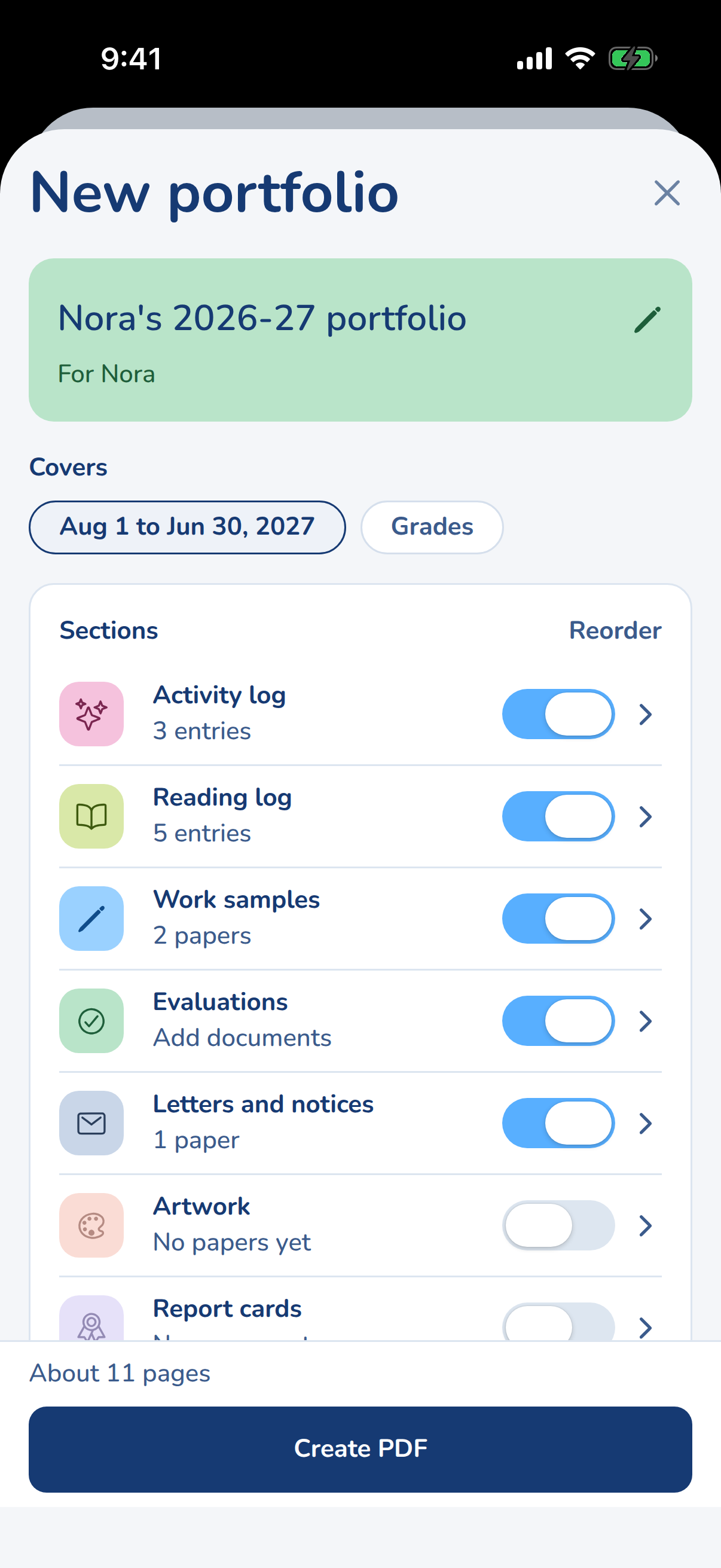
New Jersey asks for no portfolio, but one is there if you want it. Your work samples file by subject, and the Attendance or hours log can fill itself from the days your child did schoolwork, for you to check. Pick dates or grades, and the year is a PDF to share or print.
Turn on automatic backup, and every paper goes to KidsFoldr Cloud as it is filed. One tap on Back up copies every paper to your own Google Drive or iCloud.
Common questions
Do I need a portfolio to homeschool in New Jersey?
No. New Jersey law asks for equivalent instruction and sets no portfolio, record, test or evaluation (N.J.S.A. 18A:38-25).
Do I have to notify my school district?
Only in two cases: after a denied enrollment you don’t appeal, and when you take a teen out of high school. Otherwise NJDOE encourages a letter but doesn’t require one.
Does my child have to take a test?
No. NJDOE says a homeschooled child doesn’t have to take a state or district test, and the district isn’t authorized to test them.
How long should I keep homeschool records in New Jersey?
New Jersey law sets no period. HSLDA advises at least two years, and high school records forever.
Do I need a teaching certificate?
No. NJDOE says a parent teaching at home doesn’t need to be a certified New Jersey teacher.