- There is no portfolio by that name. You keep documentation at home: class schedules, copies of the materials you teach with, how you assess progress, and proof of the yearly test.
- Every year from 7 through 16, your child takes a nationally norm-referenced achievement test. You keep the results. They don’t go to the district.
- Send your district superintendent an initial report by October 1 of your first year, then a letter of intent by October 1 every year after.
The paper here is one child’s records folder: the class schedule, copies of what you teach with, a note on how you check progress, and this year’s test score report. Two papers go to the district: the initial report and, each year after, a letter of intent.
This page covers a home school under Minnesota Statutes §§ 120A.22 and 120A.24, with a parent teaching. An accredited school, person or institution runs on lighter rules. See which route you’re on.
Does Minnesota require a homeschool portfolio?
Not by that name. The word “portfolio” isn’t in either statute. But the law does ask you to keep a records file at home (§ 120A.24, subd. 2).
The file must show that the required subjects are being taught and that the yearly test was given. It “must include”:
- Class schedules
- Copies of materials used for instruction
- Descriptions of methods used to assess student achievement
Keep proof of the yearly test in the same file.
The required subjects are four areas (§ 120A.22, subd. 9):
- Reading and writing, literature and fine arts
- Math and science
- Social studies: history, geography, economics, government and citizenship
- Health and physical education
Here’s the easy part. The law sets no format, no number of pages and no hours or days.
What counts as a work sample?
Minnesota doesn’t ask for “work samples” by name. It asks for copies of the materials you teach with (§ 120A.24, subd. 2).
Examples, not rules: a page from the math book, a worksheet your child filled in, the year’s book list, a science lab sheet. Our advice: a few pieces per subject over the year show clearly that each subject was taught.
Who sees your records
They stay with you. The law gives no one a routine look. A county attorney can ask for the documentation only once a truancy or child-protection case has been opened or diverted (§ 120A.24, subd. 2(c)).
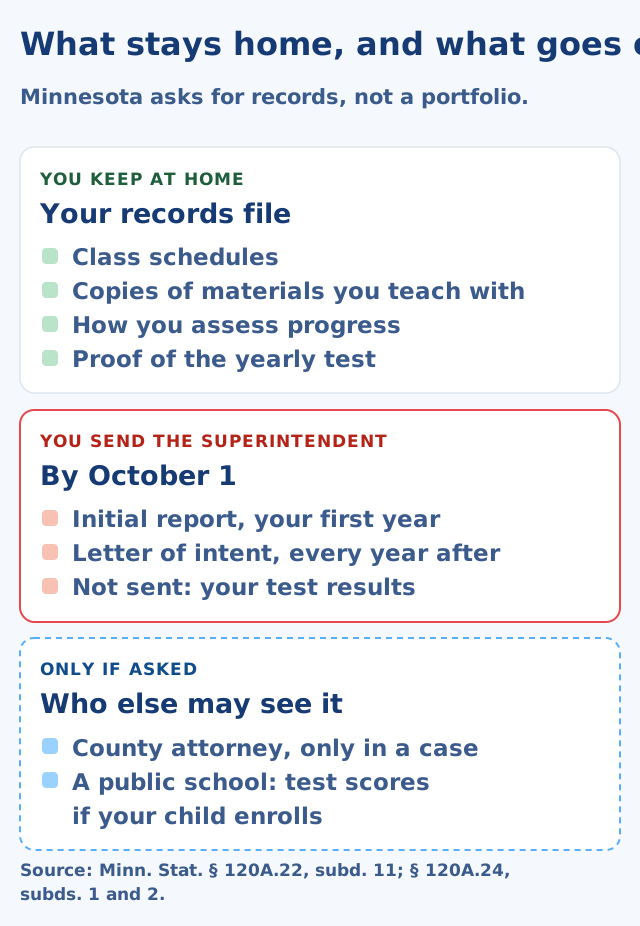
If your child enrolls full time in a public school, you give the school your child’s test scores. You also give any other education documents the school needs to place your child (§ 120A.24, subd. 2(b)).
If a superintendent thinks something is missing, the law starts gently. You get a written notice listing the specific problem, and 15 days to fix it (§ 120A.26, subds. 3 and 4).
The yearly test
Every year from age 7 through 16, your child takes a nationally norm-referenced standardized achievement test (§ 120A.22, subd. 11). A child whose first report was filed after turning 16 tests through 17.
- You and your superintendent agree on which test, and where and how it is given.
- If the test skips a required subject, you assess that subject yourself. This applies only if you aren’t a licensed teacher or supervised by one.
- If the total battery score is at or below the 30th percentile, or one grade level below children the same age, you get an additional evaluation to check for learning problems.
The results stay in your records file. Nothing in the law sends them to the district (§ 120A.24, subd. 2).
The test also does a second job: it qualifies you to teach. The law lists five instructor options: a Minnesota teaching license, supervision by a licensed teacher, teaching in an accredited school, a bachelor’s degree, or being the parent of a child tested each year (§ 120A.22, subd. 10).
Older guides may list a teacher competency exam as a sixth option. It was dropped in 2023.
The October 1 report and letter of intent
Your first year, you send your superintendent an initial report by October 1. Every year after, you send a letter of intent by October 1 (§ 120A.24, subd. 1).
The initial report lists:
- Your child’s name, birth date and address
- The test you plan to use
- The name of each instructor
- Evidence of one instructor qualification (a parent qualifies through the yearly test)
It’s due by October 1 of the first school year after your child turns 7. If you withdraw your child from public school, it’s due within 15 days.
Moving? The statute says a report is due within 15 days of moving out of a district, and by October 1 after you settle in the new one. HSLDA reads this as telling your new district within 15 days.
The letter of intent says you’ll keep teaching, plus any changes to the initial report. It’s due every October 1 while your child is 7 to 16 (§ 120A.24, subd. 1(b)).
Your district may offer an online form, but it can’t make you use one (§ 120A.24, subd. 1(c)).
One more paper: the immunization statement goes to the superintendent by October 1 of your first homeschool year in Minnesota, and again in grade 7 (§ 121A.15, subd. 8).
The Minnesota homeschool year, date by date
Minnesota runs on one date: October 1. For the yearly test, you and your superintendent agree on which test, and how and where it is given.
| When | What | Rule |
|---|---|---|
| By October 1 of the first year after your child turns 7 | Initial report | § 120A.24, subd. 1(a) |
| Within 15 days of leaving public school or moving out of a district | Initial report | § 120A.24, subd. 1(a) |
| By October 1, every year after | Letter of intent, with any changes | § 120A.24, subd. 1(b) |
| By October 1 of the first year, and in grade 7 | Immunization statement | § 121A.15, subd. 8 |
| Once a year, ages 7 through 16 | Achievement test you agreed on with the superintendent | § 120A.22, subd. 11 |
| All year | Keep schedules, materials, how you assess and proof of the test | § 120A.24, subd. 2 |
How long to keep homeschool records in Minnesota
Minnesota law sets no retention period (§§ 120A.22, 120A.24).
HSLDA advises keeping attendance records, textbook and workbook information and work samples for at least two years. It advises keeping high school records, and proof you followed the law in those years, forever. That’s advice, not law.
Our advice: keep every year’s test score report until your child finishes school. A public school asks for the scores if your child enrolls (§ 120A.24, subd. 2(b)).
Home school or accredited school: which rules apply
The testing and records rules on this page are for a home school with a parent teaching. A school, person or institution accredited by an agency the state recognizes is exempt from both (§ 120A.22, subd. 11(d); § 120A.24, subd. 3).
| Route | Law | Yearly test? | Records file? | October 1 reports? |
|---|---|---|---|---|
| Home school, parent teaching | §§ 120A.22, 120A.24 | Yes | Yes | Yes |
| Accredited school, person or institution | § 120A.22, subd. 11(d); § 120A.24, subd. 3 | No | No | Yes |
The state’s Nonpublic Education Council recognizes the accrediting agencies (§ 123B.445).
Is a digital homeschool portfolio accepted?
Minnesota law says nothing about paper or digital records. And there’s no evaluator here to accept or reject them (§ 120A.24).
The one format rule runs in your favor: your district can’t make you report online (§ 120A.24, subd. 1(c)).
A public school placing your child, or a county attorney in a case, decides what it takes. A printed copy works for anyone who wants paper.
What changes in 2026 and 2027
2026
No change to Minnesota’s home school law. The 2026 session’s list of statutes it changed includes no part of chapter 120A, and there was no special session.
The last home school change came in 2023, when the teacher competency exam dropped out of the instructor options. The 2026 changes to the immunization law were child care rules, not the home school statement.
2027
No change is scheduled. The legislature meets January 12, 2027 (§ 3.011). Your next letter of intent is due by October 1, 2027.
Keeping the records in KidsFoldr
The records file can build itself as you teach. Snap a worksheet, and KidsFoldr files it under your child, grade and subject, with nothing to type and nothing to sort. Then the page can go: scan it for peace of mind, then toss it.
No binder on the shelf, no stack on the counter: years of records fit on your phone.
- Organized with zero effort. Every paper is filed by child, grade, type and subject, and you can find it later by any word on it.
- Keeping up. A test score report that arrives by email or as a PDF files the same way. Share it to KidsFoldr or forward it.
- The papers that matter, safe. Scan the score report and anything from your superintendent for peace of mind. Keeping the paper too is your call.
- Dates on the family calendar. Snap a letter from your superintendent or the confirmation for the yearly test, and any date on it lands on the family calendar, linked back to the paper. Nothing to type.
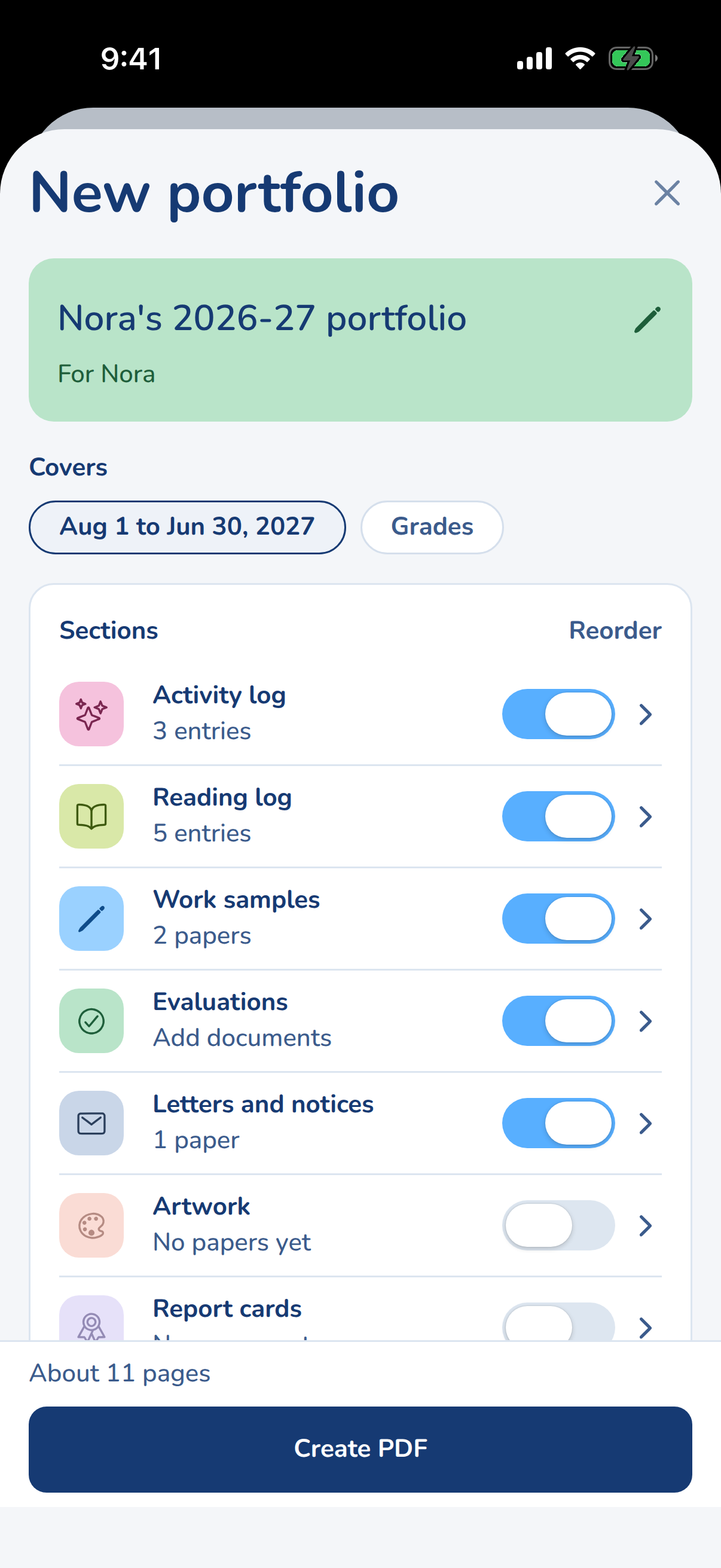
- The year’s records, on demand. Pick the school year by dates or grades, and it becomes one PDF to share or print.
- Keepsakes kept. Turn on automatic backup, and every paper, artwork included, goes to KidsFoldr Cloud as it is filed. One tap on Back up copies every paper to your own Google Drive or iCloud.
When you build a portfolio, you pick the sections and their order. For Minnesota’s list, you might use:
- An activity log (a date and what you did) for class schedules
- Work samples, grouped by subject, and a reading log for the materials you teach with
- A parent summary, in your own words, for how you assess
- Test results for the yearly score report
- Letters and notices for your initial report and letters of intent
Common questions
Do I send my homeschool records to the school district?
No. They stay with you. A county attorney can ask for them only in a truancy or child-protection case, and a public school asks for test scores if your child enrolls.
Do I send my child’s test scores to the superintendent?
No. You keep proof of the test in your records file (§ 120A.24, subd. 2).
When is the letter of intent due?
By October 1 every year. Your first year, you send the initial report by October 1 instead.
How long do I have to keep homeschool records in Minnesota?
Minnesota law sets no period. HSLDA advises at least two years, and high school records forever.
Do I have to track attendance or hours?
No. Minnesota law sets no hours or days for a home school. HSLDA suggests keeping attendance records anyway, as advice.