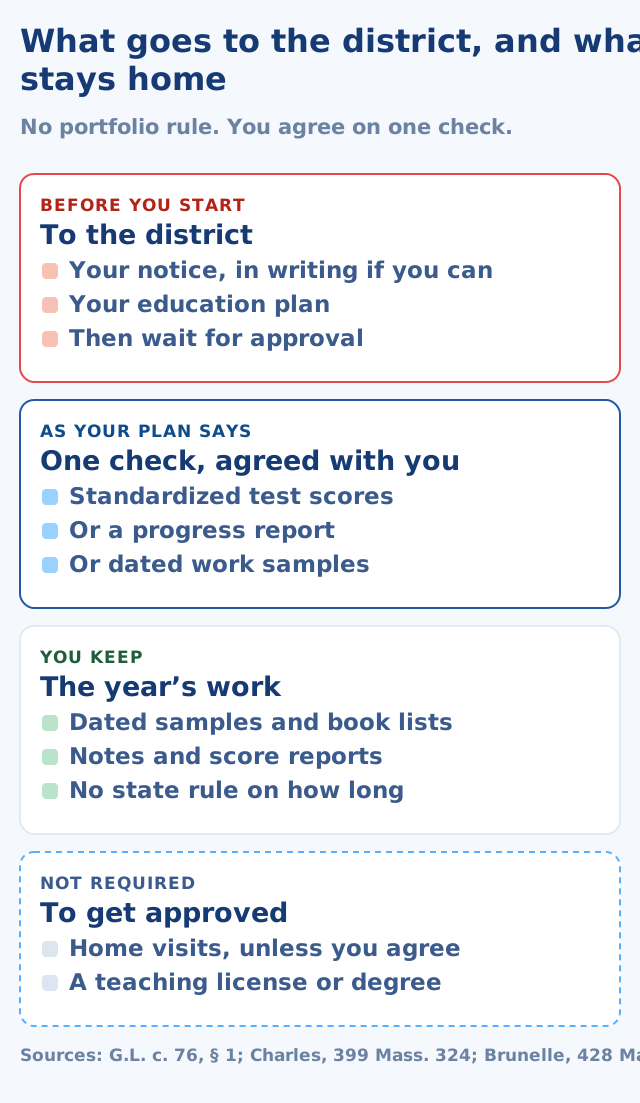
- Massachusetts law never uses the word “portfolio.” What you need is your district’s approval of an education plan, before you start.
- The district checks progress the way you agree with it: a standardized test, a progress report or dated work samples.
- No home visits without your consent, no teaching license, and no state rule on keeping records.
The papers here are the education plan you send your superintendent or school committee, the approval letter if your district sends one, and the evaluation you hand in later. Behind them sits the year’s work you keep at home.
Massachusetts has no homeschool statute. The rules come from one clause of the school attendance law, G.L. c. 76, § 1, which excuses a child “otherwise instructed in a manner approved in advance by the superintendent or the school committee.” Two Supreme Judicial Court cases fill in the rest: Care and Protection of Charles (1987) and Brunelle v. Lynn Public Schools (1998).
Do you need a homeschool portfolio in Massachusetts?
No. The word “portfolio” isn’t in the statute, the regulations or the court rulings. Some district policies use it, so read yours, but no state rule asks for one.
What you do send is simpler. You tell your district you plan to homeschool, send an education plan, and later share the evaluation you agreed on (DESE; Charles).
Each school committee sets its own homeschool policy, and the district where you live approves your plan. The state education department (DESE) doesn’t approve plans or review a district’s decision. Neither do charter schools, virtual schools or school choice districts (DESE).
This applies to children ages 6 to 16 (DESE). School starts in September of the calendar year your child turns 6 (603 CMR 8.02).
Public school rules like teacher licensing and structured learning time don’t apply to you (DESE).
What goes in your education plan
Your district may look at four things, all from the Charles decision. Here they are, with the lines it can’t cross.
| The district may ask about | What that means | What it may not do | Source |
|---|---|---|---|
| Curriculum and hours | Your subjects, the hours of instruction in each, and the length of your year | Hold you to the public school learning-time rules | Charles, 399 Mass. at 338-339; DESE |
| Your qualifications | Your background as the teacher | Require a teaching certificate or a college degree | Charles, at 339 |
| Your materials | Textbooks, workbooks, lesson plans, to compare subjects and grade level | Tell you how to teach | Charles, at 339 |
| How progress is checked | A test, a progress report or dated work samples, agreed with you | Require home visits as a condition of approval, without your consent | Charles, at 339-340; Brunelle, 428 Mass. at 515, 519 |
The court set one more limit. Approval can’t hinge on anything that isn’t essential to making sure your child gets an education (Charles, at 337).
DESE says districts typically review a plan’s content, materials, how often and how long you teach, your methods, the evaluation, and whether your child can make adequate progress.
The required subjects
Charles compares a home plan with the public school subject list in G.L. c. 71, § 1. That list is spelling (“orthography”), reading, writing, English language and grammar, geography, arithmetic, drawing, music, U.S. history and the Constitution, citizenship, health education, physical education and good behavior.
The school committee may add other subjects it considers “expedient” (G.L. c. 71, § 1).
How your district checks progress
Charles lets a district require “periodic standardized testing.” In its place, with your approval, it can take “periodic progress reports or dated work samples” (Charles, at 339-340).
| Option | What you send | Good to know | Source |
|---|---|---|---|
| Standardized test | The score report | You and the district settle on the test and where it’s given. Where practical, a neutral person gives it. | Charles, at 339-340 |
| Progress report | A written summary of what your child learned | Brunelle describes it: the subjects, areas and materials covered, and what’s planned next | Charles, at 340; Brunelle, at 518 |
| Dated work samples | A few pieces of your child’s work, each one dated | No number is set | Charles, at 340 |
Name your method in the plan. Advocates for Home Education in Massachusetts (AHEM) suggests it, so everyone knows what to expect at year end.
What counts as a dated work sample?
Any piece of your child’s work with a date on it. The law sets no count, no subject minimum and no schedule.
Examples, not rules: a dated math page, a short essay, a science lab sheet, a photo of a project.
Learning doesn’t have to come from a workbook. Brunelle names travel, community service, visits to educational places and meeting people who teach something (Brunelle, at 518).
The Massachusetts homeschool year, step by step
There’s no statewide deadline. The order is what matters: approval comes before you start (Charles, at 337).
| When | What | Source |
|---|---|---|
| Before you start | Tell your district you plan to homeschool, preferably in writing | DESE |
| Next | The district sends its policy and process and asks for your plan | DESE |
| Next | You send your education plan | DESE; Charles |
| Within a reasonable period | The district approves it, asks for changes or more information, or says no, preferably in writing | DESE |
| If it says no | It gives its reasons, and you get a chance to revise. You can explain your plan at a hearing. | Charles, at 337-338 |
| All year | Teach, and keep the year’s work | Advice |
| When your plan says | The evaluation you agreed to | Charles, at 339-340 |
| Each year, in practice | Most districts ask for a new plan. The law sets no schedule. | HSLDA; Charles |
Please don’t pull your child out before you’re approved. DESE says notice alone doesn’t let you start, and a child taken out without an approved plan is truant.
How long to keep homeschool records in Massachusetts
No law sets a period. In fact, no law asks you to keep homeschool records at all.
HSLDA advises keeping records at least two years, and high school records for good. That’s advice, not law.
Our advice: keep each year’s plan, approval letter and evaluation together with that year’s work. If your district ever has a question, the answer is in one place.
Will your district accept a digital portfolio?
The law doesn’t say. Nothing in G.L. c. 76, § 1, Charles, Brunelle or DESE’s page requires paper or mentions digital records.
So your district decides what format it takes. Ask before you send. A printed copy works for anyone who prefers paper.
What changes in 2026 and 2027
2026
No change. G.L. c. 76, § 1 reads the same, and Charles and Brunelle still set the rules.
One homeschool bill was filed in 2025. H.518 would swap district approval for a one-time letter to DESE and drop required testing unless the parent opts in. It got a hearing and no vote, and it sits in the Joint Committee on Education. It is not law.
2027
No change is scheduled. A new Legislature starts January 6, 2027, and any bill that didn’t pass in 2025-2026 has to be filed again.
Your plan and your evaluation still follow your district’s policy.
Keeping the year’s work in KidsFoldr
The stack of worksheets can go, and the year’s work stays organized with zero effort and nothing to type. Snap each page as you teach, and KidsFoldr files it by child, grade and type, with schoolwork and tests by subject too. Nobody sorts anything, and a name at the top of a page files it under that child.
- Toss the paper with no guilt. Scan a page for peace of mind, then toss it: no pile on the counter, no shelf of binders. Keep the originals of your district’s approval letter and any other official letters, and of your child’s high school records.
- Your work samples are dated already. Every paper keeps its date, and each sample in the portfolio prints with its title and date.
- The evaluation date is on your calendar. Snap the approval letter, and any evaluation date it sets lands on the family calendar, linked back to the letter. A date in your plan works the same way.
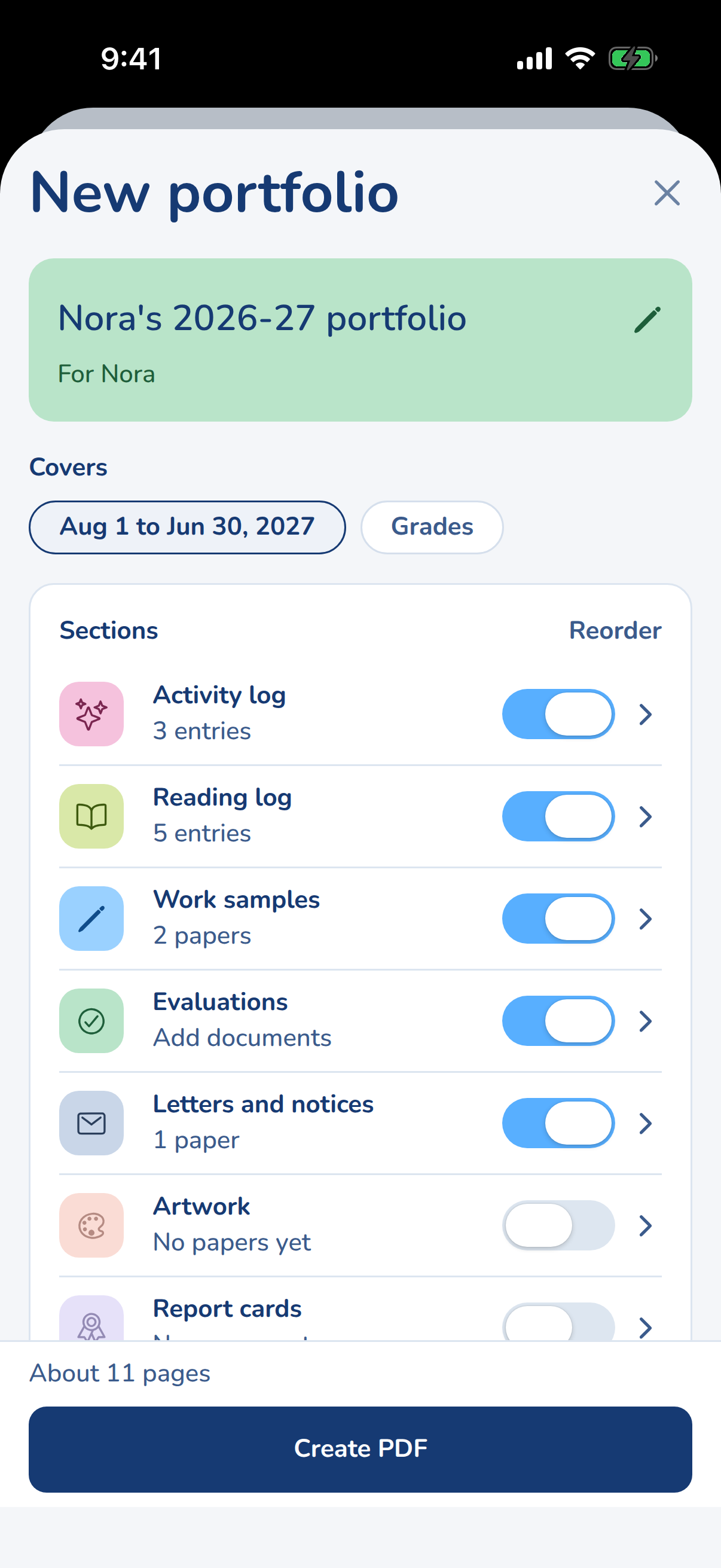
- The year is ready when the district asks. Start a New portfolio, pick the dates or grades, and switch on the sections your plan names. You get one PDF with a cover and contents.
- Share or print it with a single click. You can also share your child’s Portfolios folder read-only.
- Keepsakes stay safe, artwork included. Turn on automatic backup, and every paper goes to KidsFoldr Cloud as it is filed. One tap on Back up copies every paper to your own Google Drive or iCloud.
You pick the sections and their order. For Massachusetts:
- Dated work samples: Work samples, grouped by date. Add Artwork if you like.
- A progress report: the Parent summary, in your own words, on what they learned and what’s next. Add the Reading log and Activity log if your report lists books and outings.
- A standardized test: Test results, for the score report.
- Your plan and the approval letter: Letters and notices, with scans of each.
Common questions
Do I need a portfolio to homeschool in Massachusetts?
No. No state law asks for one. You need an approved education plan, and the evaluation you agreed on: a test, a progress report or dated work samples.
Can I start homeschooling before my district approves my plan?
No. Approval comes in advance (Charles). DESE says a child taken out of school without an approved plan is truant.
Do I need a teaching license?
No. A district may ask about your qualifications, but it can’t require a teaching certificate or a college degree (Charles).
Can the district visit my home?
Not as a condition of approving your plan, unless you agree (Brunelle).
Do I send a new plan every year?
The law sets no schedule. HSLDA finds most districts ask every year, so check your district’s policy.
How long do I keep homeschool records in Massachusetts?
No law sets a period. HSLDA advises at least two years, and high school records for good.