
- Maine asks for a yearly assessment, not a portfolio. A certified Maine teacher’s review or a support group review of your child’s portfolio is one way to do it; a test is another.
- First year: send a notice of intent within 10 days of starting. No assessment is due yet.
- Every year after: by September 1, send a letter that you’re continuing, with a copy of last year’s assessment.
The paper in your hand is this year’s assessment for one child: a certified teacher’s review letter, a support group’s acceptance or a test summary page. Behind it sits the portfolio of work it rests on. Beside it are your Notice of Intent and the acknowledgment email that came back.
This page covers home instruction under 20-A M.R.S. § 5001-A(3)(A)(4). If your child is enrolled in a private school, see which route you’re on.
Does Maine require a homeschool portfolio?
Not on its own. Maine calls homeschooling “home instruction,” and its law asks for an annual assessment of your child’s academic progress. The word “portfolio” shows up once, in one of the five assessment options: presenting your child’s educational portfolio to a local homeschool support group that includes a certified Maine teacher or administrator.
In practice, a portfolio sits behind another option too. The Department of Education describes a certified teacher’s review as a portfolio review: the teacher looks at items such as the attendance record, lesson plans and sample work to see whether your child made adequate progress.
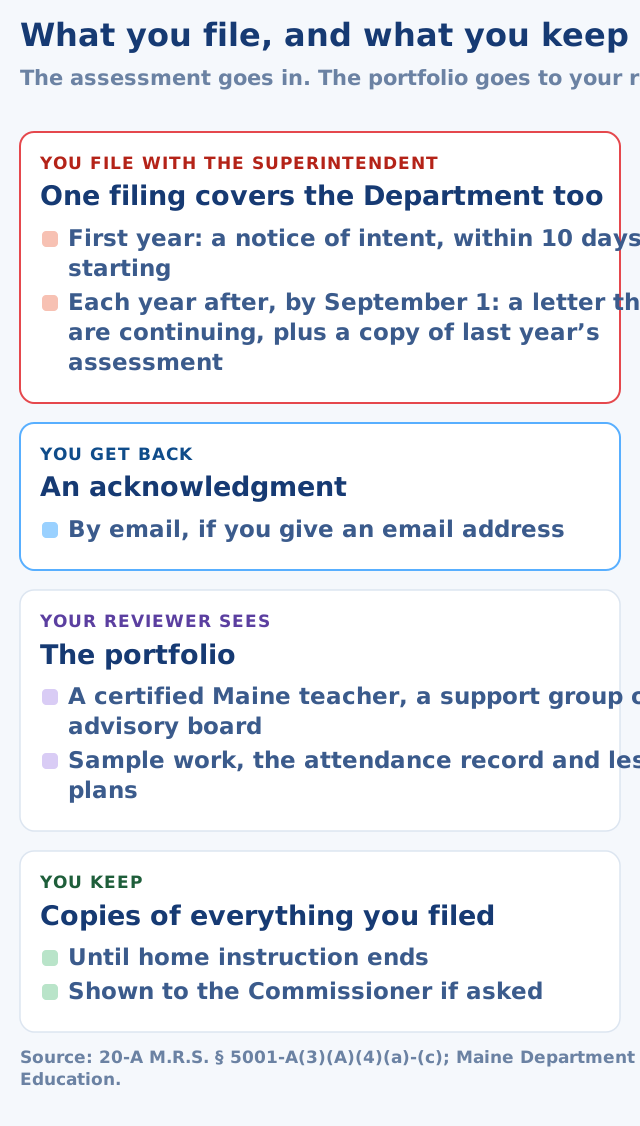
One thing to know up front: the assessment goes in. A copy travels with your letter each September 1 (§ 5001-A(3)(A)(4)(b)).
The notice of intent
In your first year, you send a written notice of intent within 10 calendar days of starting home instruction. The law sends it to your local school officials and the Commissioner of Education at the same time (§ 5001-A(3)(A)(4)(a)).
Here’s the easy part: one filing does both. The Department says a single submission through its online Home Instruction Portal, or a paper form sent to your superintendent’s office only, counts for both.
The notice includes:
- Your name, signature and address
- Your child’s name and age
- The date home instruction will begin
- Your assurance of at least 175 days of instruction a year in the required subjects
- Your assurance that the program will include an annual assessment, in one of the five forms the law allows
The Department’s own timing reads a little differently: file within 10 days of withdrawing from school, or by September 1 if you start in the fall. Filing before you begin covers both. No assessment is due with a first-year notice (Department of Education).
Give an email address, and an acknowledgment comes back by email. Without one, the Department says no acknowledgment is sent.
Each year after
On or before September 1 of each later year, you file a letter saying you’ll keep going, with a copy of last year’s assessment enclosed (§ 5001-A(3)(A)(4)(b)). The Department’s Notice of Intent form, or its portal, is that letter.
The Department asks that the two go together, not separately. A notice without an assessment gets flagged, and your superintendent’s office follows up.
The subjects and the 175 days
You promise at least 175 days of instruction a year in these subjects (§ 5001-A(3)(A)(4)(a)(iv)):
- English and language arts, math, science and social studies
- Physical education and health education
- Library skills and fine arts
- Maine studies, in at least one grade from 6 to 12
- Computer proficiency, shown at one grade level from 7 to 12
There’s no hours rule, per day or per year. If you start mid-year, the Department lets you count the days your child already spent in school. The law asks for no log, though an attendance record is one thing a reviewing teacher may look at.
The annual assessment: five options
Once a year, you assess your child’s progress one of five ways, and you send a copy in with your September 1 letter (§ 5001-A(3)(A)(4)(b)). Two options, and a test the district gives, need your district’s agreement before you file your notice of intent.
| Option | What you send in | Uses a portfolio? | Agree with the district first? |
|---|---|---|---|
| Standardized achievement test | The test summary page | No | Only if the district gives the test |
| Test made by your district | The results | No | Yes |
| Review by a certified Maine teacher | The teacher’s letter accepting your child’s progress | Usually. The Department describes it as a portfolio review. | No |
| Portfolio to a support group | The group’s acceptance. The group must include a certified Maine teacher or administrator. | Yes | No |
| Local advisory board | The board’s acceptance. The superintendent picks one district employee and two home instruction tutors. | Not set in law | Yes |
Since the assessment measures the year’s progress, the Department says to do it toward the end of the school year. For tests, it names the California, Stanford and Iowa achievement tests as examples.
What counts as a work sample?
The law sets no number of samples, no subjects and no format. A review rests on “a presentation of an educational portfolio” but is “not limited to” it, and the reviewer decides whether to accept your child’s progress (§ 5001-A(3)(A)(4)(b)(iv)).
The Department’s list of what a teacher may look at is a good start: the attendance record, lesson plans and sample work. Our advice (not law): pick a few dated pieces per subject from across the year, so the reviewer can see growth. Ask your reviewer what they’d like before you start.
The Maine home instruction year, date by date
Maine’s school year runs July 1 to June 30. Your first notice counts from your own start date, and every later filing is due September 1.
| When | What | Rule |
|---|---|---|
| Within 10 calendar days of starting (first year) | Notice of intent, no assessment | § 5001-A(3)(A)(4)(a) |
| After you file | Acknowledgment by email, if you gave one | Department |
| July 1 to June 30 | At least 175 days in the required subjects | § 5001-A(3)(A)(4)(a)(iv) |
| Toward the end of the school year | The annual assessment, in one of five forms | § 5001-A(3)(A)(4)(b); Department |
| By September 1, each later year | Letter of intent to continue, plus a copy of last year’s assessment | § 5001-A(3)(A)(4)(b) |
| Until home instruction ends | Keep copies of everything you filed | § 5001-A(3)(A)(4)(c) |
Stopping mid-year? A child of school age then enrolls in a public school or another equivalent instruction option. The receiving school decides the grade and, in high school, how much the home instruction counts (§ 5001-A(3)(A)(4)(d)).
The Department also asks for a courtesy note to the superintendent when you stop. If your child finished the year at home but won’t continue, the Department asks for that year’s assessment too.
How long to keep homeschool records in Maine
Good news: Maine’s law answers this one. You keep copies of everything you filed (each notice, letter and assessment) until home instruction ends, and you show them to the Commissioner if asked (§ 5001-A(3)(A)(4)(c)).
HSLDA’s advice goes further. Keep attendance records, work samples, portfolios and test results at least two years, and high school records for good.
That matters because the state issues no grades, diplomas or transcripts for home instruction (Department of Education). For a college, an employer or the military, your records are the record.
Home instruction or a private school: which rules apply
Maine law lists home instruction as one of several alternatives to public school. A child is either in home instruction or enrolled in a private school, not both (Department of Education).
| Route | Law | Who files |
|---|---|---|
| Home instruction | § 5001-A(3)(A)(4) | You: a notice of intent, then a letter and an assessment each September 1 |
| Private school recognized for equivalent instruction | § 5001-A(3)(A)(1)(b), (2) | The school: a certificate of each child’s attendance to your district, and a yearly letter to the Commissioner before October 1 |
| Approved private school | § 5001-A(3)(A)(1)(a); § 2901 | The school, under state approval |
School is required from age 6 until 17 (§ 5001-A(1)). The Department needs no notice for a 5-year-old.
Will a digital portfolio work?
The law doesn’t say. What the state sees is the assessment, and the Department’s portal takes it as an upload. The paper route works with photocopies.
The portfolio itself goes to your reviewer, not the state. So the teacher, support group or board decides whether a digital homeschool portfolio works for them. Ask first, and bring a printed copy for anyone who wants paper.
What changes in 2026 and 2027
2026
No change to Maine’s home instruction law. The Legislature’s 2026 session ended April 29, 2026, and none of its bills or laws touched home instruction. Its laws took effect July 29, 2026.
In 2025, the only edit to § 5001-A fixed errors in a different part of the section. Two bills aimed at home instruction students, LD 220 (a scholarship program) and LD 482 (more services for equivalent instruction students), did not pass.
2027
No change is scheduled. The new Legislature convenes December 2, 2026, so any 2027 bills come after that.
Keeping the portfolio in KidsFoldr
Snap each worksheet as your child finishes it, and it’s filed under that child, grade and subject, with nothing to sort and nothing to type. Once it’s scanned, the paper can go: scan it for peace of mind, then toss it. Less clutter, and the whole year fits on your phone.
Keep the originals someone may ask for: the signed review letter, copies of what you filed (the law says to keep those), and high school work a school may weigh for credit. Scan them too, so they’re in the same place.
- Organized with zero effort. Every paper is filed by child, grade and type as you snap it, and schoolwork and tests by subject too. A name at the top of a page files it under the right child, and any word on any paper is searchable.
- The paperwork keeps up. Forward a test summary or a teacher’s letter that arrives by email, and it files the same way. A test date or a review meeting on a paper lands on your family calendar, linked back to its paper, with nothing to type.
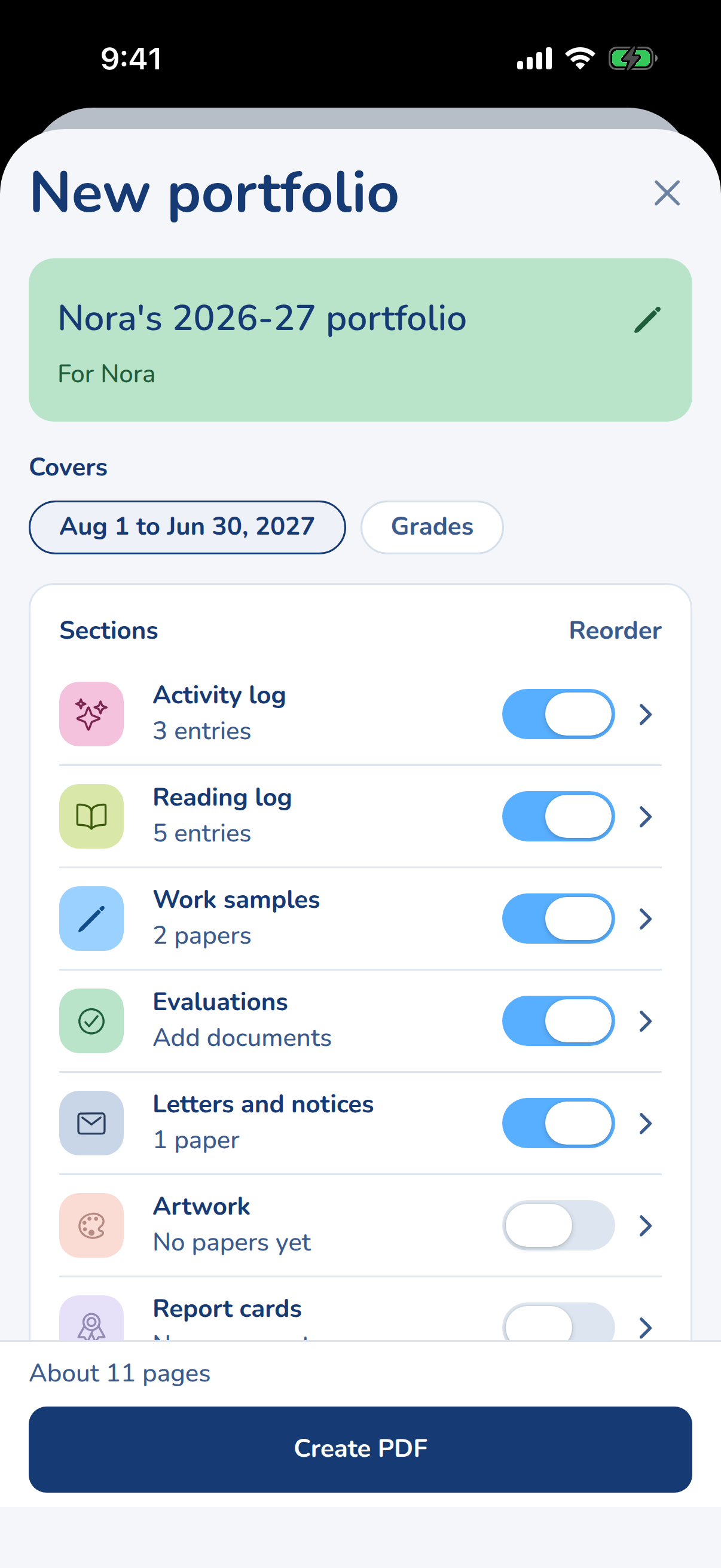
- The portfolio, on demand. Start a New portfolio, set the dates to your own school year, and create a PDF with a cover page and contents. Share it or print it, or share your child’s Portfolios folder read-only with the reviewer.
- Keepsakes, safe. Artwork and favorite work are kept as scans. Turn on automatic backup, and every paper goes to KidsFoldr Cloud as it is filed. One tap on Back up copies every paper to your own Google Drive or iCloud.
You pick the sections. For a Maine teacher or support group review:
- Work samples, grouped by subject: the sample work.
- Attendance or hours log: Fill from papers adds a day for each date your child has schoolwork, artwork or a test, for you to check.
- Reading log, Activity log and Artwork: books, PE and field trips, and fine arts.
- Evaluations or Test results: the review letter or the test summary page.
- Letters and notices: your notice and the acknowledgment.
Common questions
Do I send my child’s portfolio to the state?
No. The portfolio goes to your reviewer. What you send in, by September 1, is the assessment: the review letter, the group’s or board’s acceptance, or the test results.
What’s due on September 1?
Each year after the first: a letter that you’re continuing home instruction, with a copy of last year’s assessment (§ 5001-A(3)(A)(4)(b)).
Do I file an assessment my first year?
No. The first-year notice needs no assessment. Your first assessment goes in the following September 1.
How long do I have to keep homeschool records in Maine?
Until home instruction ends. The law says to keep copies of everything you filed and show them to the Commissioner if asked (§ 5001-A(3)(A)(4)(c)).
Do I have to track hours?
No. Maine asks for at least 175 days of instruction a year and sets no hours.