
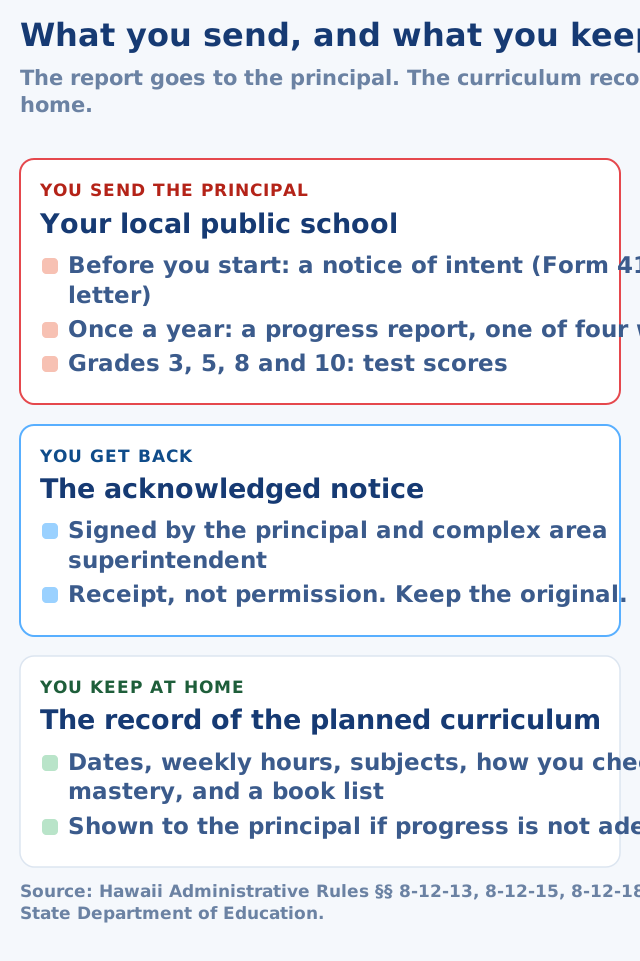
- No portfolio by name. You keep a record of the planned curriculum at home, and you don’t send it in.
- Once a year, you send your local principal a progress report, one of four ways. One is your own written evaluation, with samples of your child’s work and tests.
- Grades 3, 5, 8 and 10 need test scores. In those years, the scores can be the report.
The paper in your hand is this year’s record for one child. It’s your curriculum record, plus whatever backs up the progress report: your written evaluation with work samples and tests, a score report, or a certified teacher’s letter. Beside it sits the notice of intent the school signed and sent back.
This page covers homeschooling under HRS § 302A-1132(a)(5) and the Department of Education’s rules, Hawaii Administrative Rules (HAR) Chapter 8-12. A private school or an approved alternative program runs on other rules. See which route you’re on.
Does Hawaii require a homeschool portfolio?
Not by name. Hawaii’s statute names only the notice of intent and leaves the rest to the Department’s rules (§ 302A-1132(a)(5)). Neither the statute nor the rules use the word “portfolio.”
What the rules ask for is a record of your planned curriculum, kept at home, and a yearly progress report (HAR §§ 8-12-15, 8-12-18). The closest thing to a portfolio is one report option: your own written evaluation, with samples of your child’s work.
The record of the planned curriculum
You must keep a record of the planned curriculum for each child (HAR § 8-12-15). The rule says it should include:
- The start date and end date of your program
- The number of hours per week your child spends in instruction
- The subjects you plan to cover
- How you’ll check that your child has mastered the material
- A list of textbooks and other materials, with author, title, publisher and date of publication
Good news: it stays home. The Hawaii State Department of Education (HIDOE) says you don’t submit your curriculum, though the school may ask to see it to help. Under the rules, the principal can require it only if your child’s progress isn’t adequate (HAR § 8-12-18(d)).
There’s no hour minimum and no required subject list. The rule’s subject lists say a curriculum “may include” them, such as language arts, math, social studies, science, art, music, health and PE for younger kids (HAR § 8-12-15).
The notice of intent
Before you start, you give the principal of your local public school a notice of intent (HAR § 8-12-13(a)). That’s the school your child would attend if they weren’t homeschooled. Use HIDOE’s Form 4140 or a letter.
A letter needs:
- Your child’s name, address and telephone number
- Your child’s birthdate and grade level
- Your signature (HIDOE asks for the date, too)
The principal and the complex area superintendent sign it as acknowledged, and the school sends it back to you. They’re confirming receipt, not granting permission (HIDOE). Keep that signed copy: it protects your family from claims of truancy or educational neglect (HAR § 8-12-13(b)).
Do I file it every year?
No. As long as you send the yearly progress report, the notice stands (HAR § 8-12-13(c)). You file a new one with the new school’s principal when your child would change schools, such as moving from elementary to middle school, or when you move to another school’s area (HIDOE).
HIDOE also asks you to tell the school if you move out of Hawaii or enroll your child in a private school.
The annual progress report: four options
Once a year, you send the principal a report of your child’s progress, using one of four methods (HAR § 8-12-18(b)). Neither the rules nor HIDOE’s pages set a due date.
| Option | What you send | Uses work samples? |
|---|---|---|
| Standardized test score | A nationally normed achievement test score at grade level for your child’s age | No |
| Standardized test progress | Scores showing one grade level of progress per calendar year, even if still below grade level | No |
| Certified teacher’s evaluation | A written evaluation by a teacher certified in Hawaii | Not set in the rule |
| Your own written evaluation | Progress in each subject, representative work samples, and representative tests and assignments (with grades, if you give them) | Yes |
Our advice, not law: send the report at your program’s end date, the one in your curriculum record. Ask your school how it would like to receive it.
What counts as a work sample?
For your own evaluation, the rule asks for “representative samples of the child’s work” and “representative tests and assignments” (HAR § 8-12-18(b)(4)). It sets no number, no format and no list.
Examples, not rules: a dated math page from fall and one from spring, a writing piece, a science lab sheet, a graded quiz. Pick pieces that show where your child started and where they ended up.
Test scores in grades 3, 5, 8 and 10
Test scores are required in grades 3, 5, 8 and 10 (HAR § 8-12-18(a)). Your child can take the state’s tests at your local school at no cost, or you can arrange private testing at your own expense (HAR § 8-12-18(a); HIDOE). The principal may approve another way to meet the requirement.
In those grades, the school’s test results can serve as that year’s progress report (HAR § 8-12-18(c)). One wrinkle: HIDOE notes that public school students now test in grade 11, not grade 10. Ask your school how it handles the grade 10 year.
HIDOE’s Assessment Information sheet lists tests families can buy, such as the Iowa Assessments and MAP Growth. It calls them options, not approved tests.
If progress isn’t adequate
The principal reviews each report. If progress isn’t adequate, the principal meets with you to talk it through and help set up a plan for improvement, and may ask to see your curriculum record (HAR § 8-12-18(d)).
With test scores, adequate means stanines in the upper two thirds. No one may recommend school enrollment or legal action before third grade, or unless progress is inadequate for two semesters in a row (HAR § 8-12-18(d)). Saying no to requests beyond the rules isn’t grounds for educational neglect (HAR § 8-12-17).
The Hawaii homeschool year, date by date
Hawaii has no statewide homeschool deadline. Your dates run from your own start date and the grades your child is in.
| When | What | Rule |
|---|---|---|
| Before you start | Notice of intent (Form 4140 or a letter) to the local principal | HAR § 8-12-13(a) |
| After you file | The signed, acknowledged notice comes back to you | HAR § 8-12-13(b); HIDOE |
| All year | Keep the record of the planned curriculum | HAR § 8-12-15 |
| Grades 3, 5, 8 and 10 | Test scores | HAR § 8-12-18(a) |
| Once a year (no date set) | Progress report to the principal | HAR § 8-12-18(b) |
| When your child would change schools | A new notice to the new school’s principal | HAR § 8-12-13(c); HIDOE |
| When you stop | Tell the principal | HAR § 8-12-16 |
Stopping? HIDOE takes the notice in writing or verbally, and asks where your child is going next. Our advice: put it in writing, so you have a copy.
How long to keep homeschool records in Hawaii
The rules set no period, and neither do HIDOE’s pages. HSLDA’s advice: keep samples, letters, test results and portfolios at least two years, and high school records for good.
Those copies can matter later. Homeschooling earns no course credits in Hawaii (HAR § 8-12-20). On request, the principal of your local high school writes a letter confirming your child was homeschooled in compliance with the rules, and HIDOE says that needs your yearly reports and grade 3, 5, 8 and 10 test scores (HAR § 8-12-22).
Homeschooling, private school or an approved program
Hawaii law lists homeschooling as one of several exceptions to school attendance. Here are three routes, side by side.
| Route | Law | What you do |
|---|---|---|
| Homeschooling | § 302A-1132(a)(5); HAR §§ 8-12-13 to 8-12-22 | Send a notice, keep a curriculum record, send a yearly progress report |
| Private school | § 302A-1132(d) | Enroll in a licensed or accredited private school. The school’s own rules apply. |
| Alternative educational program | § 302A-1132(a)(5); HAR § 8-12-8 | Ask for the superintendent’s approval with Form 4140 and a planned curriculum, renewed every year |
One catch: enrolling in a private school’s home study program doesn’t count as attending a private school (HAR § 8-12-8(b)). School attendance is required for children who are 5 by July 31 of the school year and not yet 18 by January 1 of that school year (§ 302A-1132(a)).
Will a digital portfolio work?
The law, the rules and HIDOE’s pages don’t say. Nothing requires paper, and nothing mentions digital records.
The report goes to your principal, so ask the school whether it takes a PDF or email. If a certified teacher evaluates your child, ask the teacher what format works. A printed copy works for anyone who wants paper.
What changes in 2026 and 2027
2026
No change to Hawaii’s homeschool statute or rules. The statute was last amended in 2022, and Chapter 8-12 in 2000.
Two 2026 bills, SB 3193 and HB 2376, would have required homeschooled children to take state tests in person at the local school starting in the 2027-28 school year. That included the kindergarten entry assessment, screening in grades 1 and 2, and the statewide tests. Neither passed. HSLDA reports that the House Education Committee deferred HB 2376 on February 17, 2026, and both died when the session ended.
2027
No change is scheduled. The 2027 session opens January 20, 2027. Bills from 2026 don’t carry over, so any new proposal would start over as a new bill (Hawaii Constitution, Art. III, § 10).
Keeping the portfolio in KidsFoldr
Snap each worksheet and quiz as your child finishes it, and it’s filed under that child, grade and subject, with nothing to sort and nothing to type. Once it’s scanned, the paper can go: scan it for peace of mind, then toss it. Less clutter, and the whole year fits on your phone.
Keep the originals someone may ask for: the notice the school signed and sent back, test score reports, and high school work a school may want to see. Scan them too, so everything for the year is in one place.
- Organized with zero effort. Every paper is filed by child, grade and type as you snap it, and schoolwork and tests by subject too. A name at the top of a page files it under the right child, and any word on any paper is searchable.
- The paperwork keeps up. Forward a score report or a teacher’s letter that arrives by email, and it files the same way. A test date on the school’s letter or an evaluator’s appointment lands on your family calendar, linked back to its paper, with nothing to type.
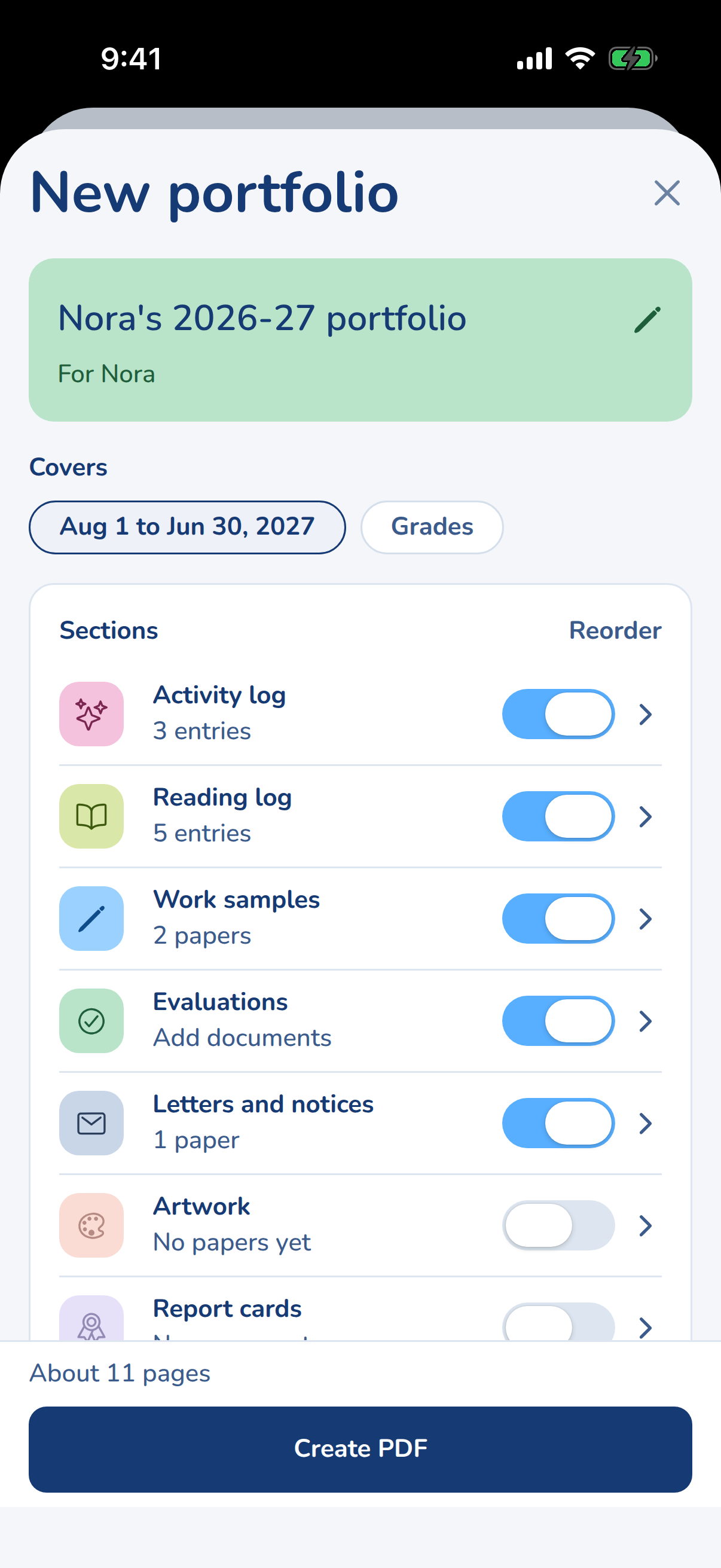
- The report, on demand. Start a New portfolio, set the dates to your own program year, and create a PDF with a cover page and contents. Share it or print it, or share your child’s Portfolios folder read-only with a certified teacher.
- Keepsakes, safe. Artwork and favorite work are kept as scans. Turn on automatic backup, and every paper goes to KidsFoldr Cloud as it is filed. One tap on Back up copies every paper to your own Google Drive or iCloud.
You pick the sections. For a Hawaii progress report:
- Parent summary: your description of progress in each subject.
- Work samples, grouped by subject: the representative work, with tests and quizzes included.
- Attendance or hours log: your hours of instruction per week.
- Reading log: the books you use. Keep the full list, with publishers, in your curriculum record.
- Test results or Evaluations: a score report or a certified teacher’s letter.
- Letters and notices: the acknowledged notice of intent.
Common questions
Do I send a portfolio to the school?
No. You send a yearly progress report to the principal. Your curriculum record stays home unless the principal asks for it after a report shows progress isn’t adequate (HAR § 8-12-18(d)).
When is the progress report due?
The rules say once a year and set no date. Our advice: send it at your program’s end date.
Which grades need test scores?
Grades 3, 5, 8 and 10 (HAR § 8-12-18(a)). HIDOE notes public schools now test in grade 11 instead of 10, so ask your school about that year.
Do I file a notice of intent every year?
No. You file it once, and again only when your child would change schools, such as moving up to middle school or moving to another school’s area (HAR § 8-12-13(c)).
How long do I keep homeschool records in Hawaii?
The rules set no period. HSLDA advises at least two years, and high school records for good.