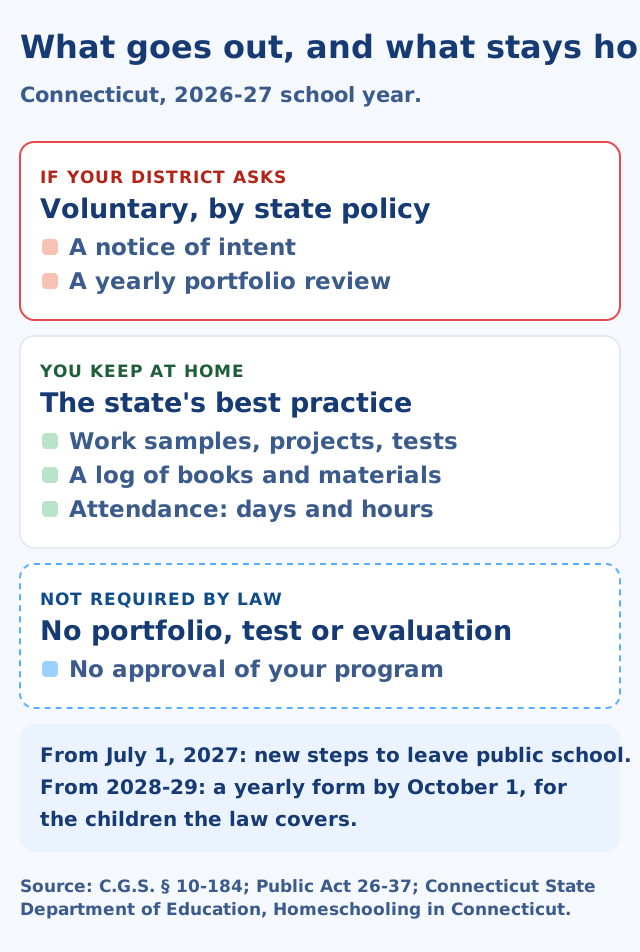
- No portfolio is required by law. C.G.S. § 10-184 lists the subjects to teach and asks for “equivalent instruction” if your child isn’t in public school.
- Your district may ask for a notice of intent and a yearly portfolio review. The state legislature’s research office describes both as “suggested rather than mandatory,” and the state education department still lists a portfolio as best practice.
- A new law, Public Act 26-37, adds steps. From July 1, 2027, leaving public school takes an in-person form and a state records check. From the 2028-29 school year, a yearly form is due October 1 for the children the law covers.
So what paper are you holding? If your district asked for one, it’s the Notice of Intent form. The state’s sample lists the subjects you’ll teach, the days of instruction, how you’ll check progress, and a blank for the date of a yearly portfolio review.
Beside it sits the portfolio you keep by choice. For the 2026-27 school year, the law behind all of it is unchanged.
Does Connecticut require a homeschool portfolio?
No. Not one Connecticut statute asks a homeschooling family for a portfolio, a record, a test or an evaluation.
What the law does ask is short. Every parent of a child from 5 to under 18 must send the child to public school, unless the parent can show the child “is elsewhere receiving equivalent instruction in the studies taught in the public schools” (C.G.S. § 10-184). The same section names the studies:
- Reading, writing, spelling and English grammar
- Geography and arithmetic
- United States history
- Citizenship, including a study of town, state and federal government
If your child is 5 or 6, you can delay school a year by signing an option form in person at the district office (C.G.S. § 10-184).
The Connecticut State Department of Education (CSDE) still suggests a portfolio and an attendance log as “best practice.” That’s advice, not a rule. The 2026 law adds no portfolio either; see what changes in 2026 and 2027.
The notice of intent and portfolio review
The General Assembly’s research office traces both to a 1994 State Board of Education policy and describes that procedure as “suggested rather than mandatory.”
CSDE asks parents who want to homeschool to contact their district’s central office and give notice of their intent. HSLDA, the Home School Legal Defense Association, says both the notice and the review are optional, and that many districts never ask for a review.
CSDE’s sample Notice of Intent asks for:
- Your child’s name, birth date and address, and the teacher’s name
- The subjects you’ll teach (the eight in the law, plus science as recommended)
- The total days of instruction you plan
- How you’ll assess your child’s progress
- A date for a yearly portfolio review
The superintendent signs only to say the form arrived, with no opinion on your program. The sample itself says to get your district’s form from the superintendent’s office.
What counts as a work sample?
CSDE’s best-practice portfolio holds samples of activities, assignments, projects and assessments, plus a log of books and materials and the results of any national tests you chose. It also suggests an attendance log of days and hours.
If you agree to a review, HSLDA suggests brief examples from each required subject. Examples, not rules: a dated math page, a spelling test, a labeled map, a short report on how your town is governed.
The Connecticut homeschool year, date by date
This school year, Connecticut has no statewide homeschool deadline. The first fixed dates arrive with the 2026 law.
| When | What | Rule |
|---|---|---|
| Ages 5 to under 18 | Teach the listed subjects; equivalent instruction outside public school | C.G.S. § 10‑184 |
| Age 5 or 6, if you delay | Option form, signed in person at the district office | C.G.S. § 10‑184 |
| When you start | A notice of intent is asked for, not required by statute | CSDE; voluntary policy |
| Once a year, if asked | A portfolio review, if you agree | Voluntary policy |
| From July 1, 2027 | Leaving public school: in-person withdrawal form and a records check | Public Act 26‑37 |
| From 2028-29, by October 1 | Intent to educate form, for the children the law covers | Public Act 26‑37 |
| From 2028-29, within 14 days of moving in | The same form for your new district | Public Act 26‑37 |
How long to keep homeschool records in Connecticut
Connecticut law sets no period, because it requires no records.
HSLDA advises keeping records for at least two years. It says to keep high school records, and proof you followed the law in those years (including any notice you filed), forever. That’s advice, not law.
High school is where records matter most. CSDE says a district doesn’t have to give graduation credit for homeschool work in grades 9 to 12, and the route to an official diploma is the GED. Your portfolio is the record of those years.
Can a Connecticut homeschool portfolio be digital?
Yes. Nothing in the statute or CSDE’s guidance says what form your records take.
Connecticut has no evaluator, and a district review is voluntary, so no rule says a district must take a digital portfolio. If someone wants paper, bring a printout. The new intent to educate form may be filled in and sent electronically (Public Act 26-37).
What changes in 2026 and 2027
2026
Connecticut passed a new homeschool law in 2026: Public Act 26-37 (House Bill 5468), signed in May. Nothing changes for the 2026-27 school year.
The law gives homeschooling a new name from July 1, 2027: “parent-managed learning,” meaning education a parent manages outside a public or nonpublic school. The subject list stays the same. CSDE must create the two new forms, a withdrawal form and an intent to educate form, by July 1, 2027.
The law adds no portfolio, no portfolio review, no test and no evaluation.
2027
From July 1, 2027, leaving public school to homeschool works like this:
- You go in person to the district office and sign a withdrawal form.
- Within two business days, the superintendent’s office runs a check with the Department of Children and Families (DCF) on every adult 18 or older who lives with your child.
- Within five business days of starting the check, the superintendent tells you whether the withdrawal is effective. Until then, it isn’t.
The check looks for anyone on the state’s child abuse and neglect registry or under a current DCF investigation. If it finds one, the child can’t be withdrawn to homeschool, and the superintendent must say why and how to challenge the finding. The law says the check is not a report of suspected abuse.
From the 2028-29 school year, a yearly form. By October 1, you complete an intent to educate form saying where your child will learn, and send it to your town’s district office. It can be completed and sent electronically.
For a homeschooled child, the law requires the form if the child turns 5 by September 1 that year, or if a withdrawal or intent to educate form was filed the year before. The legislature’s research office reads this as grandfathering most children homeschooled before 2028-29. If you move into a new district during the year, you have 14 days to file.
If a district has no form by November 1, it must try at least three times to reach you. If it can’t reach you, it tells CSDE.
The 2027 session of the General Assembly runs from January to June. Before each school year, check the General Assembly’s site and your district for anything new.
Keeping Connecticut records in KidsFoldr
Picture a whole year of records with no binder to keep, no pile to sort and nothing to type. Snap a page as you teach, and KidsFoldr files it under your child, grade and subject. Then the worksheet can go: scan it for peace of mind, then toss it.
Keep the originals that matter on paper, though. That’s your copy of the notice of intent, any letter from the district, the withdrawal form and the superintendent’s reply, and high school work you may need for credit.
When a paper has a date on it, such as a district letter setting a portfolio review, a test day if you choose to test, or a co-op calendar, snap it. The date lands on the family calendar, linked back to the paper, with nothing to type.
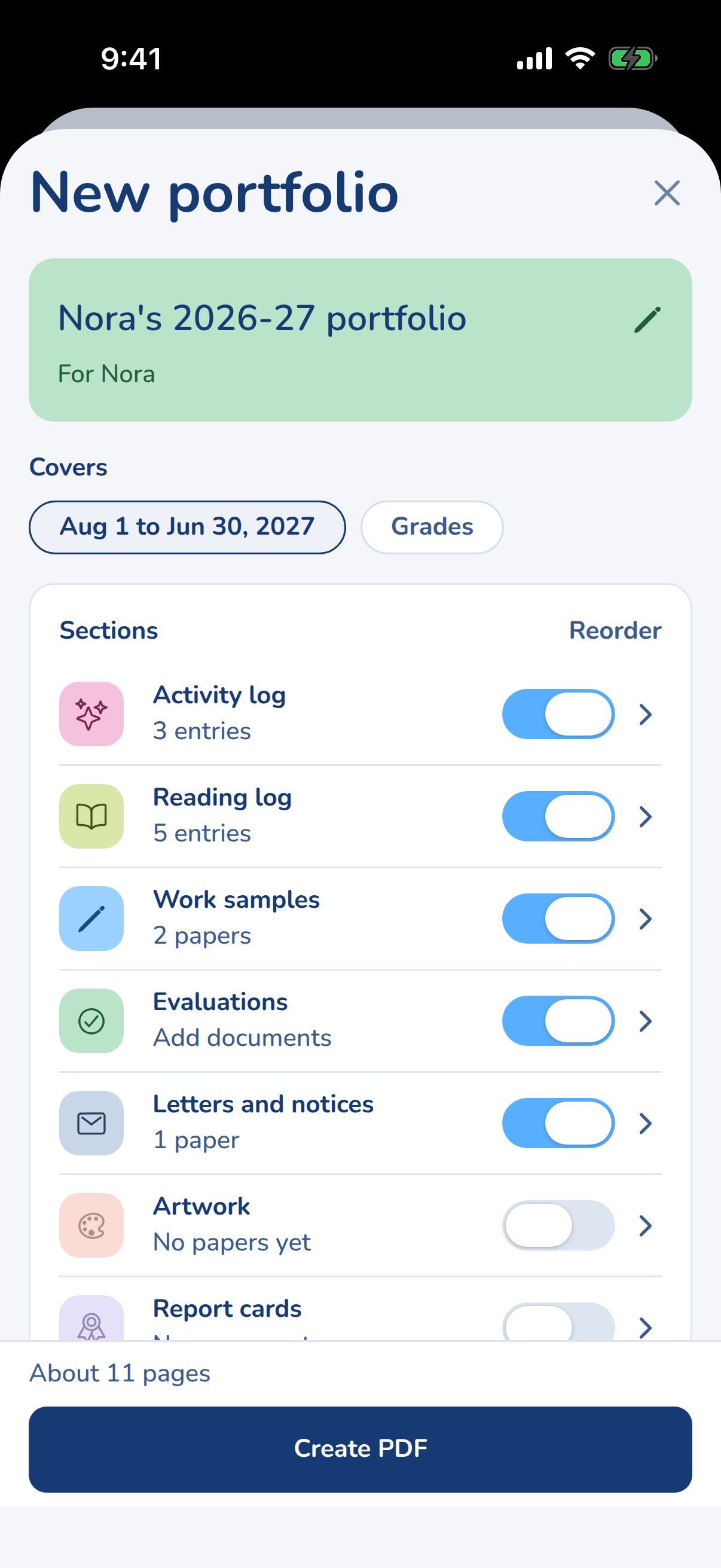
If your district asks for a review, the portfolio is already there. Your work samples file by subject, and the Attendance or hours log can fill itself from the days your child did schoolwork, for you to check. Pick dates or grades, and the year is a PDF to share or print.
Turn on automatic backup, and every paper goes to KidsFoldr Cloud as it is filed. One tap on Back up copies every paper to your own Google Drive or iCloud.
Common questions
Do I need a portfolio to homeschool in Connecticut?
No. Connecticut law names the subjects and asks for equivalent instruction, with no portfolio. A district may ask for a yearly portfolio review, which is voluntary.
Do I have to file a notice of intent?
No statute requires one today; CSDE asks for it. From the 2028-29 school year, a yearly intent to educate form is due by October 1 for the children Public Act 26-37 covers.
What changes when I take my child out of public school?
From July 1, 2027, you sign a withdrawal form in person at the district office, and the withdrawal takes effect only after a DCF records check of the adults in your home.
How long should I keep homeschool records in Connecticut?
Connecticut law sets no period. HSLDA advises at least two years, and high school records forever.
Does my child have to take a test?
No. No Connecticut statute requires a test, and the 2026 law adds none. CSDE suggests adding the results of any national test you choose to your portfolio.