- The law asks for no portfolio, no records, no notice and no standardized test. It asks for “other means of education” for the full school term.
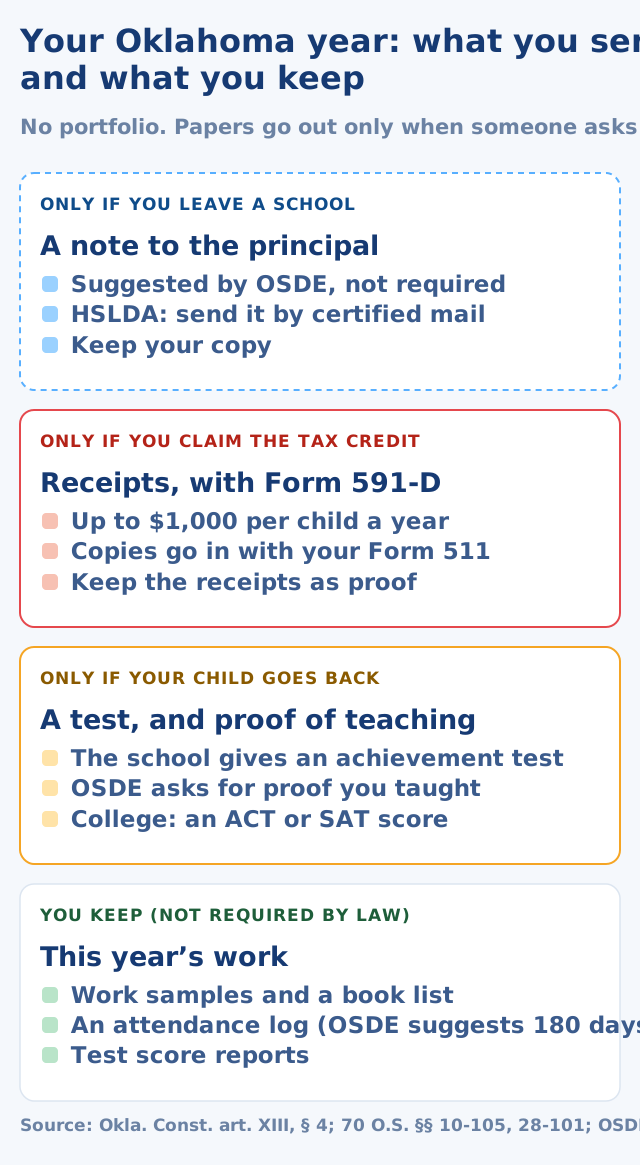
- Claiming the homeschool tax credit? It pays up to $1,000 per child a year, and you send copies of your receipts and keep them as proof.
- If your child goes back to public school, the State Department of Education says the school will give a standardized achievement test and ask for proof of your teaching.
The paper on your table is this year’s folder of work: worksheets, a book list, the curriculum you teach from. Beside it may sit receipts for books and tutoring, a copy of the note you gave your child’s old principal, and an ACT or SAT score report if you have a teen.
Oklahoma’s own constitution allows “other means of education” in place of school (Okla. Const. art. XIII, § 4). Good news: the rules are short.
Does Oklahoma require a homeschool portfolio?
No. The law requires your child to attend school “unless other means of education are provided for the full term” your district’s schools are in session (70 O.S. § 10-105). It asks for no portfolio, log, records, notice or test.
The Oklahoma State Department of Education (OSDE) agrees. It says homeschools are not regulated: you don’t register, seek approval, give state tests or allow home visits.
The rule covers children from age five until they turn 18 (§ 10-105(A)).
OSDE does offer guidelines. It says plainly that they are not required by law, but that following them helps you show you’re giving a quality education:
- Tell the principal of your local school that you plan to homeschool.
- Teach about 180 days a year, six hours a day, as fits your child’s age.
- Use a well-defined curriculum. OSDE lists reading, writing, math, science, citizenship, the U.S. Constitution, health, safety, physical education and conservation.
- Teach in good faith, at a level equal to the state’s. OSDE says that is how the Attorney General reads the law.
- Keep track of your child’s academic progress.
Since the law asks you to keep nothing, what you keep is up to you. The rest of this page covers what’s worth keeping, and who might ask for it.
Leaving school, and going back
No form is required to leave a public school. OSDE suggests telling the principal, and says some schools have you sign a form that releases them from your child’s education.
The Home School Legal Defense Association (HSLDA) advises sending letters to the school by certified mail. Keep copies of the letter, anything the school sends back, and the postal receipts.
Going back is where records count. OSDE says a returning student will take a standardized achievement test, given by the school, which may set grade placement, credit or both. OSDE also says you must bring documentation that you followed its guidelines, which the school uses to judge the teaching.
That is where a folder of dated work pays off.
What counts as a work sample?
Oklahoma has no rule, because it requires no samples. But samples are what show a school the teaching happened.
Our examples, not the law’s: a dated math page, a writing piece, a book list, a photo of a project, any test you give, and a simple attendance log for OSDE’s 180 days.
The homeschool tax credit: keep your receipts
Oklahoma’s Parental Choice Tax Credit pays up to $1,000 per homeschooled child each tax year for qualified costs (70 O.S. § 28-101). You claim it on Form 591-D, one per child, filed with your Form 511, with copies of every receipt (Oklahoma Tax Commission).
| Counts | Doesn’t count |
|---|---|
| Tuition and fees for online or in-person learning programs | Internet, laptops, tablets and other devices |
| Tutoring | Equipment for sports, dance, music or other lessons |
| Textbooks, curriculum and other teaching materials | Memberships |
| Fees for standardized tests, such as the ACT, SAT and AP exams, and test prep | Field trips |
The form lists each receipt’s vendor, date of purchase and amount. The law then says to keep your receipts as proof for each year you claim (§ 28-101(C)(5)). The Tax Commission can audit them and take back a credit spent on costs that don’t qualify.
Two limits. You can’t claim a year your child was enrolled in school for two semesters (Form 591-D). And from tax year 2026, homeschool credits are capped at $5 million a year statewide, so the Commission may cut every credit by a set percentage (§ 28-101(D)(2)).
The Oklahoma homeschool year at a glance
There is no statewide deadline. Your dates come from your own papers: the day you leave a school, the receipts you collect, tax time, and a teen’s test dates.
How long to keep homeschool records in Oklahoma
The law sets no period for homeschool records. The one keeping rule is the tax credit’s: hold your receipts for each year you claim it (§ 28-101(C)(5)).
HSLDA advises keeping most records at least two years. It says to keep high school records, and proof you followed the law in those years, forever. HSLDA notes they can come up for a teen’s driver’s license, the military or college. That is advice, not law.
Applying to college
A home study graduate can be admitted to an Oklahoma public college with its required ACT or SAT score (Oklahoma State Regents for Higher Education). You, the parent, certify that your teen took the high school courses the college requires. So keep the score report and a list of courses by year.
Will a school or the Tax Commission accept digital records?
The law doesn’t say what form your homeschool records must take. For the tax credit, Form 591-D asks for legible copies of your receipts, not the originals.
So whether a school or college takes a digital homeschool portfolio is their call. Ask first. A printed copy works for anyone who wants paper.
What changes in 2026 and 2027
2026
The homeschool rule in § 10-105 was last amended in 2024. The 2026 bills we checked left it as it was.
House Bill 3705 raised the cap on the private school tax credit to $275 million. The homeschool credit stays at $1,000 per child, with its $5 million cap. Bills to repeal the credit did not pass.
House Bill 4491 would have let school districts open their activities to homeschoolers from 2026-2027. It passed the House but stalled in the Senate, so it is not law. Oklahoma law still gives homeschoolers no right to join public school teams.
2027
The Legislature convenes February 1, 2027 (Okla. Const. art. V, § 26). Any bill filed for that session is not law until it passes.
Keeping the year’s work in KidsFoldr
The stack of worksheets can go, and the year stays organized with no sorting and nothing to type. Snap each page as you teach, and KidsFoldr files it by child, grade and type, with schoolwork and tests by subject too. It’s a homeschool record keeping app that does the filing for you.
- The paper goes, with no guilt. Scan a page for peace of mind, then toss it: no pile on the counter, no shelf of binders. Keep the originals that matter, though: receipts you’re claiming for the credit, any letter from a school, test score reports, and high school work a school may need for credit.
- You keep up as it arrives. Forward an emailed receipt or score report, and it files the same way.
- Dates land on the calendar. Snap the ACT admission ticket or a school’s letter with a testing date, and the date goes on your family calendar, linked back to its paper, with nothing to type.
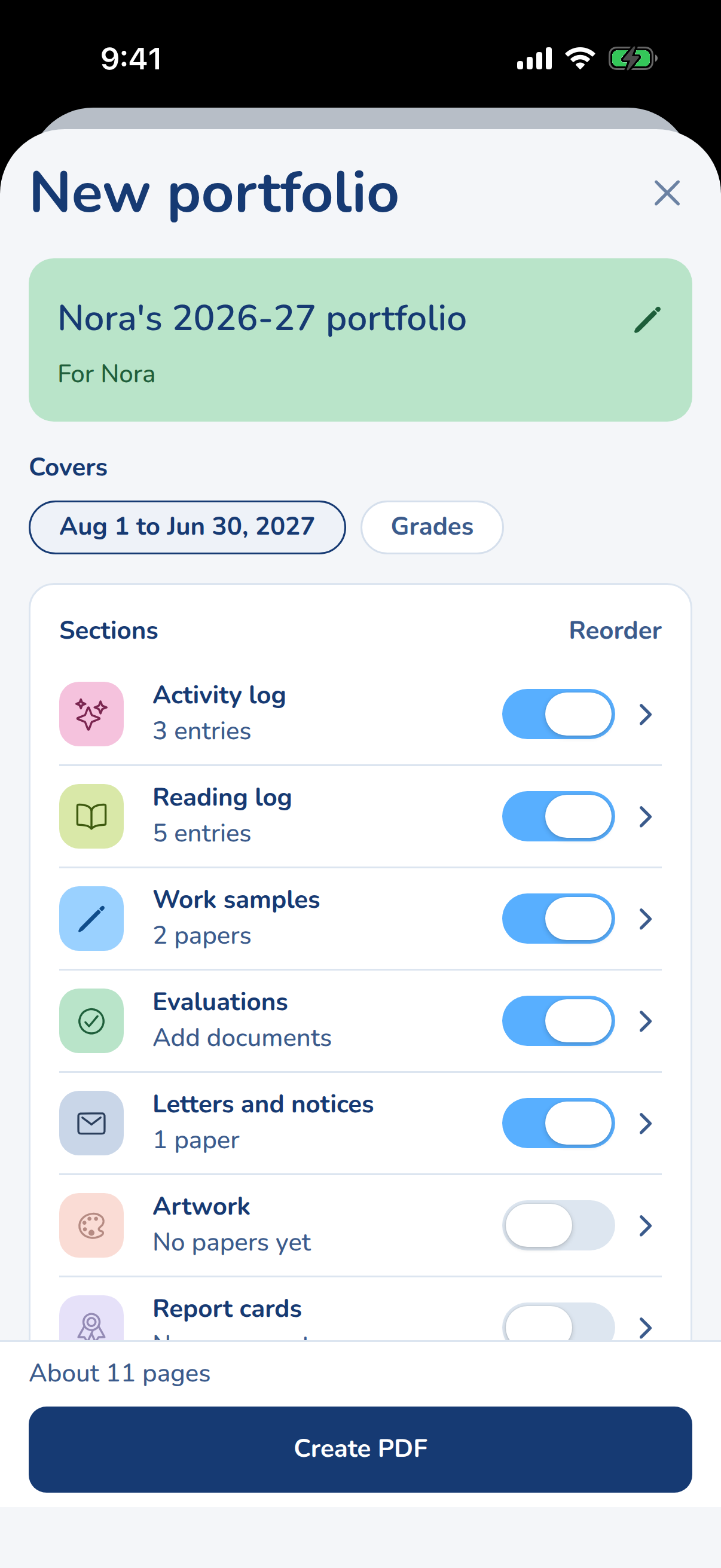
- The year is ready when a school asks. Start a New portfolio, pick your dates or grades, and get one PDF with a cover and contents. Share or print it from your phone, or share your child’s Portfolios folder read-only.
- Keepsakes stay safe, artwork and projects included. Turn on automatic backup, and every paper goes to KidsFoldr Cloud as it is filed. One tap on Back up copies every paper to your own Google Drive or iCloud.
You pick the portfolio’s sections and their order. For Oklahoma, you might switch on:
- Work samples, grouped by subject, to show a school the year’s teaching.
- A reading log (title, author and date) for the year’s books.
- An attendance or hours log, with Fill from papers adding a day for each date with schoolwork, for OSDE’s 180 days.
- Test results for an ACT or SAT score, and Letters and notices for any school letter.
Common questions
Do I have to keep a homeschool portfolio in Oklahoma?
No. The law doesn’t require one. It’s still worth keeping dated work, a book list and test results in case your child returns to school or applies to college.
Do I have to tell the state or my district that I’m homeschooling?
No. There is no notice to file. If you’re leaving a public school, OSDE suggests telling the principal.
Does my child have to take a standardized test?
No. OSDE says a child who returns to public school will be tested there, and Oklahoma public colleges look at the ACT or SAT.
How long do I have to keep homeschool records in Oklahoma?
The law sets no period, except that you keep receipts for each year you claim the tax credit. HSLDA advises at least two years for most records, and high school records forever.
Can I get a tax credit for homeschool costs?
Yes. The Parental Choice Tax Credit pays up to $1,000 per child each tax year for costs like curriculum and tutoring, claimed on Form 591-D with your receipts. A statewide cap can reduce it.