
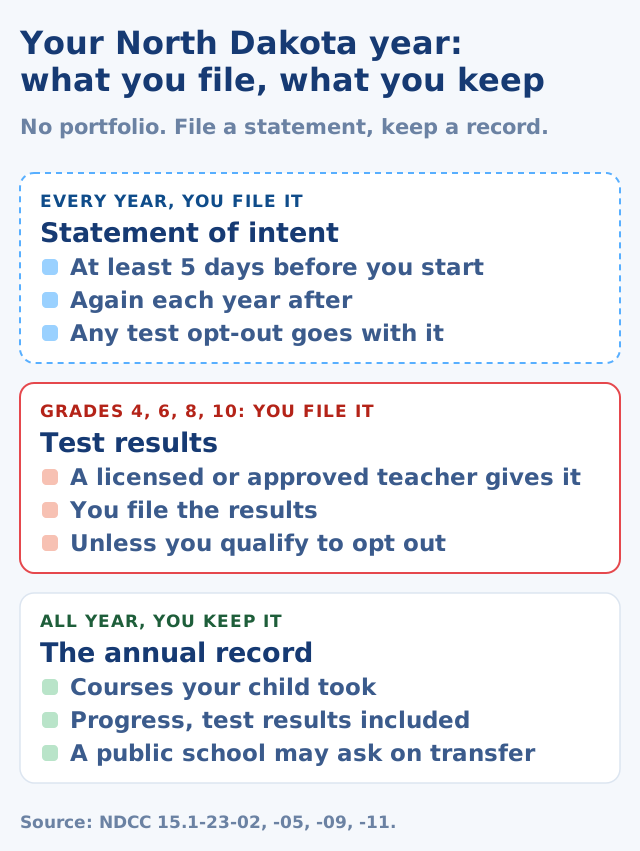
- North Dakota law requires no portfolio. You keep an annual record of the courses your child took and their progress, including any standardized test results.
- File a statement of intent with your school district superintendent at least five days before you start, and again every year.
- Your child takes a standardized test in grades 4, 6, 8 and 10, and you file the results with the superintendent, unless you qualify to opt out.
The paper here is this year’s record: the list of your child’s courses and how they’re doing, with the year’s work behind it. Beside it sit the statement of intent you file each year, the test score report in a testing year, and, for some families, a monitor’s visits or a remediation plan.
This page covers home education under North Dakota Century Code (NDCC) chapter 15.1-23. Children in an approved private school follow other rules. See which route you’re on.
Does North Dakota require a homeschool portfolio?
No. North Dakota’s home education law never uses the word “portfolio.” It asks you to keep “an annual record of courses taken by the child and the child’s academic progress assessments, including any standardized achievement test results” (NDCC 15.1-23-05).
That record stays with you. The law names one time it goes anywhere: if your child transfers to a public school district, you hand it over when the district asks (NDCC 15.1-23-05).
Good news: the law sets no format, no number of work samples and no inspection. How you keep the record is up to you. The Department of Public Instruction (DPI) calls it an annual list of courses and progress.
What counts as a work sample?
The law doesn’t ask for work samples. DPI suggests keeping some anyway, along with other papers it lists as examples, not rules:
- daily lesson plans
- a copy of your statement of intent
- a sample of work from each subject
- standardized test scores
- a yearly summary for each child: attendance, promotion, subjects taught and textbooks used
DPI says these records help if your child moves to a public school, when you apply for college and scholarships, and when you teach younger kids. Following the state’s content standards is optional for home education, says DPI.
The statement of intent, every year
File a statement of intent at least five days before you start home education, and once each year after that. If you move into a new school district, you have 14 days from the move (NDCC 15.1-23-02).
It goes to the superintendent of your child’s school district of residence, or to the county superintendent if the district has none (NDCC 15.1-23-02). DPI says always use the district where you live, even if it has no high school or your child open-enrolled elsewhere.
The statement includes (NDCC 15.1-23-02(1), (2)):
- your child’s name, address, date of birth and grade level
- your name, address and qualifications
- any public school courses your child plans to take, and the district offering them
- any extracurricular activities your child plans to join, and the school offering them
- a copy of your child’s immunization record and proof of your child’s identity
You can use DPI’s form, SFN 16909, or write your own statement that covers every item. DPI also says a district can’t make you sign up for a portal unless your child takes district courses, and can’t ask for more than the statement requires.
DPI says to file each year for every child age 7 or older. North Dakota’s compulsory school age runs from 7 to 16 (NDCC 15.1-20-01).
Who can teach, and when a monitor is needed
A parent with a high school diploma or a GED can supervise home education (NDCC 15.1-23-03). A parent without either can still do it, with a licensed or approved teacher monitoring for the first two years (NDCC 15.1-23-06, 15.1-23-07).
Here’s how monitoring works (NDCC 15.1-23-06, 15.1-23-07):
- Your district assigns and pays the monitor, unless you tell the district you’ll pick and pay your own.
- The monitor is licensed or approved to teach by the Education Standards and Practices Board.
- The monitor spends about an hour a week with you and one child, plus half an hour a month for each added child, and reports your child’s progress to the superintendent twice a school year.
- If a test score falls below the 50th percentile during monitoring, monitoring runs at least one more year, until a score reaches the 50th percentile.
- Once you finish monitoring for one child, you’re done for your other children too.
“Supervise” means choosing the materials, the approach and how teaching happens (NDCC 15.1-23-01). DPI says that lets your child learn online or in outside classes, with you still responsible for the whole education.
Subjects and school days
Teach the subjects public schools must teach, for at least four hours a day and at least 175 days a year (NDCC 15.1-23-04).
DPI points families to NDCC chapter 15.1-21 for the subjects. For elementary and middle grades, that list is (NDCC 15.1-21-01):
- English language arts: reading, composition, creative writing, grammar and spelling
- math
- social studies, with North Dakota studies in grades 4 and 8
- science, including agriculture
- physical education
- health
- computer science, including cybersecurity
For high school, DPI says home educated students follow the state’s minimum graduation requirements, including one credit in computer science or cybersecurity.
The law sets the hours and days. A simple count of days is easy to keep, and DPI lists attendance in its yearly summary.
Standardized tests in grades 4, 6, 8 and 10
In grades 4, 6, 8 and 10, your child takes a standardized achievement test: the one your school district uses, or a nationally normed test if you ask for one (NDCC 15.1-23-09).
| Step | What the law says | Rule |
|---|---|---|
| Pick the test | Your district’s test, which the district pays for and gives. Or a nationally normed test you ask for, which you pay for. | 15.1-23-09(1)(a); 15.1-23-10 |
| Who gives it | A teacher licensed or approved by the Education Standards and Practices Board, at home or at a public school if you ask | 15.1-23-09(1)(b) |
| Tell the district | The person giving the test notifies your school district | 15.1-23-08 |
| File the results | You file them with your superintendent | 15.1-23-11(1) |
| Below the 30th percentile | A team assesses your child for a learning problem. If there’s none, you file a remediation plan made with a licensed teacher. | 15.1-23-11(2), (3) |
| When the plan ends | A score at or above the 30th percentile, or one year of progress over the last test | 15.1-23-12 |
Opting out of the tests
Your child doesn’t test if you notify the district that you have a philosophical, moral or religious objection to standardized tests. You’re also exempt if you hold a teaching license, a bachelor’s degree, or a passing score on a national teacher exam (NDCC 15.1-23-09(2)).
File the notice, and any proof, with your statement of intent (NDCC 15.1-23-09(2)(b)). DPI’s form has boxes for each one.
Children with disabilities
If the team finds a disability that needs special education, you can keep homeschooling by filing a services plan, made privately or with your district (NDCC 15.1-23-13). For a child with a developmental disability, the services plan team’s progress reports go to the superintendent by November 1, February 1 and May 1 each school year (NDCC 15.1-23-14, 15.1-23-15).
The North Dakota homeschool year, date by date
North Dakota sets no single statewide homeschool date. Your year starts with your statement of intent, and testing follows your child’s grade.
| When | What | Rule |
|---|---|---|
| At least 5 days before you start, or within 14 days of moving into a district | Statement of intent to your superintendent | 15.1-23-02 |
| With the statement | Any testing opt-out notice and proof | 15.1-23-09(2)(b) |
| Every year after | A new statement (DPI: for each child 7 or older) | 15.1-23-02; DPI |
| All year | At least 4 hours a day, 175 days a year; keep the annual record | 15.1-23-04, 15.1-23-05 |
| Twice each school year, if monitored | The monitor reports to the superintendent | 15.1-23-07(3) |
| Grades 4, 6, 8 and 10 | Standardized test; you file the results | 15.1-23-09, 15.1-23-11(1) |
| Below the 30th percentile | Team assessment, then a remediation plan if needed | 15.1-23-11(2), (3) |
| November 1, February 1, May 1 | Progress reports, developmental disability route only | 15.1-23-15 |
| If your child transfers to a public school | Hand over the annual record when asked | 15.1-23-05 |
How long to keep homeschool records in North Dakota
Chapter 15.1-23 sets no number of years to keep records.
Our advice: keep each year’s record as long as your child might enroll in a public school, since the district can ask for it then (NDCC 15.1-23-05).
Keep high school work with special care. A school district, an approved private high school or the Center for Distance Education may issue a diploma if you give it course descriptions, course objectives and how they were met, and a transcript for grades 9 through 12 (NDCC 15.1-23-17). DPI says most home education diplomas are issued by the parent.
HSLDA’s advice, not law: keep attendance records, textbook lists, work samples, test results and letters from school officials for at least two years. Keep high school records, and any notice you filed in those years, forever.
Home education, private school or public school classes
Home education is one way to meet North Dakota’s school attendance law. Attending an approved private school for the same length of time is another (NDCC 15.1-20-02).
| Route | Law | Statement, tests and annual record? | Your papers |
|---|---|---|---|
| Home education | NDCC 15.1-23; 15.1-20-02(1)(e) | Yes | Your statement, the annual record, each score report |
| Home education plus public school classes or activities | NDCC 15.1-23-02(1)(c), (d); 15.1-23-16 | Yes. List them on your statement. For activities, your child meets the same standards as full-time students. | The same, plus what the school sends |
| Approved private school | NDCC 15.1-20-02(1)(a) | No, not under chapter 15.1-23 | Whatever the school asks for |
Will a school accept a digital portfolio?
The law doesn’t say. Neither chapter 15.1-23 nor DPI’s pages mention digital, scanned or emailed records.
So whether a digital homeschool portfolio is accepted is up to whoever asks: a public school your child joins, or a school or the Center for Distance Education issuing a diploma. Ask before you send. A printed copy works for anyone who wants paper.
What changes in 2026 and 2027
2026
No change to North Dakota’s home education law in 2026. Chapter 15.1-23 was last changed in 2023, when Senate Bill 2167 cut the lead time for the statement of intent from 14 days to five. The 2025 session left it alone.
The Legislature meets in regular session in odd years. It held two special sessions in 2026, on rural health funding and on kratom, and neither touched home education.
2027
One related change is set for August 1, 2027. House Bill 1621, passed in the January 2026 special session, adds the presidential physical fitness test to physical education in the public school subject law (NDCC 15.1-21-01). The list of subjects stays the same, and the home education law doesn’t mention the test.
The Legislature’s 2027 session is set to begin January 5, 2027 (Legislative Council, tentative). No 2027 bills are listed yet.
Keeping the year in KidsFoldr
The stack of worksheets can go, and the year’s record stays organized with no sorting and nothing to type. Snap each page as you teach, and KidsFoldr, a homeschool record keeping app, files it by child, grade and type, with schoolwork and tests by subject too.
- The paper goes, with no guilt. Scan a page for peace of mind, then toss it: no pile on the counter, no shelf of binders. Keep the originals that matter, though: your statement of intent and any letter from the district, each test score report, a remediation plan, and high school work a diploma issuer may want to see.
- The paperwork keeps up. A score report that arrives by email or as a PDF files the same way.
- Dates land on the calendar. When the tester emails a test date, or a district letter names one, snap or forward it, and the date goes on your family calendar, linked back to its paper, with nothing to type.
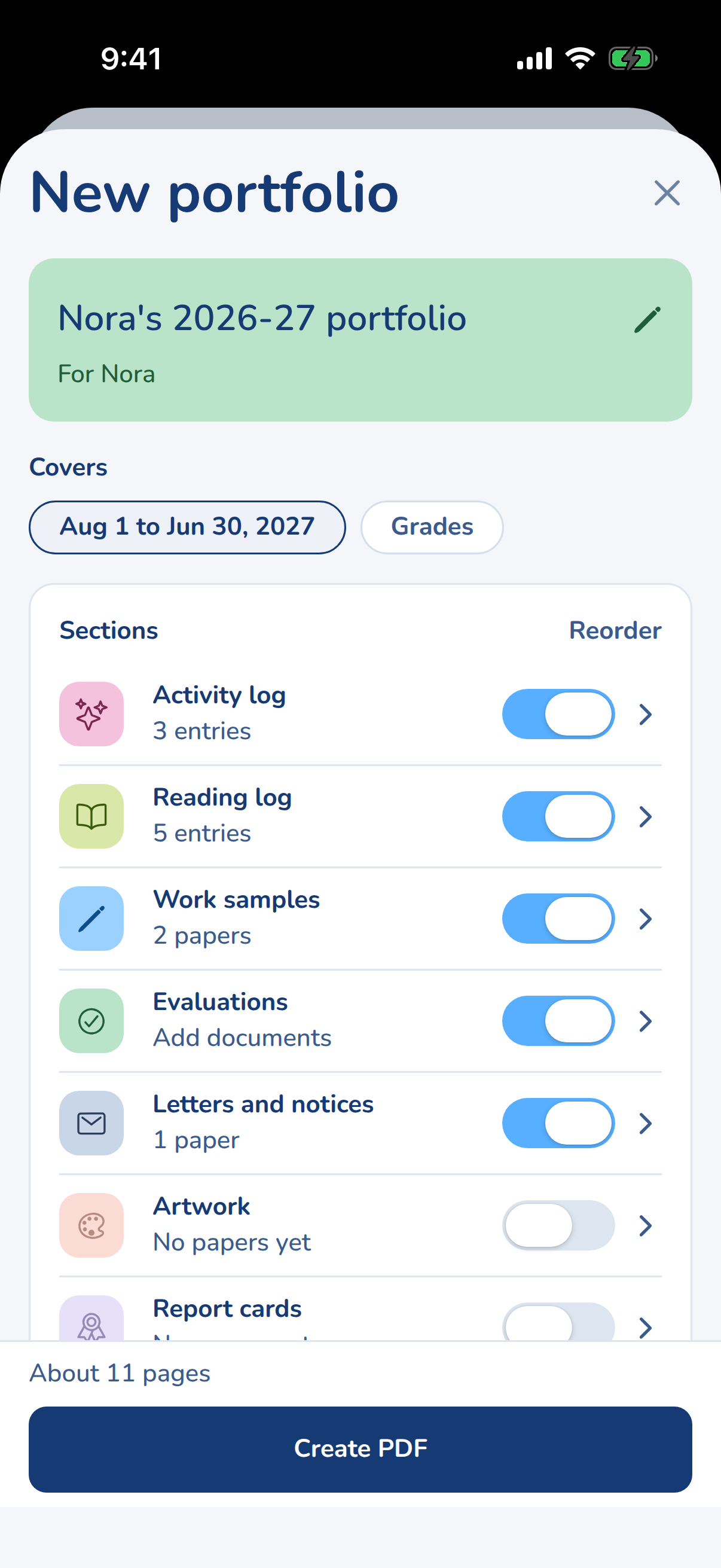
- The year is ready when someone asks. Start a New portfolio, pick your dates or grades, and get one PDF with a cover and contents. Share or print it from your phone, or share your child’s Portfolios folder read-only.
- Keepsakes stay safe, artwork and projects included. Turn on automatic backup, and every paper goes to KidsFoldr Cloud as it is filed. One tap on Back up copies every paper to your own Google Drive or iCloud.
You pick the portfolio’s sections and their order. For North Dakota, you might switch on:
- Parent summary for the year’s list of courses.
- Work samples, grouped by subject, with one from each subject as DPI suggests.
- Test results for each score report.
- An attendance or hours log. Fill from papers adds a day for each date your child has work filed, and you type the hours.
- Letters and notices for your statement of intent and the district’s letters, and Evaluations for a remediation or services plan.
Common questions
Do I have to keep a homeschool portfolio in North Dakota?
No. You keep an annual record of courses and progress, including any test results (NDCC 15.1-23-05). DPI suggests adding a sample of work from each subject.
Do I file a statement of intent every year?
Yes. You file it at least five days before you start, then once each year (NDCC 15.1-23-02). DPI says to file for each child age 7 or older.
Which grades are tested, and who sees the scores?
Grades 4, 6, 8 and 10. You file the results with your school district superintendent (NDCC 15.1-23-09, 15.1-23-11).
Can I opt out of the tests?
Yes, if you notify the district of a philosophical, moral or religious objection, or you hold a teaching license, a bachelor’s degree or a passing national teacher exam score. File it with your statement of intent (NDCC 15.1-23-09(2)).
How long do I have to keep homeschool records in North Dakota?
The law sets no period. Keep the record while your child might enroll in a public school. HSLDA advises at least two years, and high school records forever.