- Nevada asks for no portfolio, no work samples and no tests. No law says how long to keep homeschool records.
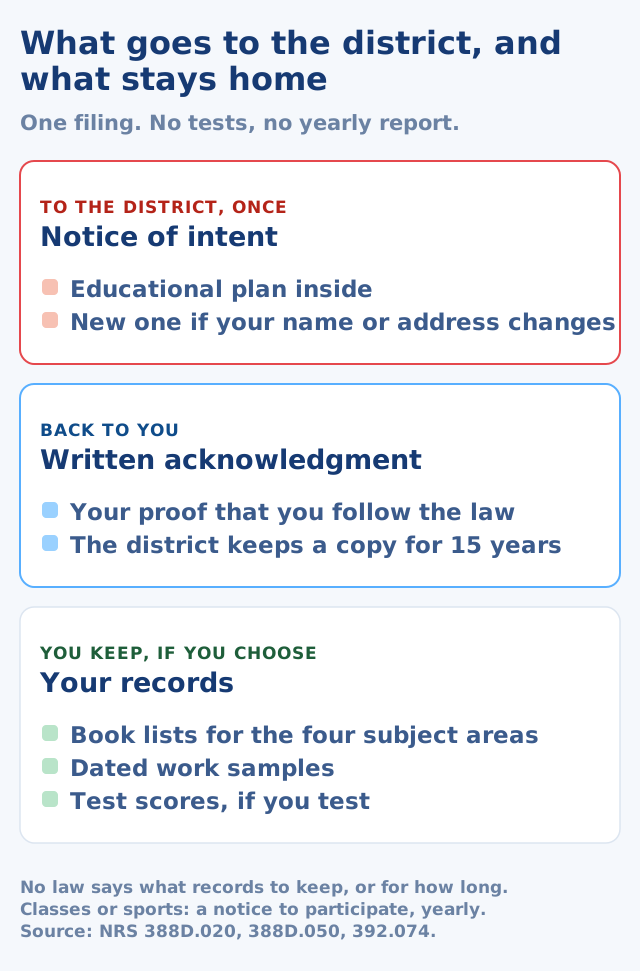
- You file a notice of intent to homeschool with your school district once, when you start. It includes an educational plan in English language arts, math, science and social studies.
- The district must accept a complete notice and send you a written acknowledgment. That letter is your proof that you’re following the law.
Picture one child’s records folder. It holds a copy of the notice of intent and educational plan you filed, the district’s acknowledgment letter, and some dated work and book lists. Maybe a test score report too, or a form for a public school class or sport.
This page covers homeschooling under NRS 392.070 and NRS 388D.010 to 388D.070. Enrolling in a private school is the other way to be excused from public school, and it isn’t covered here.
What Nevada requires instead of a portfolio
Nevada has no portfolio rule. The law asks for one filing, with a plan inside it (NRS 388D.020, 388D.050).
| Requirement | What the law says | Rule |
|---|---|---|
| Notice of intent | Filed once with the superintendent of schools of your school district | NRS 388D.020(1) |
| Educational plan | Part of the notice: English language arts, math, science and social studies | NRS 388D.050 |
| Who teaches | A parent, legal guardian or other person with the legal right to direct the child’s education | NRS 388D.010 |
| Days, hours, tests | None set | NRS 388D.010 to 388D.070 |
| Records | None required | NRS 388D.010 to 388D.070 |
Here’s the easy part. The law names no teaching certificate or degree.
Filing the notice of intent
You file it with the superintendent of schools of the district where your child lives, on the Nevada Department of Education’s (NDE) standard form. Use one form per child, and file it once (NRS 388D.020(1); NDE).
File it before you start homeschooling. If your child was in public school, file within 10 days of formally withdrawing. If you just moved to Nevada, file within 30 days (NRS 388D.020(2)).
The notice holds only these things (NRS 388D.020(5)):
- Your child’s full name, age and gender
- The name and address of each parent filing
- A signed, dated statement that you have charge of your child and the legal right to direct their education, and take full responsibility for it
- The educational plan
- The last Nevada public school your child attended, if any
- An optional statement that blocks release of the information without your written consent
Only one parent’s signature is needed (NDE). The superintendent must accept a complete notice and can’t ask for anything more (NRS 388D.020(6)).
File a new notice within 30 days if your name, your child’s name or your address changes (NRS 388D.020(4)). NDE also says to file again if your child returns to homeschooling after public school.
Next, the district sends you a written acknowledgment. The law calls it proof that you’re following Nevada’s school attendance law. The district keeps its own copy for at least 15 years (NRS 388D.020(7)).
What goes in the educational plan
The plan covers four subject areas: English language arts, math, science, and social studies, including history, geography, economics and government. You decide what fits your child’s age and skill (NRS 388D.050(1)).
The plan goes in with the notice. If it covers what the law asks, it can’t be a reason to turn down a complete notice (NRS 388D.050(2)). You don’t have to teach every subject every year (NRS 388D.050(3)).
The law sets no format and no length, and no one approves the plan. One rule to know: you must be ready to show the plan and proof of your child’s identity to a court, if a court asks (NRS 388D.050(2)).
Examples, not rules: a short section per subject, naming the books or curriculum you’ll use and the skills you’ll work on.
Who checks your homeschool
After the notice, no one does, on any schedule. Nevada has no required tests, no evaluator and no yearly report for homeschoolers (NRS 388D.010 to 388D.070).
The law also protects you. No school or organization may discriminate against a child who is or was homeschooled (NRS 388D.040(2)).
The Nevada homeschool year, step by step
Nevada’s dates come from your own moves, not a statewide calendar. These are the moments that create paper.
| When | What | Rule |
|---|---|---|
| Your child is 6 on or before August 1 | School age starts that school year | NRS 392.040 |
| Before you start, or within 10 days of withdrawing, or 30 days of moving to Nevada | File the notice of intent, once | NRS 388D.020(2) |
| After you file | The district sends a written acknowledgment | NRS 388D.020(7) |
| Within 30 days of a name or address change | File a new notice | NRS 388D.020(4) |
| Each school year your child takes a public school class or sport | File a notice of intent to participate | NRS 392.074; 388D.070 |
| Your child’s 18th birthday | The attendance law no longer applies | NRS 392.040(1) |
School is required from age 6 to 18 (NRS 392.040(1)). Filing the notice is what excuses your child from public school (NRS 392.070).
How long to keep homeschool records in Nevada
The law sets no time, because it requires no homeschool records at all. Your district keeps its copy of the acknowledgment for at least 15 years (NRS 388D.020(7)).
The Home School Legal Defense Association (HSLDA) suggests keeping most records, like book lists, work samples and test results, at least two years. It says to keep high school records and proof that you followed the law in those years, including your notice, forever. Both are advice, not law.
Our advice: keep a few originals on paper. Those are the notice and plan you filed, the district’s acknowledgment, any other letter to or from your district, test score reports if you test, and high school work you may need for credit. Everything else can be a scan.
Work samples: not required, still worth keeping
Nevada asks for no work samples. But they help if your child goes back to school, where a school may use only commonly used practices to place a homeschooled child (NRS 388D.040(1)).
High school is where records count most. To enroll in a public high school, your child shows they finished the courses needed for promotion. That proof is an accredited homeschool program the district recognizes, a district exam, or other proof the district accepts (NRS 392.033(5)).
For credit, NDE points homeschoolers to NAC 389.680. A district grants credit for correspondence courses from schools accredited by the groups it names, if the course matches one the district offers. Keep those course records.
What counts is up to you. Examples, not rules: a dated math page, a writing piece, a science lab sheet, a book list.
Public school classes, sports and tests
Your homeschooled child can take public school classes and play school sports. File a notice of intent to participate with your district for each school year (NRS 392.074; 388D.070).
For classes, the district must say yes if there’s space and you show your child is qualified. It doesn’t have to provide transportation (NRS 392.074(1)).
For sports, your child plays for the public school they’re zoned for, under the same rules as enrolled students and none stricter. The district must ask for proof of identity, such as a birth certificate, and may ask for it before classes too (NRS 392.074(3), (4), (5)).
Every district must also let homeschooled children take the SAT, ACT, PSAT and National Merit test, and post where to find the details on its website (NRS 388D.040(3)).
Can your records be digital?
Yes, as far as the law goes. No law sets a format for homeschool records, and no evaluator ever reviews them. The statute even lets the district keep its copy of your acknowledgment electronically (NRS 388D.020(7)).
Keep copies you could print if a school, a court or a college asks. That is advice, not law.
What changes in 2026 and 2027
2026
No change to Nevada’s homeschool law. The notice of intent rules last changed in 2023, and no 2025 act touched the homeschool sections.
One 2023 law changed the start date: school age has begun at 6, not 7, since July 1, 2024 (AB 65).
2027
No change is scheduled. Nevada’s Legislature meets every other year, and the 2027 session begins February 1, 2027. Any new law would come from that session.
Keeping your records in KidsFoldr
In Nevada the records are yours to keep, so keep them the easy way: on your phone, not on a shelf of binders. Snap each paper for peace of mind, and the paper can go. Every book list and work sample is filed by child, grade and type (and subject for schoolwork), with nobody sorting and nothing to type.
The few originals named above stay on paper. Snap them too, so a copy is always at hand. Snap a test date notice or a sports schedule, and the date lands on your family calendar, linked back to the paper, with nothing to type.
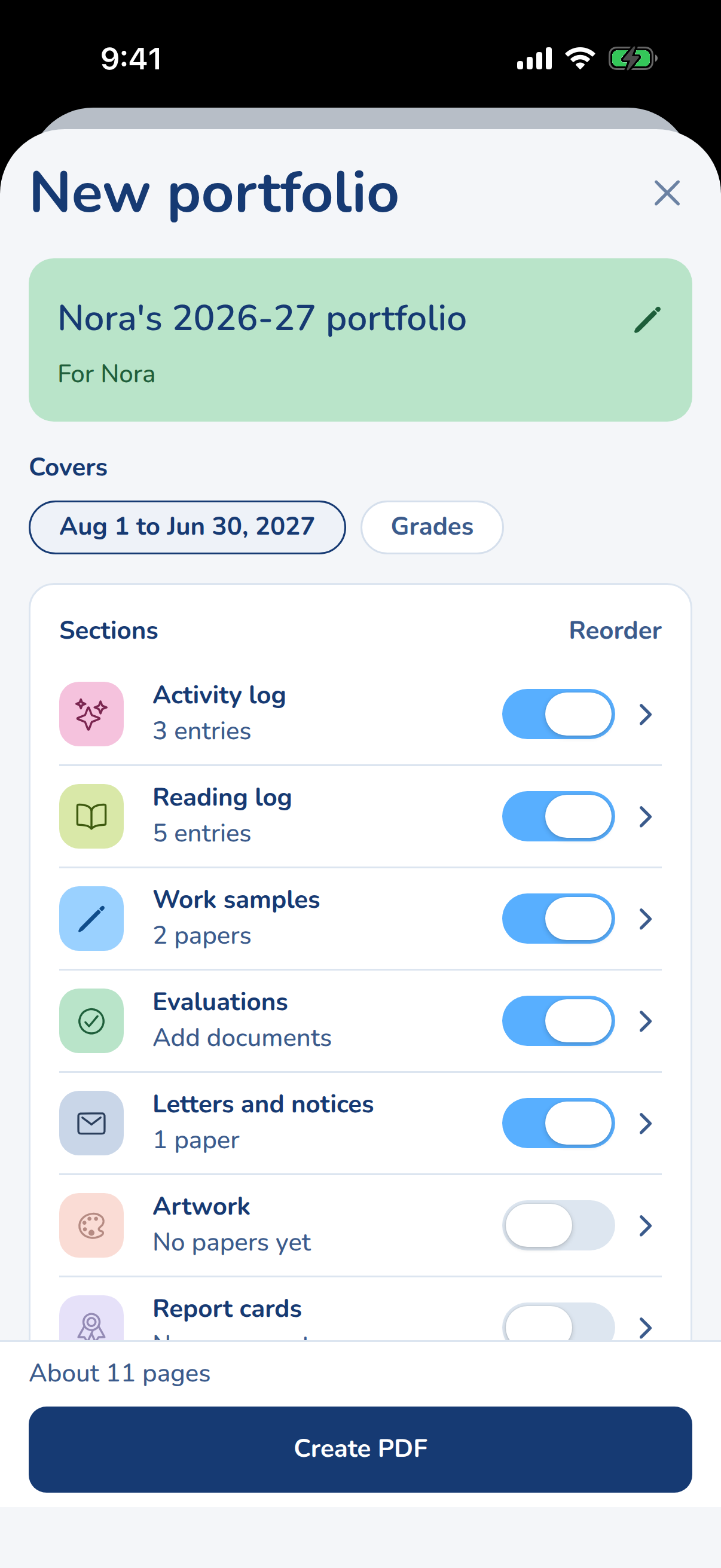
If a high school, a court or a college asks, the year is ready. Start a New portfolio for a grade or your own dates, and print or share the PDF. You pick the sections. For Nevada, you might switch on:
- Work samples, sorted by subject, for the four subject areas
- A reading log, for English language arts
- Letters and notices, for your notice, your plan and the acknowledgment
- Test results, if you test
Turn on automatic backup, and every paper goes to KidsFoldr Cloud as it is filed. One tap on Back up copies every paper to your own Google Drive or iCloud, and every paper is searchable by any word on it.
Common questions
Do I need a homeschool portfolio in Nevada?
No. Nevada law asks for no portfolio, no work samples and no tests. You file a one-time notice of intent with an educational plan (NRS 388D.020, 388D.050).
Do I have to file a notice of intent every year?
No. You file it once, and again within 30 days if your name, your child’s name or your address changes (NRS 388D.020(4)). NDE also says to refile if your child returns to homeschooling after public school.
Does the district approve my educational plan?
No. The superintendent must accept a complete notice and can’t ask for anything more (NRS 388D.020(6)).
How long do I have to keep homeschool records in Nevada?
No law sets a time. Your district keeps its copy of the acknowledgment for at least 15 years. HSLDA advises keeping most records at least two years, and high school records forever.
Can my homeschooled child play sports at the public school?
Yes. File a notice of intent to participate for the school year, and your child plays for their zoned school under the same rules as enrolled students (NRS 392.074).