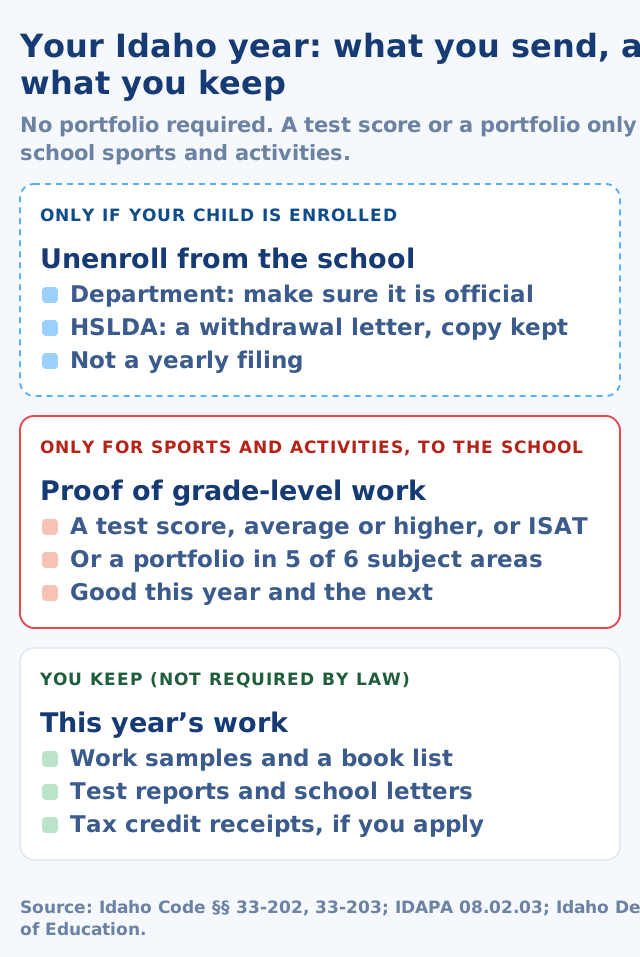
- Idaho law asks for no portfolio, notice, registration, records or standardized test.
- You teach the subjects “commonly and usually taught” in Idaho’s public schools, to children from 7 to 16.
- To join a sport or activity at your public school, your child shows grade-level work: a test score in the average range or higher, or a portfolio.
The paper on your table is this year’s folder of work: worksheets, a book list, the curriculum you teach from. Beside it may sit a copy of the withdrawal letter you sent your child’s old school. If your child plays a sport at the public school, there may be a dual enrollment form and a test score report too.
If you apply for Idaho’s Parental Choice Tax Credit, add your receipts to the pile. Good news: the rules are short.
Does Idaho require a homeschool portfolio?
No. Idaho’s attendance law lets a parent have a child “privately instructed by, or at the direction of” the parent (Idaho Code § 33-202). It asks for no portfolio, log, records, notice or test.
The Idaho Department of Education says it does not regulate or monitor homeschooling. There is no registration and no reporting, and the Department keeps no records on homeschool families. There is no state testing, and you don’t need a teaching license (Department FAQ).
Here is what Idaho does ask: teach the subjects “commonly and usually taught” in Idaho’s public schools, to children from 7 to 16 (§ 33-202). The Department points to the Idaho Content Standards and says you choose which ones to teach. The Home School Legal Defense Association (HSLDA), an advocacy group, recommends language arts, math, science and social studies.
The Department also recommends keeping your own records of attendance and finished work. That is advice, not law. The rest of this page covers what’s worth keeping, and when someone will ask for it.
Leaving a school
If your child is enrolled in a public school, the Department’s first step is to make sure your child is officially unenrolled. No Idaho law sets a form for it.
HSLDA advises withdrawing formally, and before a new school year starts if your child is enrolled for it, so the school doesn’t mark your child absent. Your school may have its own form. HSLDA also suggests sending letters by certified mail and keeping copies.
If your district asks about your homeschool later, HSLDA says you are not legally required to give it the information.
Sports and activities at your public school: where a portfolio counts
Idaho lets a homeschooled child dual enroll in a public school, charter schools included, and join its programs on the same terms as other students (§ 33-203(1), (2), (9)). This is the one place Idaho asks for a portfolio, and only as one way to show grade-level work.
| What the school needs | Rule |
|---|---|
| Proof you live in the school’s attendance area, such as a copy of your driver’s license or a recent utility bill | § 33-203(6); IHSAA |
| Grade-level work: a composite, core or survey score in the average range or higher on a nationally normed test, an ISAT score, or a portfolio | § 33-203(4); IDAPA 08.02.03.111.13 |
| The same rules and standards of behavior and performance as other students | § 33-203(2) |
| The Idaho High School Activities Association’s (IHSAA) dual enrollment form, signed by you, your child and the school | IHSAA |
A score or portfolio counts for this school year and the next (§ 33-203(4)). Schools must let a student who wants to dual enroll take the state or standardized tests their own students take. IHSAA says your child arranges the test and gives the principal the results.
One catch: a public school student who lost academic eligibility can’t win it back by switching to homeschool, that year or the next (§ 33-203(5)). Each district sets its own dual enrollment procedures, and full programs give full-time students priority (§ 33-203(1)).
What counts as a work sample?
The State Board of Education’s rule asks for a portfolio that shows grade-level work in at least five of six areas: language arts and communications, math, science, social studies, health and humanities. A committee judges it: at least one teacher from each subject in the portfolio, plus the principal of the school (IDAPA 08.02.03.111.13).
IHSAA’s form says the portfolio should include core classes. IHSAA also posts a sample rubric a school may use, scoring each area from 1 to 4, where an average of 3 means grade level.
Our examples, not the rule’s: dated math pages, a writing piece, a science lab sheet, a book list, a health unit, and a photo of an art or history project.
The Idaho homeschool year: what you send, and when
There is no statewide deadline. Your dates come from your own papers: the day you leave a school, a sports season, a test window, the tax credit’s application period.
How long to keep homeschool records in Idaho
The law sets no period, because it asks you to keep nothing. Our advice: keep your withdrawal copy for as long as you homeschool.
HSLDA advises keeping records for at least two years. It says to keep high school records, and proof you followed the law in those years, forever. That is advice, not law.
If your child goes back to school
The school your child joins decides the grade. The Department says it may test your child, review your coursework or records, or place your child by age for a trial period.
Homeschooled students don’t graduate with a diploma from an accredited high school, and colleges will ask homeschoolers for more to apply (Department FAQ). That is where a folder of dated work pays off.
The Parental Choice Tax Credit: keep the receipts
Idaho’s Parental Choice Tax Credit is a refundable income tax credit of up to $5,000 per student, or $7,500 for a child with certain disabilities (§ 63-3029N). You apply first. An award is not approval of your expenses, so keep every receipt: the Tax Commission says everyone is subject to audit.
The law says home schooling doesn’t count as being enrolled in a public school (§ 63-3029N(10)(b)). But instruction you give your own child is not a qualified expense (§ 63-3029N(10)(c)).
The Tax Commission lists expenses that might qualify, including a base curriculum covering English, math, science and social studies, textbooks, tutoring in those subjects, and standardized, college admission and AP tests. Applications open January 15 each year, for 60 days (§ 63-3029N(4)).
For an unaccredited private school, microschool or learning pod, the law asks for a “portfolio of evidence or learning record” of the student’s growth (§ 63-3029N(2)(d)). Ask the Tax Commission how the rules fit your family before you apply.
Will a school accept a digital portfolio?
The law doesn’t say what form your records must take. The State Board’s rules define a portfolio as “a digital or physical collection” of a student’s work (IDAPA 08.02.03.007.18).
So for a sport or activity, the school’s committee and principal decide what they will look at. For placement, the school your child joins decides. Ask first. A printed copy works for anyone who wants paper.
What changes in 2026 and 2027
2026
The homeschool law did not change. Section 33-202 was last amended in 2009, and § 33-203 in 2017.
Two 2026 proposals went nowhere. House Joint Resolution 9, a constitutional amendment adding a right to educate children without government regulation outside public schools, failed in the House on March 5, 2026. House Bill 778, on taking part in public school activities, was sent to committee and went no further.
House Bill 934 changed the tax credit, back to January 1, 2026. A curriculum can now come from more than one company, and a homeschooled student who plays public school sports isn’t counted as enrolled.
2027
The next session opens January 11, 2027 (Idaho Const. art. III, § 8), and any bill filed for it is not law until it passes. The tax credit’s 2027 application period puts parents who got a credit the year before first in line (§ 63-3029N(6)).
Keeping the year’s work in KidsFoldr
The stack of worksheets can go, and the year stays organized with no sorting and nothing to type. Snap each page as you teach, and KidsFoldr files it by child, grade and type, with schoolwork and tests by subject too. It’s a homeschool record keeping app that does the filing for you.
- The paper goes, with no guilt. Scan a page for peace of mind, then toss it: no pile on the counter, no shelf of binders. Keep the originals that matter, though: your withdrawal letter copy, test score reports, tax credit receipts if you apply, and high school work a school may need for credit.
- You keep up as papers arrive. Forward a school’s email or a score report, and it files the same way.
- Dates land on the calendar. Snap a test admission ticket or a school letter with a testing date, or forward the test center’s email, and the date goes on your family calendar, linked back to its paper, with nothing to type.
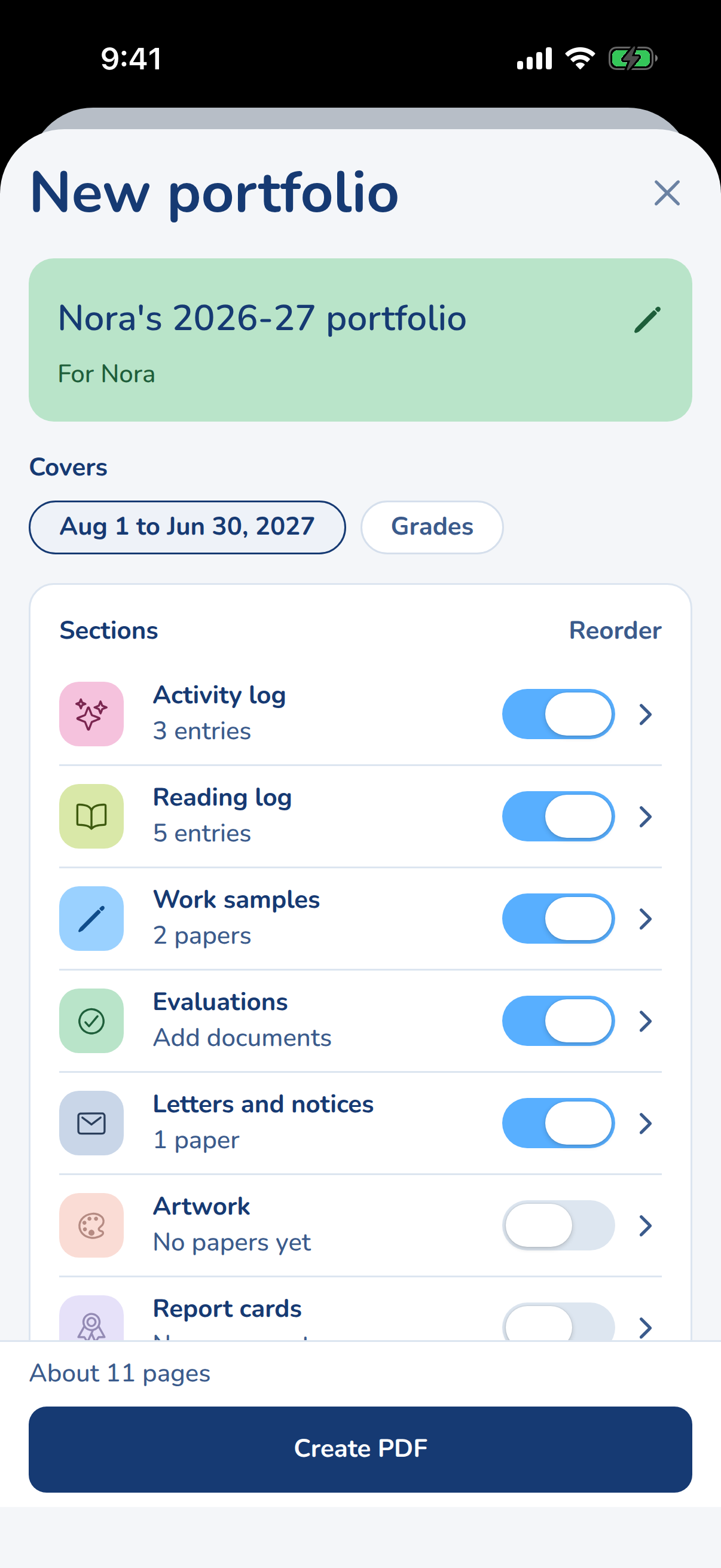
- The portfolio is ready when the principal asks. Start a New portfolio, pick your dates or grades, and get one PDF with a cover and contents. Share or print it from your phone, or share your child’s Portfolios folder read-only.
- Keepsakes stay safe, artwork and projects included. Turn on automatic backup, and every paper goes to KidsFoldr Cloud as it is filed. One tap on Back up copies every paper to your own Google Drive or iCloud.
You pick the portfolio’s sections and their order. For an Idaho activities portfolio, you might switch on:
- Work samples, grouped by subject, for the five or six areas the committee looks at.
- Test results for an ISAT or other test score.
- A reading log (title, author and date) for the year’s books.
- Letters and notices for your withdrawal letter and any school letters.
Common questions
Do I have to keep a homeschool portfolio in Idaho?
No. The law doesn’t require one. It’s still worth keeping dated work, a book list and test results in case your child joins a public school sport, returns to school or applies to college.
Do I have to tell the state or my district that I’m homeschooling?
No. There is no registration and no reporting. If your child is enrolled in a public school, the Department says to make sure your child is officially unenrolled.
Does my child have to take a standardized test?
No. A test score is one way to show grade-level work for a public school sport or activity, and a portfolio is another (§ 33-203(4)).
How long do I have to keep homeschool records in Idaho?
The law sets no period. HSLDA advises at least two years for most records, and high school records forever.
Can my homeschooler play sports at the public school?
Yes, through dual enrollment at the school whose attendance area you live in, with a test score in the average range or higher, or a portfolio (§ 33-203).