
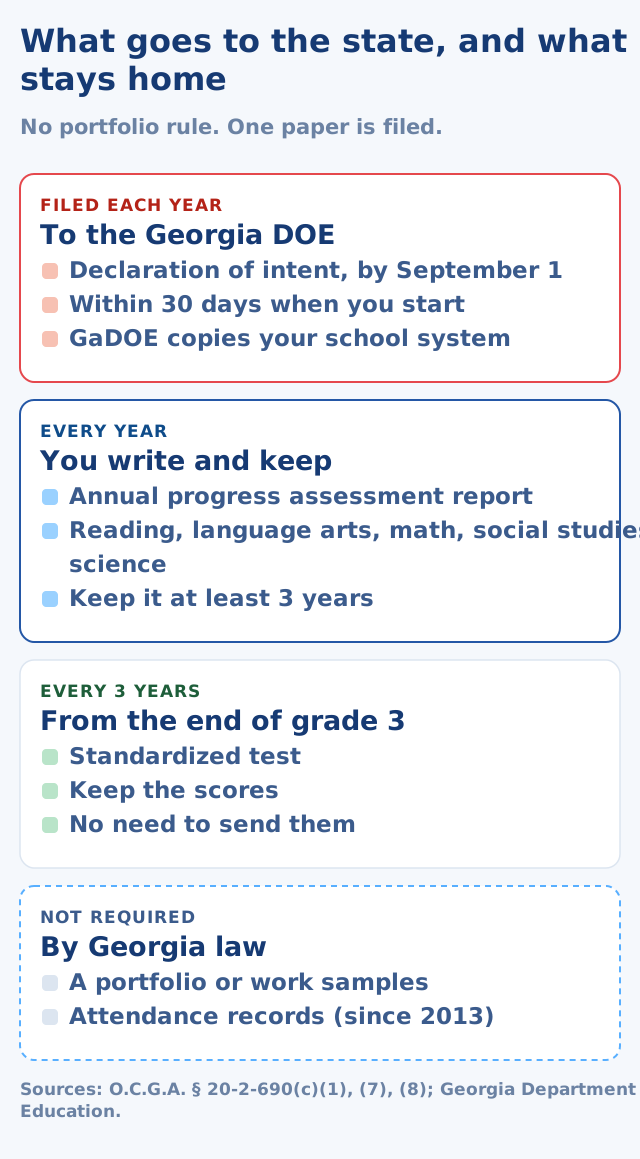
- No portfolio. You file one paper with the state: a declaration of intent, within 30 days of starting and by September 1 each year.
- Once a year, you write an annual progress assessment report covering five subjects. Keep each one at least three years.
- Test at least every three years, starting at the end of third grade. You keep the scores; you don’t send them.
The paper here is this year’s annual progress assessment report: the pages you write about how your child did in each subject. Beside it sit the declaration of intent you filed with the state and, in a testing year, the score report.
This page covers a home study program under O.C.G.A. § 20-2-690(c). A private school runs under its own part of the law, subsection (b).
Does Georgia require a homeschool portfolio?
No. Georgia’s home study law never uses the word “portfolio” (§ 20-2-690(c)). It names three papers instead, and only one of them goes to the state.
| Paper | What the law says | Send it? | Keep it |
|---|---|---|---|
| Declaration of intent | Within 30 days of starting, then by September 1 each year | Yes, to the Georgia Department of Education, which copies your school system | Keep a copy (GaDOE’s advice) |
| Annual progress assessment report | Written each year by the teaching parent or tutor, covering five subjects | No | At least three years |
| Standardized test scores | At least every three years, from the end of third grade | No | Kept; the law sets no period |
| Attendance records | Not required since 2013 | No | Your choice |
| Work samples | Not required | No | Your choice |
Good news: the state’s part is small. The Georgia Department of Education (GaDOE) says its role is “very limited.” It collects the declaration of intent and nothing else.
The declaration of intent
File it with GaDOE within 30 days of starting your home study program. After that, file it by September 1 every year (§ 20-2-690(c)(1)).
It lists each child’s name and age, your program’s address, your local school system, and the 12-month period you count as your school year (§ 20-2-690(c)(2)). You can file it online through GaDOE’s system, or print the form and send it by email, fax or mail.
GaDOE sends a copy to your local school system (§ 20-2-690(c)(1)). The form also asks you to tell GaDOE if you move or stop homeschooling.
Keep a copy. GaDOE strongly encourages it, and a teen needs one to get a driving permit, a license or a youth work permit.
Leaving a public school? The declaration is the proof of enrollment your school system needs. If a child stops attending for 45 days with no declaration filed, the school refers the family to the Division of Family and Children Services, and showing a copy of the declaration ends that check (§ 20-2-785).
Who teaches, what, and for how long
A parent with a high school diploma or a state approved high school equivalency (HSE) diploma may teach their own children. You may also hire a tutor with the same diploma (§ 20-2-690(c)(3)).
Your program must include reading, language arts, math, social studies and science. That list is a floor: “includes, but is not limited to” (§ 20-2-690(c)(4)).
Each 12-month school year needs the equal of 180 school days of at least four and a half hours each, unless your child is physically unable (§ 20-2-690(c)(5)). You choose the 12 months, and you can start any time of year. GaDOE’s form says days your child spent in a public or private school earlier that year count toward the 180.
Do I have to keep attendance records?
No. Georgia law once said attendance records “shall be kept” and sent in, and a 2013 law struck that sentence (HB 283). The 180-day rule still stands, but the law doesn’t say how to show it.
Advice, not law: the Home School Legal Defense Association (HSLDA) suggests keeping attendance records anyway.
The annual progress assessment report
Once a year, the teaching parent or tutor writes an assessment of your child’s progress in reading, language arts, math, social studies and science. You keep each report at least three years (§ 20-2-690(c)(8)).
The law sets no form, no length and no due date. You don’t send it to anyone.
Here’s where it gets used. Under the Dexter Mosely Act, a home study student in grades 6 to 12 can try out for sports and activities at the local public school. At least 30 days before the semester, the family gives the principal and superintendent written notice and a copy of the most recent progress report, with the instructor’s written word that the child is passing each course. The student also takes one qualifying course through the school system each semester they take part (§ 20-2-319.6(c)).
A student who leaves public school to homeschool has to wait 12 months from the declaration before joining (§ 20-2-319.6(d)).
What counts as a work sample?
Georgia law asks for no work samples at all. Keeping a few still makes the report easier to write.
Examples, not rules: a dated math page, a writing piece, a science sheet, a reading list. One or two per subject per year is plenty to back up what you write.
Standardized testing every three years
Your child takes a nationally standardized test at least every three years, starting at the end of third grade. The test is given “in consultation with” a person trained in giving and reading norm-referenced tests (§ 20-2-690(c)(7)).
Keep the scores. You don’t send them to any school or state office, and the law sets no end date for keeping them (§ 20-2-690(c)(7)). The law doesn’t name a test.
Since July 1, 2025, a school system that gives the PSAT, SAT, PreACT, ACT, ASVAB or an AP exam must open it to home study students in grades 6 to 12 who live there. It must post the dates and can’t charge you a fee its own students don’t pay (§ 20-2-324.8).
The Georgia homeschool year, date by date
Georgia has one statewide date: September 1. Everything else runs on the school year you choose.
| When | What | Rule |
|---|---|---|
| Within 30 days of starting | First declaration of intent to GaDOE | § 20-2-690(c)(1) |
| By September 1 each year | Declaration for the coming year | § 20-2-690(c)(1) |
| Through your 12-month school year | 180 days of at least 4.5 hours, five subjects | § 20-2-690(c)(4), (5) |
| End of third grade, then at least every 3 years | Standardized test; keep the scores | § 20-2-690(c)(7) |
| Once a year | Write the annual progress assessment report | § 20-2-690(c)(8) |
| Three years after each report | The earliest the law lets it go | § 20-2-690(c)(8) |
How long to keep homeschool records in Georgia
Progress reports: at least three years (§ 20-2-690(c)(8)). Test scores: the law says “retained” and gives no end date (§ 20-2-690(c)(7)). Nothing else has a rule.
Advice, not law: keep a copy of every declaration, as GaDOE suggests. HSLDA advises keeping other records at least two years, and high school records and proof that you followed the law in the high school years for good.
Our advice: keep test scores at least as long as the progress reports.
Can your records be digital?
Yes, as far as the law goes. Georgia’s home study law doesn’t say paper or digital, and nobody reviews your records by default (§ 20-2-690(c)). GaDOE itself takes the declaration online and can email you a copy.
Two times a school may want to see them: the Dexter Mosely route, and enrolling in a public school, where the school system decides your child’s placement and credit. Ask what format they want. A printed copy works for anyone who wants paper.
What changes in 2026 and 2027
2026
No change to Georgia’s home study rules in § 20-2-690(c) in 2025 or 2026. The last changes were small: in 2021 the parent’s power to sign documents grew to cover the Dexter Mosely Act, in 2022 “GED” became “high school equivalency (HSE),” and in 2024 a Code cleanup fixed one word in the testing rule.
Laws nearby did change:
- HB 1193 took effect May 5, 2026. State policy now encourages starting school, home study included, at age five. Attendance is still required from six to 16 (§ 20-2-690.1(b)).
- HB 1193 also says a child enrolled 20 or more days in a public school before turning six is covered by the attendance rules (§ 20-2-150(c)).
- SB 179 took effect July 1, 2026. A school that teaches only online can now count as a private school (§ 20-2-690(b)(3)).
- In 2025, SB 63 opened school-run tests to home study students, and SB 123 rewrote the attendance rules for public schools.
A special session in 2026 dealt with property taxes, not schools.
2027
No change to § 20-2-690(c) is scheduled, and no 2027 bill has been filed. Your declaration is still due by September 1.
Keeping your records in KidsFoldr
Three years of progress reports and score sheets don’t need a shelf of binders. Snap each one for peace of mind, and the paper can go. It’s filed by child, grade and type, with schoolwork and tests by subject too, and nobody sorts a thing or types a word.
Keep the originals of anything a school or program may need on paper: official letters from GaDOE or your school system, and high school work you may need for credit. Snap those too, so a copy is always at hand.
Dated papers take care of themselves. Snap a testing appointment or a letter from your school system, and the date lands on your family calendar, linked back to the paper, with nothing to type.
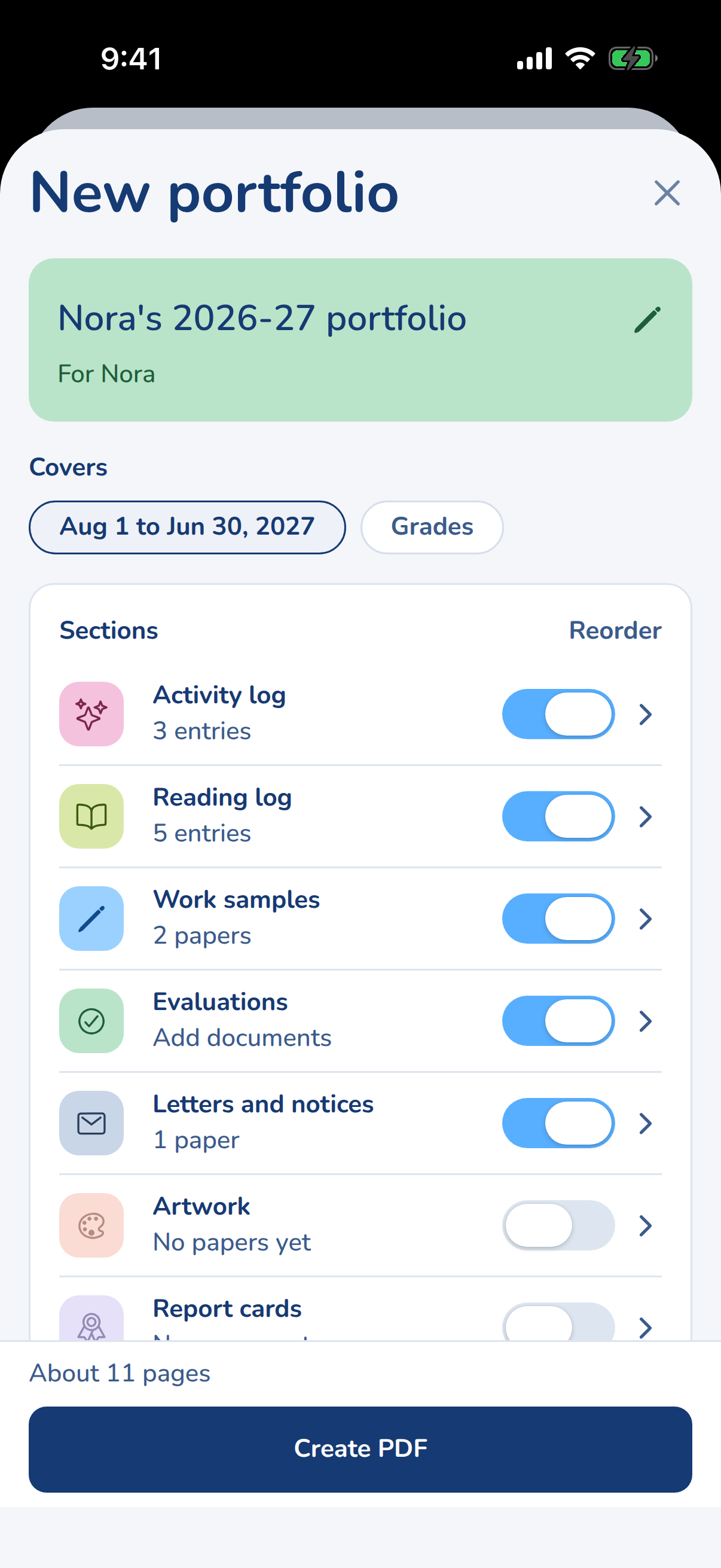
When a school asks, the year is ready. Start a New portfolio for your own school year or a grade, and print or share the PDF. You pick the sections. For Georgia, you might switch on:
- The Parent summary, for the progress report in your own words, or Evaluations for a report you wrote elsewhere
- Test results, for the score report
- Letters and notices, for your declaration copies
- The attendance or hours log, if you keep one: Fill from papers adds a day for every date your child has work on file
- Work samples and a reading log, if you like
Keepsakes stay safe, artwork included. Turn on automatic backup, and every paper goes to KidsFoldr Cloud as it is filed. One tap on Back up copies every paper to your own Google Drive or iCloud, and every paper is searchable by any word on it.
Common questions
Do I need a homeschool portfolio in Georgia?
No. Georgia law names three papers: a yearly declaration of intent, an annual progress assessment report, and standardized test scores every three years (§ 20-2-690(c)).
Do I send my progress reports or test scores to anyone?
No. You keep both (§ 20-2-690(c)(7), (8)). The one exception is by choice: the Dexter Mosely Act asks for the latest progress report if your child joins a public school team or activity.
How long do I have to keep homeschool records in Georgia?
Progress reports, at least three years. Test scores must be kept, but the law gives no end date (§ 20-2-690(c)(7), (8)).
Do I file a declaration of intent every year?
Yes. File it within 30 days of starting, then by September 1 every year (§ 20-2-690(c)(1)).
Do I have to keep attendance records?
No. A 2013 law removed that duty. You still teach the equal of 180 days of four and a half hours (§ 20-2-690(c)(5)).
Who can teach a homeschool in Georgia?
A parent with a high school diploma or an HSE diploma, for their own children. You can also hire a tutor with the same diploma (§ 20-2-690(c)(3)).