- California asks a home-based private school for no portfolio, no work samples and no testing. No one reviews your teaching each year.
- File the private school affidavit between October 1 and 15, every year. You sign it under penalty of perjury, and filing it is not an approval.
- Keep three records: an attendance register that marks every absence of a half day or more, your courses of study, and each teacher’s name, address and qualifications.
Picture one child’s records folder. It holds this year’s affidavit printout or confirmation, the attendance register, a list of the courses you teach and a short list of who teaches them. Some work samples sit behind those, because you chose to keep them.
This page covers homeschooling as a home-based private school under Cal. Educ. Code §§ 48222 and 33190. A private school satellite program (PSP), a credentialed tutor, or a charter or independent study program is a different route. See which route you’re on.
What California requires instead of a portfolio
California has no portfolio rule. Your homeschool is a private school, and the law exempts a child taught “in a private full-time day school by persons capable of teaching” (§ 48222).
| Requirement | What the law says | Rule |
|---|---|---|
| Teachers | “Persons capable of teaching.” No credential is required | § 48222 |
| Language | Taught in English | § 48222 |
| Subjects | The branches of study public schools must teach | § 48222; §§ 51210, 51220 |
| Attendance | A register that clearly shows every absence of a half day or more | § 48222 |
| Yearly filing | A private school affidavit, October 1 to 15 | § 33190 |
| Records kept | The register, your courses of study, and each teacher’s name, address and qualifications | § 33190(f) |
For grades 1 to 6, the public school subjects are English, math, social sciences, science, visual and performing arts, health and physical education (§ 51210). Grades 7 to 12 add a world language, applied arts, career technical education and driver education (§ 51220).
Here’s the easy part. The law sets no hours, minutes or days for a private school, and it names no tests and no evaluator.
The affidavit asks about background checks under § 44237. That section does not apply to a parent or guardian working only with their own children (§§ 33190(g), 44237(b)(4)).
The private school affidavit, every year October 1 to 15
The one thing you file is the private school affidavit, between October 1 and 15 each year (§ 33190). As the owner or head of your school, you sign it under penalty of perjury.
It gives your school’s name and address, where your records are kept and who keeps them, your enrollment by grade and your number of teachers. It also states that your register, courses of study and teacher list are kept at that address and are true and accurate (§ 33190(a)-(f)).
It is not an approval. Filing does not mean the state has evaluated, approved or endorsed your school, and no school may claim it does (§ 33190). Your school district’s attendance supervisor verifies that you filed, and that check is not an approval either (§ 48222).
The law names the Superintendent of Public Instruction as the official you file with until the end of 2026. The Home School Legal Defense Association (HSLDA) says the form is on the California Department of Education’s website. From January 1, 2027, you file with a new Education Commissioner (see 2026 and 2027 changes).
The law names only the October window. If you start after October 15, HSLDA advises filing as soon as possible. That is advice, not law.
Who checks your homeschool
No one reviews your teaching on a schedule. California law has no testing, no evaluator and no yearly review for a home-based private school.
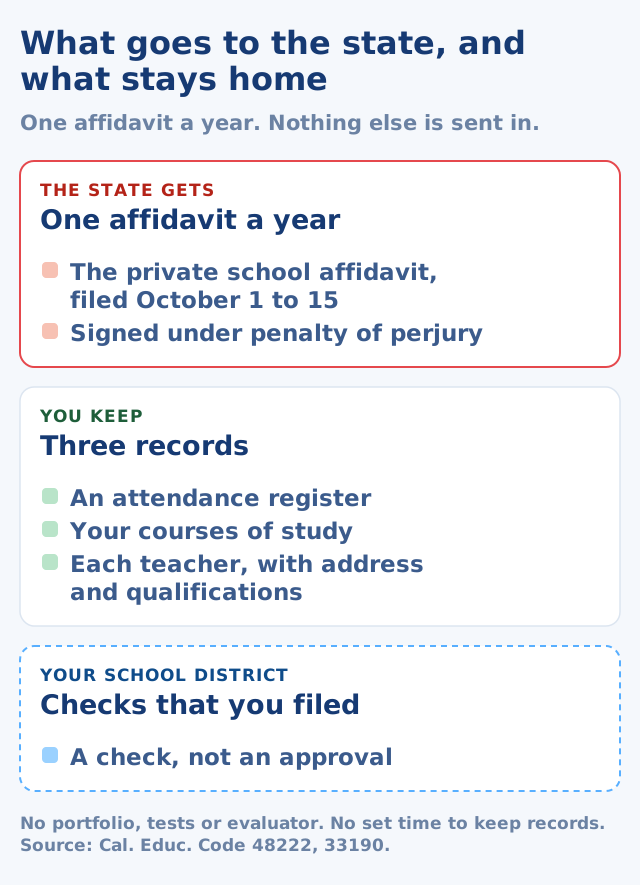
The affidavit goes to the state. The register, the courses of study and the teacher list stay at the address on your affidavit, and you state that they are true and accurate (§ 33190(f)). The district checks only that you filed (§ 48222).
Keep those three records current and in order. They are the records the law names.
The California homeschool year, date by date
One window matters every year: October 1 to 15.
| When | What | Rule |
|---|---|---|
| Ages 6 to 18 | Full-time school is required, unless your child is exempt | § 48200 |
| October 1 to 15, every year | File the private school affidavit | § 33190 |
| Starting after October 15 | File as soon as possible (HSLDA’s advice) | HSLDA |
| Every school day | Keep the register. Mark every absence of a half day or more | § 48222 |
| All year | Keep your courses of study and teacher list current | § 33190(f) |
| From January 1, 2027 | File with the Education Commissioner | AB 181 |
A private school that meets § 48222 exempts your child from public school attendance (§§ 48200, 48222).
How long to keep homeschool records in California
The law sets no time. Neither § 48222 nor § 33190 says how long to keep the register or the lists.
HSLDA suggests keeping most records at least two years. It says to keep high school records and proof that you followed the law during the high school years forever. Both are advice, not law.
Our advice: keep a few originals on paper. Those are every affidavit printout or confirmation, any letter from a school district or the state, test score reports if you test, and high school work you may need for a transcript or credit. Everything else can be a scan.
Work samples: not required, still worth keeping
California asks for no work samples. HSLDA still lists samples of schoolwork, the textbooks and workbooks you used, and test results among the records worth keeping.
They show your teaching if a college, a program or a school ever asks. That is advice, not law.
What counts is up to you. Examples, not rules: a dated math page, a writing piece, a book list, a science lab sheet, an art project.
Home-based private school, PSP, tutor or public school at home
The rules on this page are for a home-based private school. Three other routes run on other rules.
| Route | Who files an affidavit? | Records and rules | Law |
|---|---|---|---|
| Home-based private school | You, October 1 to 15 | You keep the register, courses of study and teacher list | §§ 48222, 33190 |
| Private school satellite program (PSP) | The PSP, as the private school | The PSP keeps the records the law names. Anything else is the PSP’s own policy | §§ 33190, 48222, 48986(e)(3) |
| Credentialed private tutor | No affidavit | The tutor holds a credential for the grade, and teaches at least 3 hours a day, 175 days a year, between 8 a.m. and 4 p.m. | § 48224 |
| Charter school or district independent study | No affidavit: it is a public school | The school’s own rules | §§ 47615, 51745 |
“PSA” and “PSP” are common shorthand, not the statute’s words. The tutor route is the only one that needs a teaching credential (§ 48224).
Can your records be digital?
Yes, as far as the law goes. It sets no format for the register or the lists, and no evaluator reviews them.
Keep copies you could print if a district or a college asks. That is advice, not law.
What changes in 2026 and 2027
2026
No change to the affidavit, the register or the subjects. This year’s affidavit is due October 1 to 15, 2026.
SB 848, the Safe Learning Environments Act (ch. 460, Stats. 2025), required private schools to adopt written safety policies by July 1, 2026 (§ 32100). HSLDA reads its main private school parts as not reaching parents who teach only their own children, but as possibly reaching PSPs. Read the law, or ask your PSP, if you are unsure.
Two 2026 laws amended § 44237, the background check rule (AB 2796, ch. 313, and SB 685, ch. 975). Both keep the line that it does not apply to a parent working only with their own children.
2027
From January 1, 2027, AB 181 (ch. 66, Stats. 2026) has you file the affidavit with the Education Commissioner, a new office the Governor appoints to run the Department of Education. It replaces the Superintendent of Public Instruction in § 33190. The October 1 to 15 window and the affidavit’s contents stay the same.
Also from January 1, 2027, SB 1188 (ch. 154, Stats. 2026) says a school district or other local educational agency with a JROTC program must let a homeschooled pupil who lives in its attendance area join, if the pupil meets the program’s other rules.
The new Legislature convenes December 7, 2026. Any new bill would come after that.
Keeping your records in KidsFoldr
The law names three records and nothing more, so the easy answer is to keep every paper of the year on your phone instead of a shelf of binders. Snap each paper for peace of mind, and the paper can go. Every paper is filed by child, grade and type (and subject for schoolwork and tests), with nobody sorting and nothing to type.
The few originals named above stay on paper. Snap them too, so a copy is always at hand. Snap a letter from your district, a test appointment or a PSP’s meeting schedule, and the date lands on your family calendar, linked back to the paper, with nothing to type.
Your attendance can fill itself in from your papers. In the Attendance or hours log, Fill from papers adds a day for every date your child has schoolwork, artwork or a test on file. Add the other days you taught, and the log is yours.
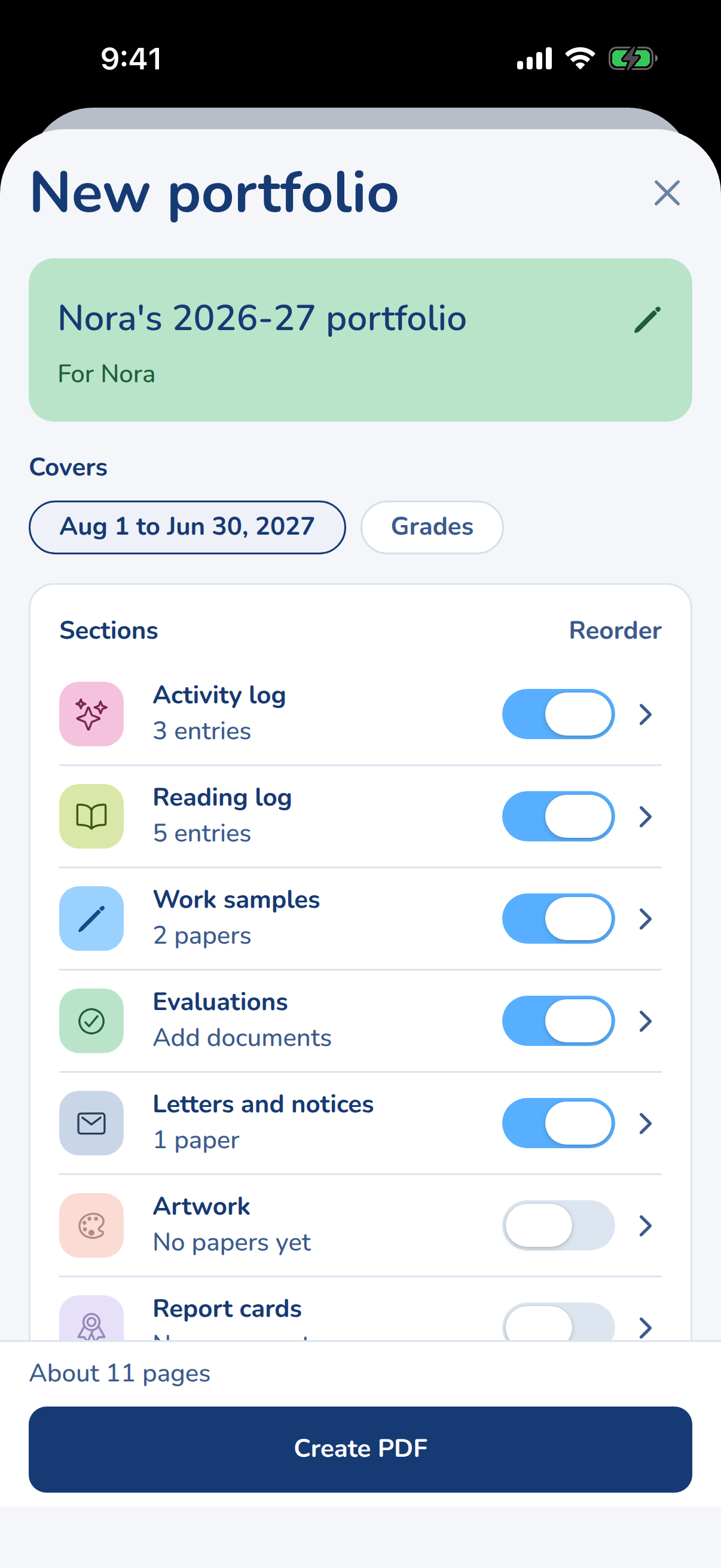
If anyone asks, the year is ready. Start a New portfolio for a grade or your own dates, and print or share the PDF. You pick the sections. For California, you might switch on:
- The attendance or hours log, for your school days
- Letters and notices, for each year’s affidavit, your course list and your teacher list
- Work samples, sorted by subject, if you keep them
Turn on automatic backup, and every paper goes to KidsFoldr Cloud as it is filed. One tap on Back up copies every paper to your own Google Drive or iCloud, and every paper is searchable by any word on it.
Common questions
Do I need a homeschool portfolio in California?
No. California law asks for no portfolio, no work samples and no tests. You file the private school affidavit each October and keep the register, your courses of study and your teacher list (§§ 48222, 33190).
When is the private school affidavit due?
Between October 1 and 15 each year (§ 33190). If you start after October 15, HSLDA advises filing as soon as possible.
Does filing the affidavit mean the state approved my homeschool?
No. Filing is not an approval or an endorsement, and neither is the district’s check that you filed (§§ 33190, 48222).
How long do I have to keep homeschool records in California?
The law sets no time. HSLDA advises keeping most records at least two years, and high school records forever.
Do I need a teaching credential to homeschool in California?
Not for a home-based private school, where the law asks for “persons capable of teaching” (§ 48222). A private tutor does need a credential for the grade taught (§ 48224).