- Teaching your own child at home under AS 14.30.010(b)(12) takes no portfolio, notice, test or records.
- A correspondence program is public school at home: a yearly learning plan, a certificated teacher who reviews the work, and the statewide tests.
- Running a private or religious school instead means yearly forms, 180 days, monthly attendance and a test in grades 4, 6 and 8.
The paper on your table is this year’s folder of work: worksheets, a reading list, the books you teach from. Beside it may sit a correspondence program’s learning plan and signed agreement, a state test score report and allotment receipts. Or DEED’s private school forms. Or a copy of the letter you sent your child’s old school.
Which of those you need depends on your route. Alaska’s Department of Education and Early Development (DEED) draws the line itself: a correspondence program is district schooling in the home, and “homeschooling” means schooling with no district (DEED). Good news: the home statute is one line long.
Does Alaska require a homeschool portfolio?
No. The attendance law does not apply to a child who “is being educated in the child’s home by a parent or legal guardian” (AS 14.30.010(b)(12)). The law adds no conditions to that line.
DEED’s own guide puts it plainly: if every student is your own family, you are homeschooling, and that “no longer requires paper work” (DEED). There is no notice to file, no required subject, no test, no attendance log and no records rule.
The attendance law covers children from 7 to 16 (AS 14.30.010(a)). If you enroll a six-year-old in first grade at a public school, the law then applies. You can still withdraw your child within 60 days of enrolling, and the law won’t apply again until age seven (AS 14.30.010(c)).
So what you keep is up to you. The rest of this page covers the routes that do keep records, and what’s worth keeping either way.
Which route are you on?
Alaska law gives five ways to school a child at home, and only the home statute asks for nothing (AS 14.30.010(b)).
| Route | What it asks | Law |
|---|---|---|
| Home statute: you teach your own child | Nothing to file or keep | AS 14.30.010(b)(12) |
| Correspondence program, through a district | A yearly learning plan with a certificated teacher, work reviews and the statewide tests | AS 14.30.010(b)(10); AS 14.03.300 |
| Private or religious school | Yearly forms, 180 days, monthly attendance, a test in grades 4, 6 and 8, permanent records | AS 14.30.010(b)(1)(C); AS 14.45.110 to 14.45.130 |
| Tutor | Teaching by a tutor certificated in Alaska | AS 14.30.010(b)(1)(B) |
| School board approval | A written request, approved by your child’s school | AS 14.30.010(b)(11) |
The State Library’s homeschooling guide says you can use your own district’s correspondence program, a statewide program run by another district, or the centralized one, now the AK Virtual School.
Correspondence programs: the plan, the teacher and the tests
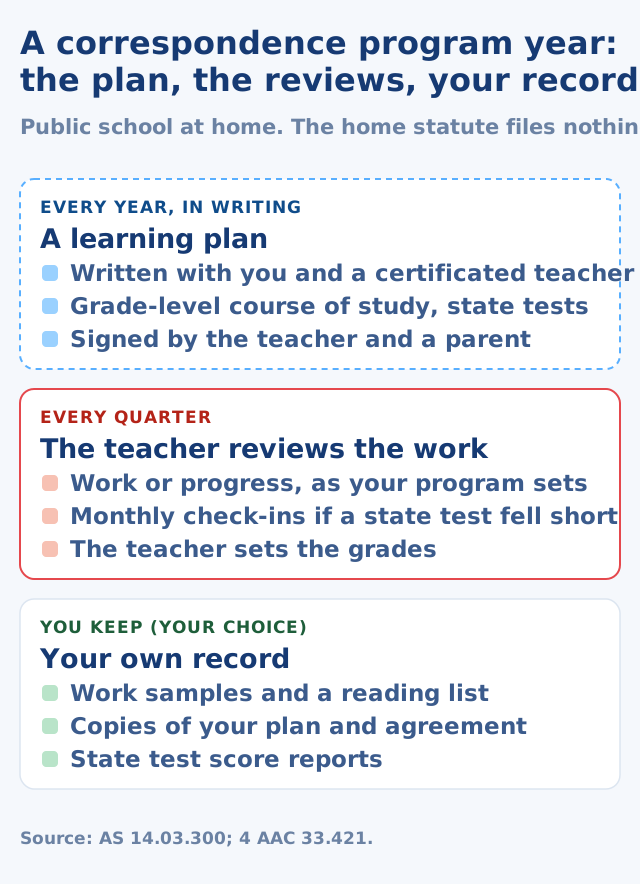
Enroll in a correspondence program, and your child is a public school student learning at home. Each year the program writes an individual learning plan (ILP) with you, your child and a certificated teacher assigned to your child (AS 14.03.300(a)).
The plan must include:
- A course of study for the grade, consistent with state and district standards.
- An assessment plan that includes the statewide tests public schools give.
- A signed agreement between the teacher and at least one parent that you’re following the plan.
- The teacher’s monitoring of your child’s work and progress.
Under the state’s rules, the teacher reviews the work or progress each quarter. If your child’s last state test did not meet standards, the teacher also checks in at least monthly (4 AAC 33.421(a)(1)). The teacher, not the parent, sets the course grade (4 AAC 33.421(a)(2)).
Here’s the easy part for strong students: a child who scores proficient or advanced on the state tests can’t be given extra requirements beyond the plan and the allotment rules (AS 14.03.300(b)).
What can the allotment buy?
A program may give you a yearly allotment for your child’s instruction (AS 14.03.310(a)). It can pay for nonsectarian services and materials your child’s plan needs, from a public, private or religious organization, if the district approves them and they line up with state standards (AS 14.03.310(b)).
It can’t pay a family member for services (AS 14.03.310(e)). The program keeps the record of what you spend, and any unspent money goes back when your child leaves (AS 14.03.310(d)). The law sets no amount, and the State Library’s guide says allotments vary by program.
What counts as a work sample?
The law asks for the teacher’s quarterly reviews, not a portfolio by name. Your program sets how it takes the work.
Our examples, not the law’s: a dated math page, a writing piece, a reading list, a lab sheet, a photo of a project. The same samples make a good record for a home statute family, too.
Running a private or religious school at home
A private or religious school that follows AS 14.45 files and keeps much more:
- Each year, you file an enrollment form for your child with your local superintendent, signed by you and the school’s administrator (AS 14.45.110(a)).
- The school runs at least 180 days, keeps monthly attendance, and reports its enrollment by grade and its calendar to DEED each year (AS 14.45.110(b)).
- It gives a nationally standardized test in grammar, reading, spelling and math in grades 4, 6 and 8, and keeps the results (AS 14.45.120).
- It keeps permanent student records, including test results, grades and courses, and its administrator certifies to DEED that it does (AS 14.45.130).
DEED’s guide asks for the school’s packet by October 15. That same guide says a school of only your immediate family is homeschooling, which takes no paperwork (DEED).
How long to keep homeschool records in Alaska
Under the home statute, the law sets no period. A private school’s student records are permanent (AS 14.45.130(a)).
The Home School Legal Defense Association (HSLDA), an advocacy group, advises keeping attendance, a list of your books, work samples, letters with school officials, and test results for at least two years. It says to keep high school records, and proof you followed the law in those years, forever. That is advice, not law.
Leaving a school? HSLDA also advises a withdrawal letter, with copies kept of it and any reply. The law itself asks for no letter.
Will a program or school accept digital records?
The law doesn’t say what form your records must take. A correspondence program decides how it takes work for its reviews, and a school or college decides what it accepts.
So whether someone takes a digital homeschool portfolio is their call. Ask first. A printed copy works for anyone who wants paper.
What changes in 2026 and 2027
2025 and 2026
Neither House Bill 57 (2025) nor House Bill 28 (2026) touches the home statute (AS 14.30.010).
The Alaska Supreme Court also kept the allotment laws in place. In 2025 it held that the correspondence and allotment laws are not unconstitutional on their face, since allotments have many valid uses. It sent the question of paying private school tuition with allotments back to the trial court (State v. Alexander).
House Bill 28 became law in 2026. A student who leaves a district correspondence program may now keep the books, equipment and materials it provided, allotment purchases included, where a student leaving a regular school in the district could (AS 14.03.300(c)). Bills on correspondence funding and testing (Senate Bill 277, House Bill 248) did not pass.
2027
A new Legislature convenes January 19, 2027, the third Tuesday in January (AS 24.05.090). Any bill filed then is not law until it passes.
Keeping the year’s work in KidsFoldr
The stack of worksheets can go, and the year stays organized with no sorting and nothing to type. Snap each page as you teach, and KidsFoldr files it by child, grade and type, with schoolwork and tests by subject too. It’s a homeschool record keeping app that does the filing for you.
- The paper goes, with no guilt. Scan a page for peace of mind, then toss it: no pile on the counter, no shelf of binders. Keep the originals that matter, though: a correspondence program’s signed plan and agreement, a private school’s forms and test results, and high school work a school may need for credit.
- You keep up as papers arrive. Forward a teacher’s email or a score report, and it files the same way.
- Dates land on the calendar. Snap your program’s testing schedule or a teacher check-in notice, or forward its email, and each date goes on your family calendar, linked back to its paper, with nothing to type.
- The year is ready when someone asks. Start a New portfolio, pick your dates or grades, and get one PDF with a cover and contents. Share or print it from your phone, or share your child’s Portfolios folder read-only with the program’s teacher.
- Keepsakes stay safe, artwork and projects included. Turn on automatic backup, and every paper goes to KidsFoldr Cloud as it is filed. One tap on Back up copies every paper to your own Google Drive or iCloud.
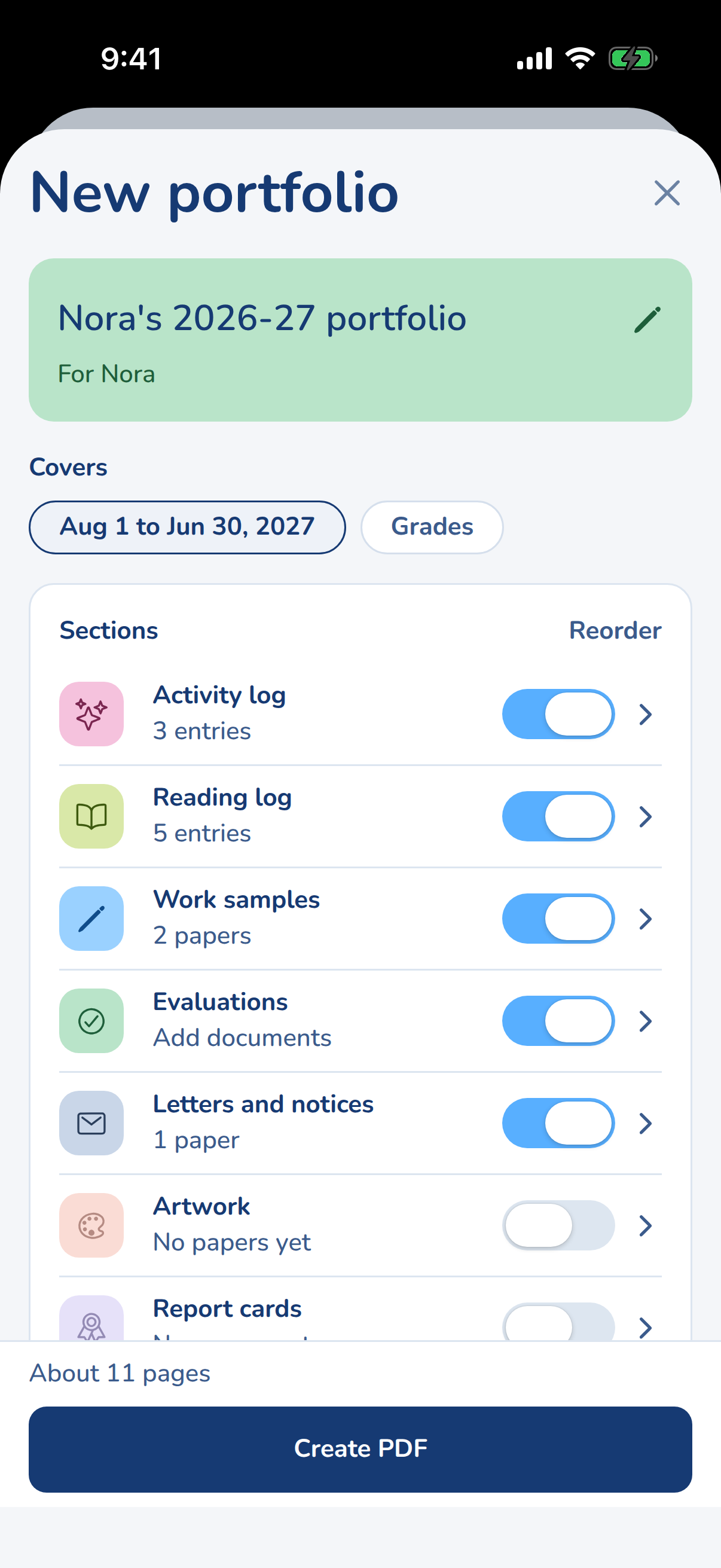
You pick the portfolio’s sections and their order. For Alaska, you might switch on:
- Work samples, grouped by subject, for a quarterly review or your own record.
- A reading log (title, author and date) for the year’s books.
- Test results for a state test or a grade 4, 6 or 8 test.
- An attendance log, which can fill itself from the days your child has schoolwork, if you run a private school.
- Letters and notices for the learning plan, the agreement or DEED’s forms.
Common questions
Do I have to keep a homeschool portfolio in Alaska?
Not under the home statute. In a correspondence program, the teacher reviews your child’s work each quarter, in the way the program sets. Dated work and a reading list are still worth keeping.
Do I have to tell the state or my district that I’m homeschooling?
Not under the home statute. Enrolling in a correspondence program, or filing private school forms, is how families on those routes deal with the district and DEED.
Does my child have to take a standardized test?
Not under the home statute. Correspondence students take the statewide tests (4 AAC 33.421(f)). A private school tests grades 4, 6 and 8 (AS 14.45.120).
How long do I have to keep homeschool records in Alaska?
The law sets no period under the home statute. A private school’s records are permanent. HSLDA advises at least two years for most records, and high school records forever.
Can I get a homeschool allotment without a correspondence program?
No. The allotment goes to the parent of a student enrolled in a correspondence program, for what the learning plan needs (AS 14.03.310).