
- Alabama law asks for no portfolio, no work samples and no testing. It sets no time to keep records either.
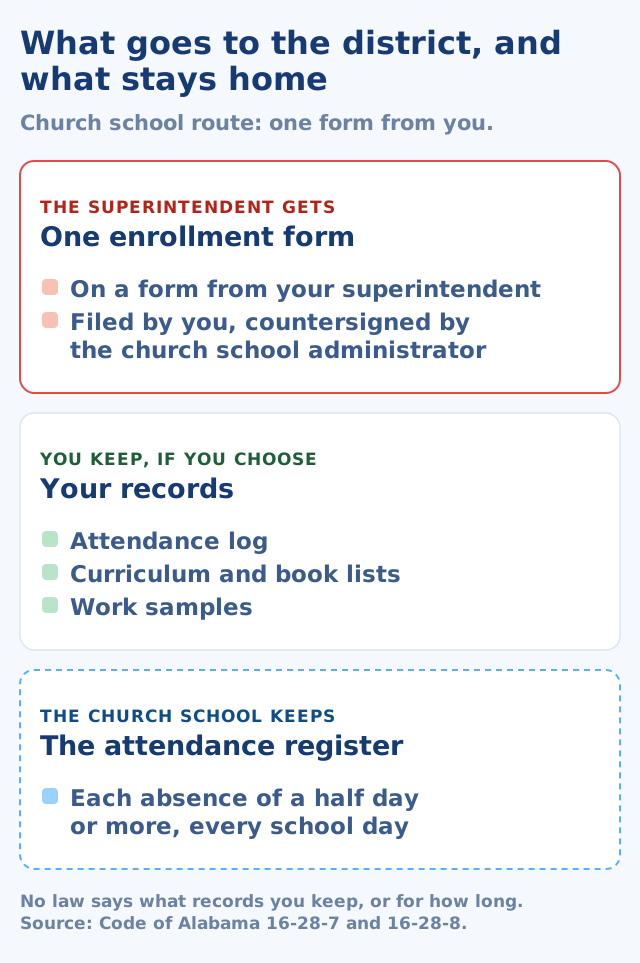
- Teaching through a church school (often called a cover school)? You file one enrollment form with your local superintendent, countersigned by the church school, and the church school keeps the attendance register.
- The other two routes ask more. A private school run from home reports enrollment and absences, and a private tutor must hold an Alabama teaching certificate and teach three hours a day, 140 days a year.
Picture one child’s records folder. It holds a copy of the church school enrollment form you filed with your local superintendent, an attendance log, a list of books and curriculum, and a few work samples.
Alabama’s attendance law never uses the word “homeschool.” It names four routes: public school, private school, church school, or a certified private tutor (Code of Ala. § 16-28-3). This page covers the three you can run from home. See which route you’re on.
Church school, private school or private tutor
Alabama has no portfolio rule on any route. What you file depends on which of three routes you teach under.
| Route | What you file | Who keeps attendance | Rule |
|---|---|---|---|
| Church school (cover school) | An enrollment form, filed by you with the local superintendent and countersigned by the church school. No weekly reports | The church school’s principal teacher | §§ 16-28-1(2), 16-28-7, 16-28-8 |
| Private school run from home | An enrollment report on the fifth day of the public school year, then weekly reports of new students and unexcused absences. A yearly registration with the Department of Education by October 10 | The school’s principal teacher | §§ 16-28-1(1), 16-28-7, 16-28-8, 16-1-11 |
| Private tutor | A statement of students, subjects and schedule before teaching starts. The tutor holds a state teaching certificate and teaches at least three hours a day, 140 days a year, between 8 a.m. and 4 p.m. | The tutor, in a daily register of work | §§ 16-28-5, 16-28-7 |
A church school, in the law’s words, can teach “through on-site or home programs.” It runs as a ministry of a church or group of churches and takes no state or federal money (§ 16-28-1(2)).
The state does not license or regulate church schools, private schools or home-schooled students (§ 16-1-11.2). They still follow Alabama’s school attendance law (§ 16-1-11.3).
The law sets no subjects for church school students. A church school can set its own rules on teachers, days and subjects, and the Home School Legal Defense Association (HSLDA) says you follow them.
Public school classes and sports
HSLDA says no Alabama law gives homeschooled students a right to public school classes or activities. Each district decides, so ask yours. HSLDA also says the Alabama High School Athletic Association changed its bylaws in 2016 to let homeschool students play, with requirements.
The church school enrollment form
The one paper a church school family files is an enrollment form. You get it from your local superintendent, the church school’s administrator countersigns it, and you return it to the superintendent (§ 16-28-7).
The law sets no deadline for it and no yearly refiling. HSLDA says to file it when your child first enrolls, and not every year.
When you enroll, you give the church school your consent to tell the superintendent if your child stops attending (§ 16-28-7). Church school families send no weekly enrollment or absence reports (§§ 16-28-7, 16-28-8). The church school keeps the attendance register (§ 16-28-8).
School is required from age 6 to 17. If your child is 6, you can write to your local board of education that your child will start at 7 (§ 16-28-3).
Who checks your homeschool
No state reviewer. Alabama law sets no testing, no evaluator and no yearly review, and the state does not license or regulate church schools or home-schooled students (§ 16-1-11.2).
The attendance law still applies. Superintendents compare enrollment reports with lists of children who should be in school, and an attendance officer looks into any child who isn’t enrolled, with written notice to the parent first (§§ 16-28-11, 16-28-16). Failing to have a child enrolled is a misdemeanor (§ 16-28-12).
The Alabama homeschool year, date by date
There is no statewide homeschool deadline for church school families. Your dates come from your route, your child’s age and your local public school’s calendar.
| When | What | Rule |
|---|---|---|
| Age 6 | School is required. Or tell the local board in writing that your child starts at 7 | § 16-28-3 |
| Your child enrolls in a church school | File the countersigned enrollment form. The law sets no deadline; HSLDA says when your child first enrolls | § 16-28-7; HSLDA |
| Fifth day of the public school year | Private schools report enrollment to the superintendent | § 16-28-7 |
| Every week | Private schools and tutors report unexcused absences. Church schools don’t | § 16-28-7 |
| By October 10, every year | Private schools, but not church schools, register with the Department of Education | § 16-1-11 |
| Before a tutor starts | The tutor files a statement of students, subjects and schedule | § 16-28-5 |
| Your child leaves the church school | The church school tells the superintendent, with the consent you gave at enrollment | § 16-28-7 |
| Age 17 | End of the required age range (6 to 17) | § 16-28-3 |
How long to keep homeschool records in Alabama
The law sets no time. The attendance register is the school’s or the tutor’s job, and no law tells a family what to keep (§§ 16-28-5, 16-28-8).
Records still matter if your child goes back to public school. The Alabama State Department of Education (ALSDE) says a student coming from a private school, a tutor or a home school may have to take a placement test, especially without an official transcript. Each district may also ask for more documents.
HSLDA suggests keeping most records, like attendance, book lists and work samples, at least two years. It says to keep high school records and proof that you followed the law forever. Both are advice, not law.
Our advice: keep a few originals on paper. Those are the signed enrollment form (or your tutor’s statement), any letter from a school district or your church school, test score reports if you test, and high school work you may need for a transcript or credit. Everything else can be a scan.
Work samples: not required, still worth keeping
Alabama asks for no work samples. They still help if your child goes back to public school, where placement can come down to a test (ALSDE).
They help with college too. No public college or university in Alabama may turn down a qualified student for having been home schooled (§ 16-1-11.4). Your records show the work.
What counts is up to you. Examples, not rules: a dated math page, a writing piece, a book list, a science lab sheet, a history project.
Can your records be digital?
Yes, as far as the law goes. It sets no format for any record a family keeps, and it names no evaluator.
The enrollment form is a paper form with two signatures, so keep that original. Keep copies of everything else that you could print if a district or a college asks. That is advice, not law.
What changes in 2026 and 2027
2026
Good news: no 2025 or 2026 law changed the attendance, church school, private school or tutor sections (§§ 16-28-1, 16-28-3, 16-28-5, 16-28-7, 16-28-8 and 16-1-11 to 16-1-11.4).
Three 2026 bills about homeschoolers did not pass. HB 183 would have opened public career and technical classes to them, SB 201 would have opened JROTC to some military families, and SB 191, the HOME Act, covered military families and school activities.
One new 2026 law, Act 2026-481, lets a family sue an athletic association that bars a student only for using the CHOOSE Act. The CHOOSE Act’s education savings accounts give $2,000 a year per student in a home education program, up to $4,000 per parent, for costs like curriculum, books and tutoring. For 2026-2027, they were limited by family income.
2027
The CHOOSE Act drops its household income limit for the 2027-2028 school year (§ 16-6J-3). Nothing else is scheduled for the rules on this page.
The Legislature meets every year, so new bills could come in 2027. Any change would start there.
Keeping your records in KidsFoldr
No law tells you what to keep, so the easy answer is to keep it all, on your phone instead of a shelf of binders. Snap each paper for peace of mind, and the paper can go. Years of attendance logs, book lists and work fit on your phone, filed by child, grade and type (and subject for schoolwork), with nobody sorting and nothing to type.
The few originals named above stay on paper. Snap them too, so a copy is always at hand. Snap your church school’s calendar, a letter from your district or a test appointment, and the date lands on your family calendar, linked back to the paper, with nothing to type.
If your church school asks for your days, they fill in from your papers with one tap. In the Attendance or hours log, tap Fill from papers to add a day for every date your child has schoolwork, artwork or a test on file. Add hours if you count them.
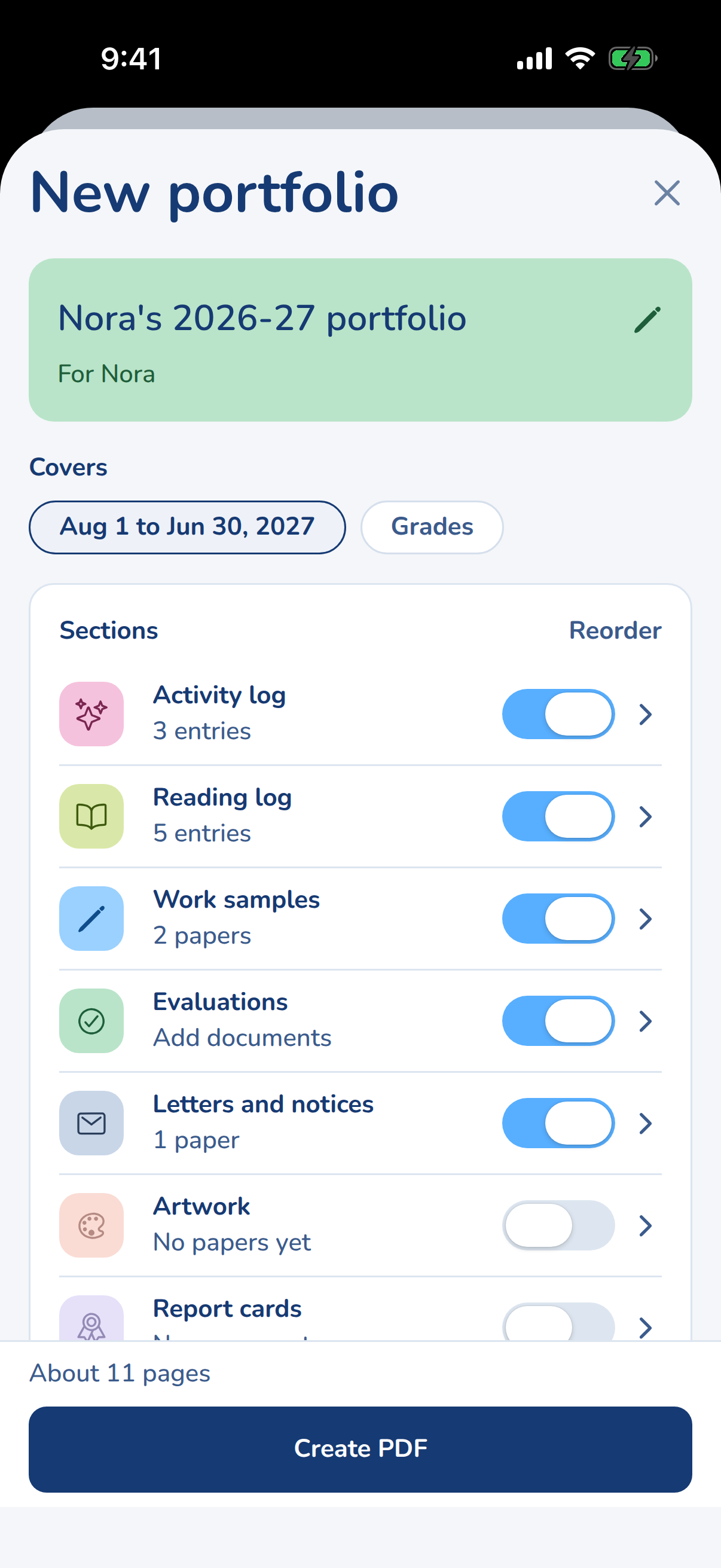
If your church school, a district or a college asks, the year is ready. Start a New portfolio for a grade or your own dates, and print or share the PDF. You pick the sections. For Alabama, you might switch on:
- The attendance or hours log, for your school days
- Work samples, sorted by subject
- A reading log, for your book list
- Letters and notices, for your enrollment form
Turn on automatic backup, and every paper goes to KidsFoldr Cloud as it is filed. One tap on Back up copies every paper to your own Google Drive or iCloud, and every paper is searchable by any word on it.
Common questions
Do I need a homeschool portfolio in Alabama?
No. Alabama law asks for no portfolio, no work samples and no tests on any home route. Church school families file one enrollment form (§ 16-28-7).
Do I file the church school enrollment form every year?
The law sets no yearly refiling. HSLDA says to file it when your child first enrolls in the church school, and not every year.
Who keeps attendance for a church school student?
The church school’s principal teacher keeps the attendance register (§ 16-28-8). Church school families send no weekly reports.
How long do I have to keep homeschool records in Alabama?
The law sets no time. ALSDE says a child returning to public school may need a placement test, so records help. HSLDA advises keeping most records at least two years.
Does Alabama test homeschoolers?
No. The law sets no state test and no evaluator. A church school can set its own rules, so check yours.