- To prepare for a parent-teacher conference, pull this term's report card and last year's, any progress reports, last spring's state score report, any reading-level report, and three or four recent tests in the subject that worries you. Add the IEP or 504 progress report if your child has a plan.
- Find the key before you read a mark. On many standards-based report cards a 2 means working toward the standard, not failing, and "approaching" on a state test means different things in different states.
- Write one question per paper and ask your top one first. Slots are often 15 or 20 minutes, so ask for a follow-up if you need more time.
Many schools hold conferences in the fall, often in October or November. Some hold them by video.
Either way, the papers your child brought home already hold most of what the teacher will cover. Read them the night before, and each one turns into a question.
What to bring to a parent-teacher conference: the pull list
What to bring to a parent-teacher conference is simple: the papers that show how your child is doing, not a folder of everything. Here is the list, and where each paper usually lives.
-
1
Pull this term's report card. If it is not out yet, use the last one. Check the backpack, the Friday folder or the school's family portal.
-
2
Pull last year's report card for the same term. You will compare the two, subject by subject.
-
3
Pull any progress or interim reports. A mid-term note can flag a slipping grade before the report card does.
-
4
Find last spring's state test score report. It came home on paper, or it sits in the district or state family portal.
-
5
Pull any reading-level report. It may show a level, a Lexile measure or a percentile.
-
6
Pick three or four recent tests or graded pieces in the subject that worries you. The math tests, the spelling quizzes, the essay with the teacher's comments.
-
7
Add the latest IEP or 504 progress report. Add it if your child has an IEP or a 504 plan.
Then write a short list of questions, and a line or two on what you see at home (Washington Office of the Education Ombuds). One district suggests writing the questions with your child first.
How to read a report card
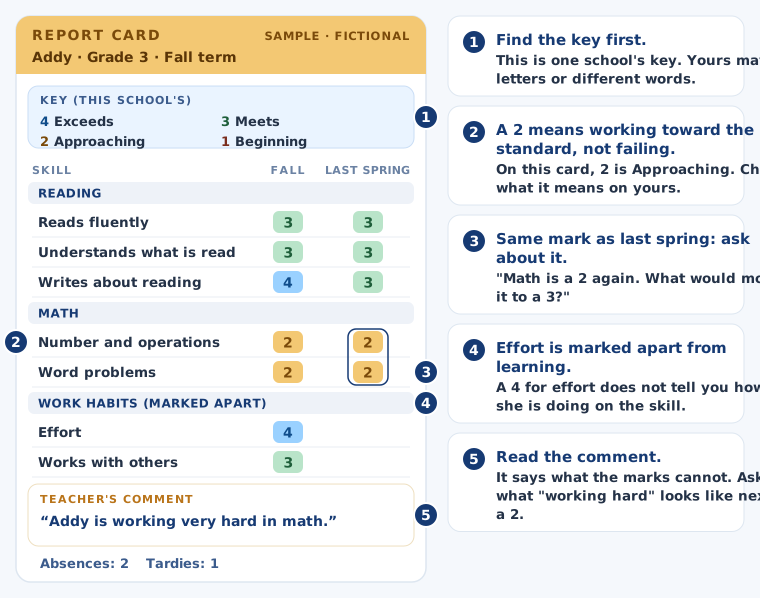
To read a report card, find the key first. Report cards use letter grades or standards-based marks such as 1 to 4, and the key printed on your own card is the one that counts.
Letter grades vs. standards-based marks
A letter grade sums up a whole subject. A standards-based card marks each skill in a subject on its own, so math might carry one mark for computation and another for word problems.
On many standards-based cards, a 3 means your child meets the grade-level standard. A 2 means working toward it, still with some support. A 2 is not failing: one school's guide says even top students can earn one.
Marks can also step down during the year without meaning a real drop. One district explains that a 3 early in the year can become a 2 later, because the grade's expectations rise as the year goes on.
On some cards, a 0 or a blank means the skill was not assessed this period. Watch for letter codes that look better than they are. EdNavigator, a family advising nonprofit, points out that "AB" can mean "Approaching Basic," which is closer to a D than to something between an A and a B.
Effort marks, comments and attendance
Many report cards mark work habits or effort apart from what your child has learned. Read the two separately. A child can try hard and still need help, or coast and still meet the standard.
Read the comment box closely. EdNavigator notes that comments can be coded: "working very hard" may mean focused but struggling. Check that the comments, the marks and any scores tell one story.
Check absences and tardies against what you remember. On younger kids' cards, a reading test code may sit beside the marks with no explanation. Ask what grade level that score means.
Compare it with last year's
Lay this year's card beside last year's, same term, same subject. A big swing is a question. So is a mark that has sat at 2 for several terms in a row.
A step down within the year can be rising expectations. Ask before you worry.
How to read state test scores
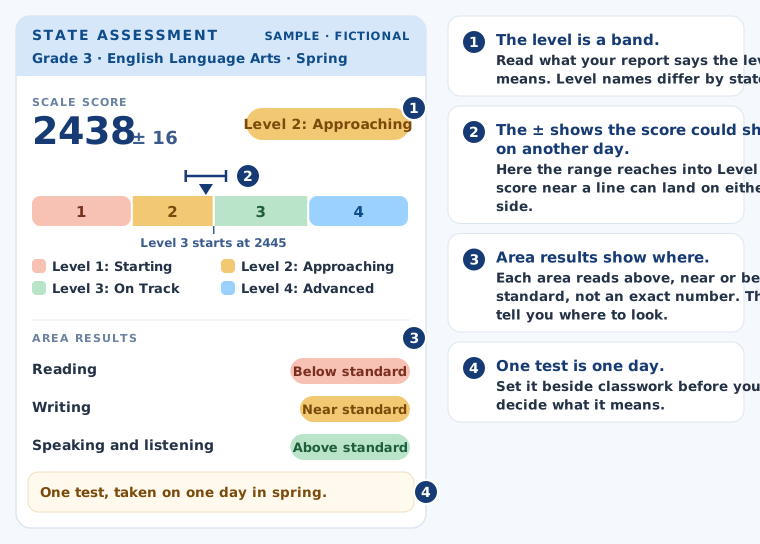
To read state test scores, start with the two main results: a scale score and an achievement level. The level tells you the band your child landed in. The scale score and the area results tell you where (Smarter Balanced).
Scale score, achievement level, and what "approaching" means
The scale score is one number on a scale that rises from grade to grade, so it can show growth over time. The achievement level is one of four bands that number falls into (Smarter Balanced).
Level names vary by state. A state can even rename them with no change to the test. California now calls its four levels Advanced, Proficient, Developing and Minimal, and says earlier years can still be compared.
What "approaching" means varies too. California says all four of its levels are grade-level learning at different depths. Texas says a student at "Approaches Grade Level" passes but likely needs targeted help to succeed in the next grade.
Every score also carries a margin of error, often shown as a plus-or-minus range. A score near the line between two levels could land in the other level on another day (Smarter Balanced).
The area results show where
Many reports break the test into areas, such as reading, writing, and speaking and listening. Each area often shows as above, near or below standard, not as a precise number (Smarter Balanced). That tells you where to look, not exactly how far.
Treat the whole report as one day's snapshot. The test's own publisher calls describing a student by one level alone an oversimplification, and a starting point for discussion. Washington's education department says to weigh classwork, not just test scores.
Reading-level reports: a level, a Lexile, a percentile
A reading level is a teaching tool, not a label. The three common kinds each tell you something different, and none of them is a grade level.
Guided reading level. Fountas and Pinnell, who publish one set of these levels, say their levels are for teachers' assessment and instruction. They are not meant for report cards or for parents, because a child does not read at one exact level. In the publisher's words, a level is "a teacher's tool, not a child's label."
Lexile measure. This is a number with an L after it. The range a child can read alone runs from about 100L below to 50L above their measure, and "BR" means Beginning Reader. MetaMetrics, which makes the measure, says it does not line up directly with grade levels.
Percentile on a screener or interim test. A 46th percentile means your child scored higher than 46 percent of same-grade students in the U.S. Some reports show achievement and growth as separate results. NWEA, which makes one such test, says its score is not a grade and not make-or-break.
Recent tests and graded work: look for the pattern
One grade tells you little. Three or four tests in the same subject show a pattern.
Spread them out and look for the same kind of mistake. Is it the math, or the reading in the word problems? Is it careless slips at the end, or blanks where work is missing?
Note any retakes and any missing assignments. Then check the pattern against the report card and the score report. When all three point to the same skill, you have your top question.
IEP and 504 progress reports
If your child has an IEP, the IEP itself must say how progress on each annual goal is measured and when you get progress reports, for example alongside report cards (34 CFR 300.320). Read each goal against its own measure, not against the report card's grades.
Put the latest progress report beside the last one. A goal that shows the same result two reports in a row is worth a question: "Goal 2 shows the same score as last quarter. What changes now?"
A 504 plan works differently. If your child has one, ask how and when the school reports on it.
Questions to ask at a parent-teacher conference, paper by paper
Pick three questions, one per paper, and ask the most important one first. Conferences are short, often 15 or 20 minutes by one scheduling guide's count (SignUpGenius), and time runs out fast.
The fastest way to prepare for a parent-teacher conference is to let the papers write the questions. The mark that stayed put, the area the score report flagged and the pattern in the tests beat any generic list.
Save a few minutes at the end. Make a plan together, and agree how you and the teacher will stay in touch (Washington Office of the Education Ombuds).
You don't have to wait for a conference to raise a concern. If something on a paper worries you now, ask the teacher now.
If your child leads the conference
Some schools run student-led conferences. Your child walks you through their work and may share two or three goals for the year (University of Hawaii College of Education).
Keep private topics for a separate talk. Most teachers will set one up if you ask (University of Vermont, Tarrant Institute).
If you need an interpreter or a different time
Call the school office (Washington Office of the Education Ombuds). Federal civil rights law requires schools to make conferences meaningful for parents with limited English (U.S. Department of Education).
What comes home, and which school papers to keep
Keep the report card, the score report and any IEP or 504 progress report. If a goals sheet comes home, keep it with the report card, so at the next conference you can check the goals.
That is the short answer to which school papers to keep: the ones you will want next time. Handouts and most graded work don't need a drawer. Scan them for peace of mind, then toss them.
That night, talk with your child about what the teacher said (Washington Office of the Education Ombuds). Start with what went well.
For everything else in the backpack, here is what to do with the rest of your kids' school papers. And if you want last year's report card easy to find next fall, compare the apps that file school papers.
Next conference, every paper is already on your phone
Snap each report card and test as it comes home, and KidsFoldr files it under the right kid, grade and type, with every test filed by subject too. Nobody types a label or sorts anything. Next fall, last year's report card and this month's math tests are on your phone at the conference, with no digging.
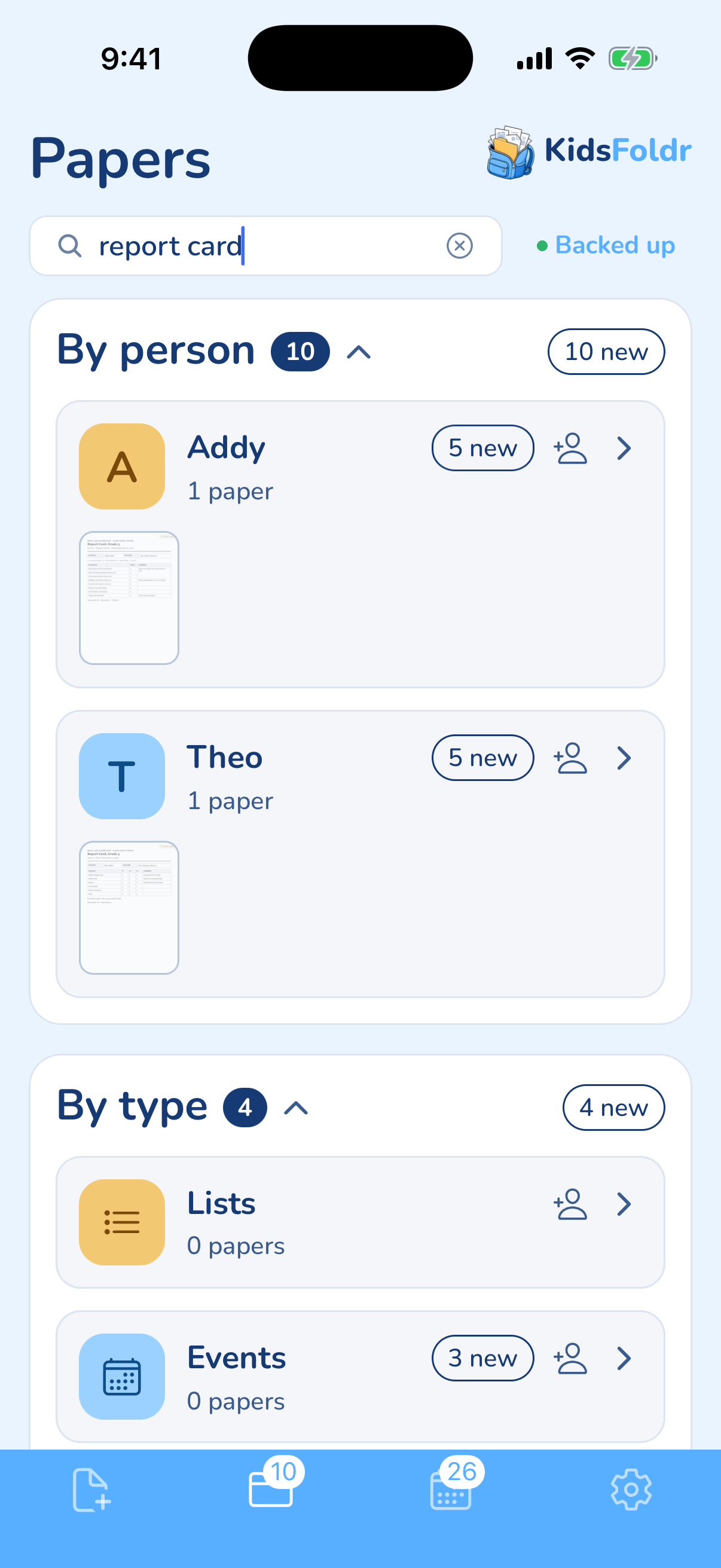
The rest of the stack lands the same way. Save the score report from the portal as a PDF or a screenshot, and it is filed by kid and grade like every other paper. Two kids, two conferences, and each paper is already under the right one.
Report cards are kept for good as scans. Turn on automatic backup, and every paper goes to KidsFoldr Cloud as it is filed. This year's report card and last year's are both a tap away.
So the handout and the graded work can go: scan it for peace of mind, then toss it. Any word on a paper finds it, even with no signal in the school building.
Common questions
What questions should I ask at a parent-teacher conference?
Ask one question per paper: the mark that stayed or dropped, the area the score report flagged, the pattern in recent tests. Ask the most important one first, since slots are short.
Does a 2 on a report card mean my child is failing?
On many standards-based report cards, no. A 2 means working toward the standard, with some support. Check the key on your child's card.
What if I can't understand a mark or a score?
Ask the teacher, and don't wait for the conference. Under federal privacy law, schools must respond to reasonable requests to explain your child's education records (34 CFR 99.10).
Should I bring my child?
It depends on the school. Some run student-led conferences, so your child is part of it by design. Either way, keep private topics for a separate talk with the teacher.